
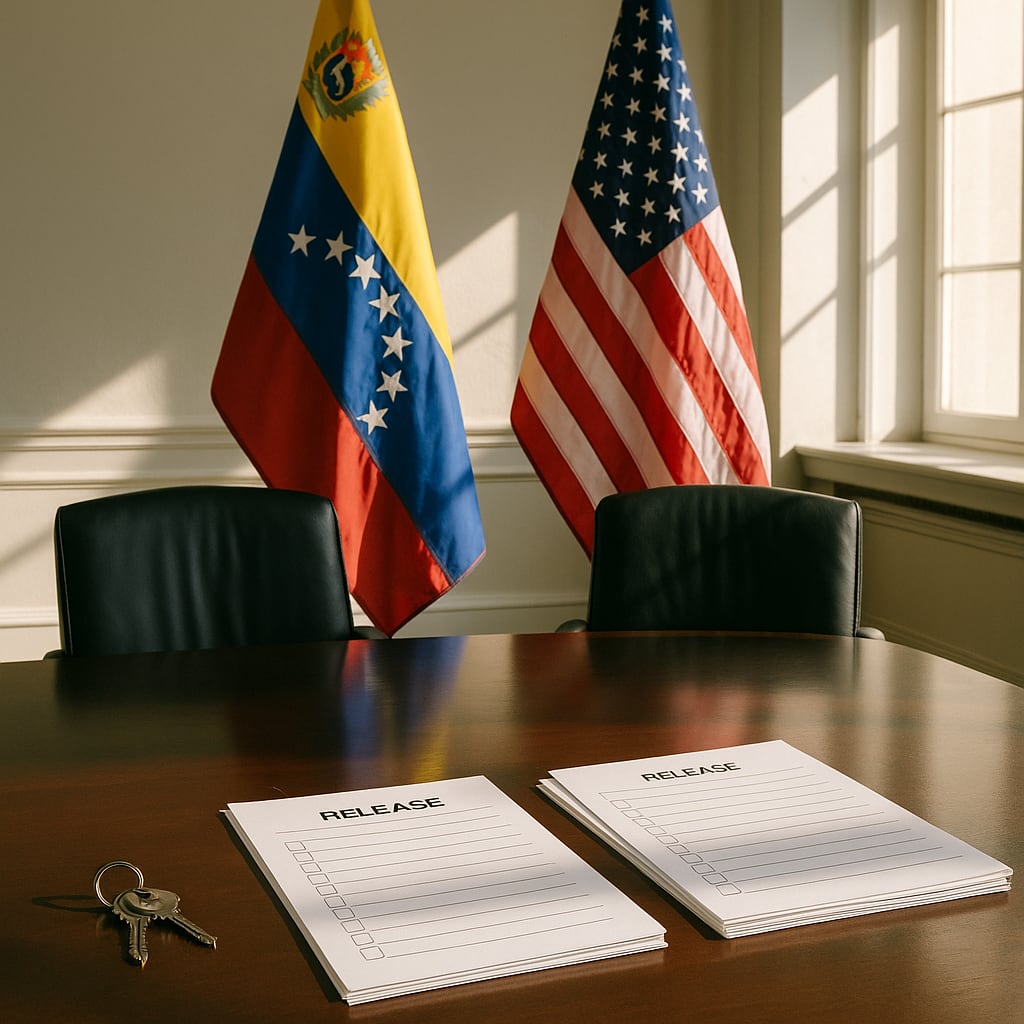
Venezuela frees 131 political prisoners amid US-supervised talks with opposition
Narrative Snapshot
Across outlets there is broad agreement that mass prisoner releases are being framed as a negotiated gesture tied to talks between the Venezuelan authorities and the opposition under active US auspices. Both Clarin and Le Monde emphasize Washington’s convening and supervisory role and cite US Secretary of State Marco Rubio praising the step as crucial to reconciliation, giving the move a clear diplomatic anchor rather than treating it as a unilateral act. France24 complements this by foregrounding on-the-ground human impact and validation from human rights groups, reinforcing that the releases carry societal as well as elite-political resonance.
Where accounts diverge most is in the political setting for the talks. Al Jazeera English and the Bangkok Post describe a “post-Maduro” process, while Folha de S.Paulo specifies that Maduro was captured by US Armed Forces seven months earlier. Clarin, by contrast, situates the action within the “government of Delcy Rodríguez,” signaling a domestic executive counterpart whose authority is treated as operative in the negotiations. Legal framing also varies: Al Jazeera underscores that detainees received “alternatives” to imprisonment, suggesting conditional measures rather than blanket amnesties—an element absent from other reports that focus on the headline number as a confidence-building marker.
What Happened
Venezuela’s authorities announced the release of 131 detainees on Friday, presented as part of measures agreed at a newly established dialogue table between the government led by Delcy Rodríguez and the opposition, with US sponsorship and oversight (Clarin; Le Monde; France24; Al Jazeera English). The decision was publicly welcomed by US Secretary of State Marco Rubio, who called it a crucial step toward national reconciliation, underscoring Washington’s role supervising the discussions (Clarin; Le Monde). Al Jazeera reports the individuals were granted alternatives to imprisonment, indicating conditional legal dispositions rather than unconditional freedom. France24 highlights reunions with families and support from human rights groups, which say many had been unjustly detained. The Bangkok Post situates the move as progress in reconciliation talks following Nicolás Maduro’s ouster, while Folha de S.Paulo characterizes it as an additional tranche of releases in US-sponsored negotiations seven months after Maduro’s reported capture by US forces.
Why It Matters
The releases operationalize a negotiation architecture in which Washington is not only sponsor but an explicit overseer, a role multiple outlets describe as structuring Venezuelan authorities’ and the opposition’s steps (Clarin; Le Monde). As such, the action functions as a measurable benchmark within a reconciliation process, linking political concessions—like detainee releases—to the credibility of a broader settlement. Al Jazeera’s note that releases involve alternatives to imprisonment points to a transitional justice design choice with consequences for accountability and reintegration, while France24’s focus on human rights validation suggests civil society actors are shaping the perceived legitimacy of each move.
Regionally and internationally, the episode signals how external guarantors can influence sequencing and verification in post-crisis negotiations. The Bangkok Post’s and Al Jazeera’s “post-Maduro” framing, and Folha de S.Paulo’s assertion of US military capture of Maduro, highlight that the talks are embedded in a power reconfiguration in which recognition of domestic counterparts—such as the government led by Delcy Rodríguez—matters for who can commit and deliver on agreements.
Diverging Narratives
Outlets differ in characterizing the underlying political transition. Al Jazeera and the Bangkok Post describe the process as “post-Maduro,” indicating a change of leadership context without detailing mechanics. Folha de S.Paulo goes further, asserting that Maduro was captured by the American Armed Forces seven months earlier, a specificity no other source echoes. Clarin refrains from referencing Maduro and instead centers the “government of Delcy Rodríguez,” implying a functioning executive with agency in the talks.
They also diverge on the legal nature of the releases. Al Jazeera’s reference to “alternatives to imprisonment” suggests conditional measures or supervised release, whereas France24, Clarin, Le Monde, and the Bangkok Post present the development as freeing detainees, without detailing legal modalities. The emphasis varies as well: Le Monde and Clarin foreground US oversight and Rubio’s “crucial step” framing, aligning the move tightly with a reconciliation roadmap. France24 prioritizes the social dimension—families and rights groups’ assessments—while the Bangkok Post highlights momentum by describing “dozens more” releases. These variations shape whether the event is read primarily as a negotiated compliance step, a humanitarian rectification, or an indicator of speed and scale in the post-crisis settlement.
What Happens Next
The next inflection points turn on how the US-supervised dialogue translates into further verifiable actions. Given Le Monde’s and Clarin’s accounts of Washington’s oversight and Rubio’s public signaling, additional steps—such as subsequent release tranches or other agreed measures from the dialogue table—will test whether both sides are sequencing commitments as planned. Analysts should watch for official communiqués from the government led by Delcy Rodríguez and the opposition identifying which obligations have been met.
The legal contours flagged by Al Jazeera create another decision point: whether “alternative” measures remain narrowly tailored or expand, affecting perceptions of accountability and reintegration. France24’s reporting suggests human rights groups’ appraisals will function as cues for whether the process is meeting basic justice standards. Finally, the broader context noted by the Bangkok Post and Folha de S.Paulo means sustained reconciliation talks are themselves an indicator: continued meetings under US auspices will signal momentum; visible pauses or conflicting narratives about the transition’s foundations will signal fragility.