
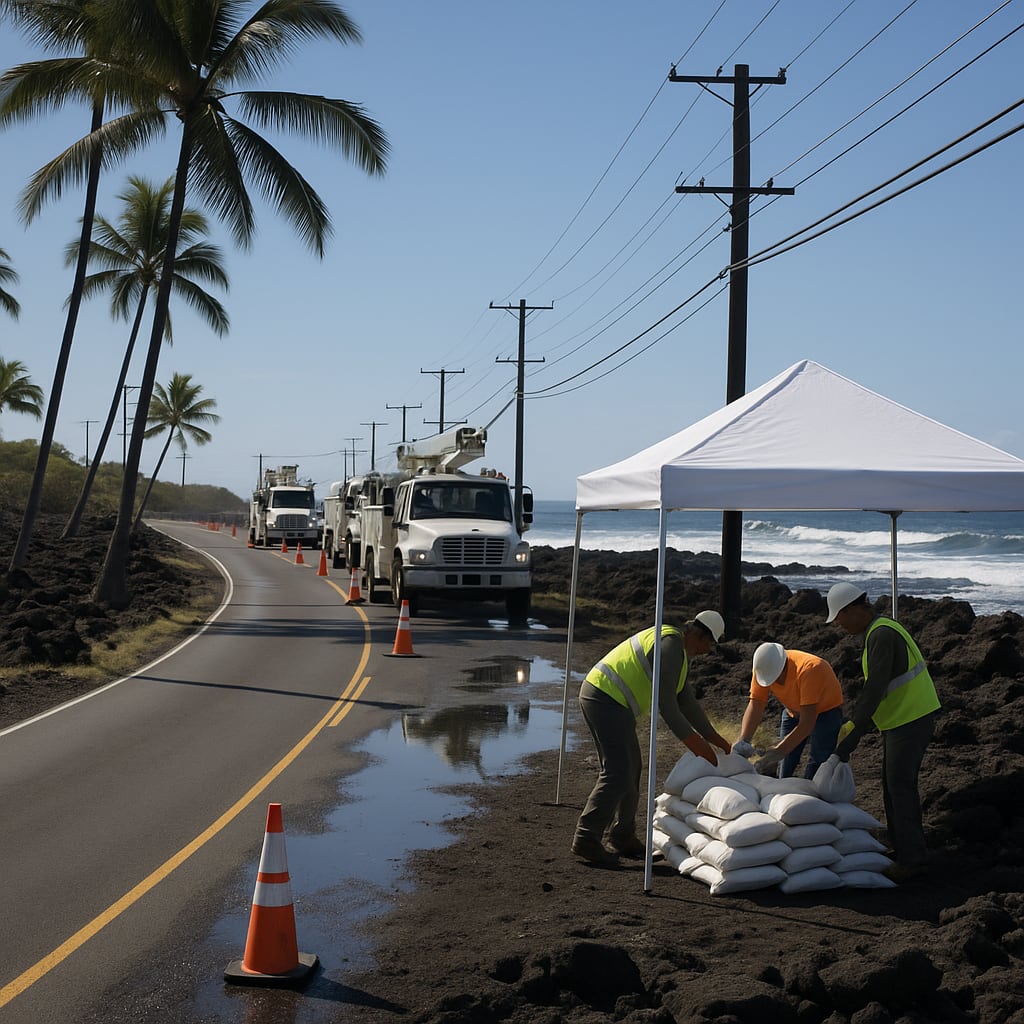
Hawaii’s Big Island faces rare hurricane as Lala strengthens to Category 1; power cuts and flood risk reported
Narrative Snapshot
Across outlets, the through line is the convergence of rarity and risk. European and U.S. coverage alike stresses that hurricanes seldom strike Hawaii directly, with Deutsche Welle underscoring that a Big Island landfall would be the first since 1871, the BBC calling it the potential first direct hit by a hurricane in 34 years, and the New York Times situating Lala against the benchmark of Hurricane Iniki in 1992. That baseline of rarity is paired with warnings of intense rain and wind, a declared state of emergency, and official calls for caution.
Infrastructure exposure and hydrological extremes draw particular focus. Before impact, Hawaiian Electric warned outages could last days if trees and lines fell as the storm crossed the state, and by August 16, both The Hindu and Le Monde reported Lala had reached Category 1 and left thousands without power, with Le Monde citing more than 40,000 households affected. Rainfall projections are consistently severe: the BBC flagged a worst-case 25 inches on the Big Island, and Le Monde described 25 to 50 centimeters, with localized totals above 60 centimeters, alongside “life-threatening” flood language echoed from U.S. advisories.
Some outlets expand the hazard frame. The Toronto Star (via AP) and Argentina’s Clarín highlight the potential for strong winds to fuel wildfires even as floods loom, a dual-risk message less prominent elsewhere. Preparedness is portrayed at both institutional and household levels: Clarín reports shelters open and alerts on the Big Island and Maui; Al Jazeera notes authorities urging precautions across the island chain; and the New York Times captures on-the-ground provisioning behavior as residents prioritize essentials.
What Happened
As of August 14, NOAA advisory language cited by the Guardian placed Tropical Storm Lala about 420 miles southeast of Hilo with 60 mph winds, prompting a Hawaii state of emergency and warnings of dangerous surf and “life-threatening” floods. Forecasts across multiple outlets anticipated strengthening to hurricane intensity before the Big Island encounter, with alerts issued on the Big Island and Maui and shelters opened, according to Clarín. Hawaiian Electric warned that any outages could last days as trees and lines fell when the system crossed the state, the New York Times reported. By early August 15, CBC described the Big Island already being “whipped and soaked,” with hurricane-force winds possible even without formal upgrade. On August 16, The Hindu reported the National Hurricane Center had confirmed 75 mph sustained winds, making Lala a Category 1 hurricane, and Le Monde noted more than 40,000 households without power amid severe rain and flash-flood risks.
Why It Matters
A rare hurricane-grade impact in Hawaii tests emergency governance, critical infrastructure resilience, and risk communication in an island state where redundancy is limited and inter-island coordination is essential. The pre-impact utility warning of multi-day restorations, followed by widespread outages, spotlights grid hardening and vegetation management challenges that carry implications for regulators and operators well beyond Hawaii. Forecast rainfall extremes, quantified by the BBC and Le Monde, stress stormwater, landslide, and flash-flood management capacities, while the Toronto Star and Clarín’s emphasis on wind-driven wildfire potential underscores compounding hazards emergency planners must manage concurrently. Internationally, the Guardian’s reference to a strengthening “super” El Niño frames Lala as a stress test for Pacific seasonal risk planning rather than a purely localized shock. For decision-makers in U.S. federal agencies, Pacific island governments, and multilateral responders, Lala’s trajectory and impacts inform contingency baselines for logistics, sheltering, and rapid power restoration under rare but high-consequence tropical cyclones in the central Pacific.
Diverging Narratives
Historical framing diverges by geography and metric. Deutsche Welle’s “first since 1871” applies specifically to a Big Island hurricane landfall, while the BBC’s “first direct hit in 34 years” references statewide experience since 1992’s Iniki; the New York Times contextualizes with Iniki’s human and economic toll. Hazard emphasis varies: most outlets foreground flooding from extreme rainfall and storm surge, with “life-threatening” language carried by the Guardian and The Hindu, whereas the Toronto Star and Clarín also elevate wildfire ignition risks from strong winds. Timing and certainty differ across datelines: on August 14–15, several sources reported forecasts of hurricane-force conditions or imminent upgrade (Guardian, CBC), while by August 16 The Hindu confirmed Category 1 status and Le Monde detailed realized power losses. Geographic scope also splits coverage, with Al Jazeera and the New York Times discussing effects across the island chain versus Big Island–specific alerts and preparations noted by Clarín. Only the Guardian explicitly links the episode to a strengthening El Niño, while others maintain an immediate, impact-focused frame.
What Happens Next
Key inflection points will hinge on Lala’s track and persistence over terrain. If the center makes or skirts a Big Island landfall—as contemplated by Deutsche Welle—the combination of orographic rainfall and wind exposure could drive the higher-end precipitation and flood outcomes flagged by the BBC and Le Monde. Power restoration speed will depend on the extent of treefall and line damage forewarned by Hawaiian Electric and borne out in the reported outages; watch utility updates and state emergency communications for repair prioritization and resource shortfalls. Shelter demand and potential expansion, noted by Clarín, will track evacuation guidance as localized flooding evolves. Analysts should monitor National Hurricane Center advisories for intensity changes, flash-flood warnings and rainfall gauges for signals of runoff hotspots, and incident reports for any wind-driven fire starts highlighted as a risk by the Toronto Star and Clarín. These indicators will determine whether impacts remain localized or propagate across the island chain, as anticipated by Al Jazeera and the New York Times.