
Cuba marks Fidel Castro’s centenary with official tributes, publication project, and a rare appearance by Raúl Castro
Narrative Snapshot
Across outlets, there is broad agreement that Cuba used the centenary to stage state-led commemorations at home and abroad and that Raúl Castro’s appearance was unusual. France24 and Clarín both stress the island’s deep economic strain and power blackouts as the backdrop, while Telesur and CGTN foreground ceremony, continuity, and international solidarity. The tenor thus ranges from crisis-framed observance to celebratory homage.
International amplifiers divide in emphasis. RT packages the moment around a retrospective of Cuban achievements in health, science, and education and long-standing ties with Moscow, while CGTN highlights cultural and theoretical programming and on-the-ground coverage from Havana. Telesur extends the frame beyond Cuba, spotlighting allied commemorations in Caracas and a Vietnam–Cuba publishing initiative as a milestone of cooperation.
Several outlets explicitly contest Fidel Castro’s legacy. Clarín labels him a dictator and notes regional endorsements from Venezuela’s leadership, while Al Jazeera’s photo essay frames his centenary as a legacy that “continues to overshadow the island.” Folha introduces a scholarly challenge to entrenched narratives, citing a Harvard researcher’s claim that Castro did not initially identify as communist until pressured by the United States, reframing the causal arc of the revolution’s alignment.
What Happened
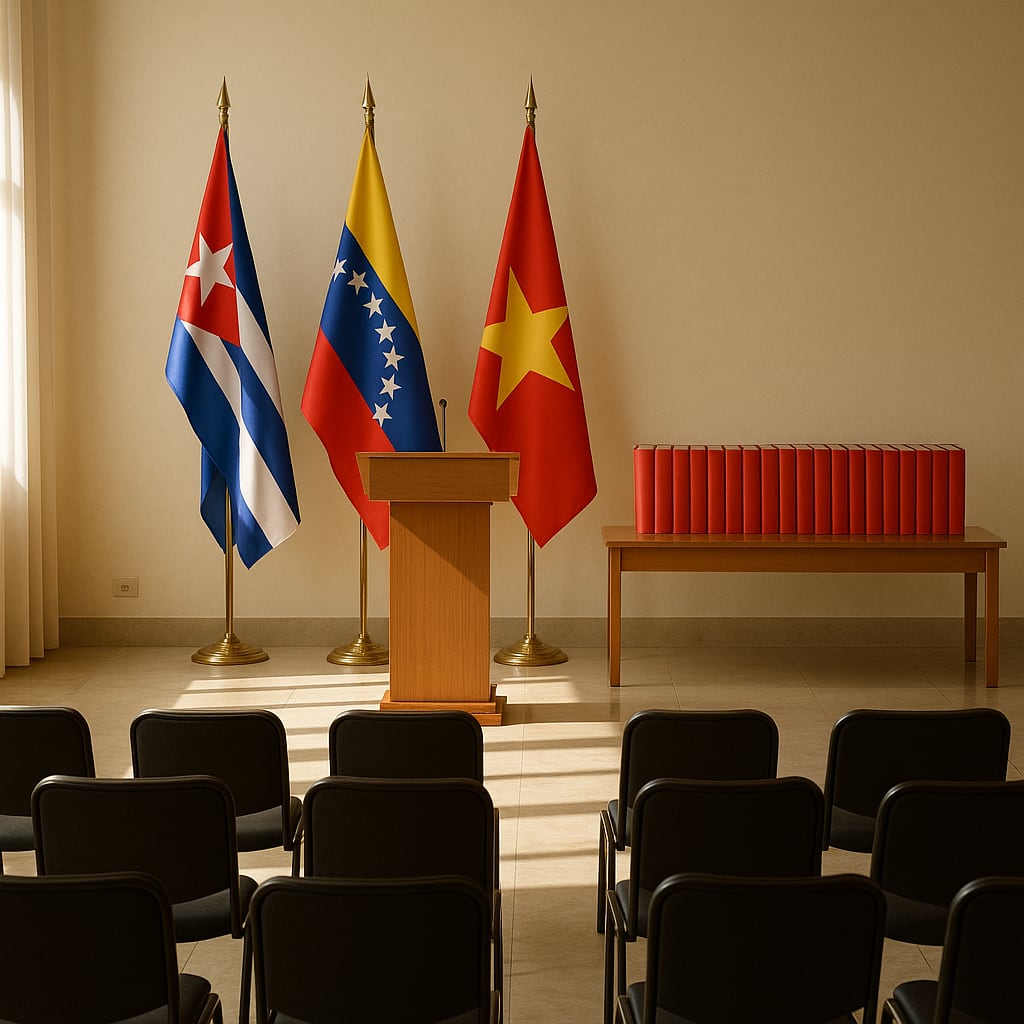
Cuba marked the 100th anniversary of Fidel Castro’s birth with official events in Havana and across the island. At a secure centenary event in the capital, 95-year-old Raúl Castro made a rare public appearance and received a standing ovation, according to France24; Bangkok Post similarly reported his reemergence after months out of view. A 23-volume collection of Fidel Castro’s “Selected Works” was presented at the Havana Convention Center during the First International Colloquium “Fidel: Legacy and Future,” with organizers calling the edition—compiled from 690 documents and nearly 16,000 pages and published by Vietnam’s National Political Publishing House, La Verdad—a milestone of bilateral cooperation, Telesur reported. In Santiago de Cuba, officials laid a floral offering on behalf of Raúl Castro at Castro’s monolith in Santa Ifigenia Cemetery and inducted 100 new Communist Party members, Telesur added. Abroad, Venezuelan authorities and Cuban diplomats held a ceremony at Caracas’s National Pantheon, where Acting President Delcy Rodríguez praised Castro’s “commitment to dignity, social justice, sovereignty and solidarity-based internationalism,” per Telesur. RT released a documentary surveying Castro’s rise, Cold War role, and ties with Moscow, while CGTN reported on island-wide cultural and theoretical activities. France24 and Clarín underscored Cuba’s mounting economic crisis and frequent blackouts as context for the commemorations.
Why It Matters
The centenary functioned as a coordinated exercise in political continuity, alliance signaling, and narrative consolidation under duress. Domestically, the presentation of a comprehensive “Selected Works” and the induction of 100 new party members in Santiago point to efforts to institutionalize and transmit doctrine at a time when France24 and Clarín describe severe economic and energy stress. Internationally, the publication by Vietnam’s National Political Publishing House showcases cultural cooperation with a longstanding partner, while ceremonies in Caracas—attended by Venezuelan officials and Cuban diplomats—reiterate the resilience of Havana’s regional alliances, as reported by Telesur. Parallel media treatments by RT and CGTN emphasize ties with Moscow and Beijing and celebrate state-led achievements, reinforcing supportive external narratives. For policy actors, the episode underscores how Havana leans on symbolic statecraft, party-building, and allied platforms to bolster legitimacy and external backing during crisis conditions, with implications for how multilateral and bilateral interlocutors read Cuba’s internal cohesion and diplomatic latitude.
Diverging Narratives
Outlets converge on the facts of commemoration and Raúl Castro’s presence but diverge on characterization and context. RT centers achievements and geopolitical steadfastness—Soviet alliance, the Cuban Missile Crisis, and advances in healthcare, science, and education—casting the centenary as a reaffirmation of global influence. CGTN keeps focus on cultural programming and reportage from Havana. In contrast, France24 and Clarín frame the ceremonies against a “deepening economic crisis and frequent blackouts,” with Clarín also adopting the term “dictador cubano” to describe Fidel. Al Jazeera’s photo-led piece notes the centenary as an event whose legacy “continues to overshadow the island,” a formulation that implies ambivalence rather than celebration.
Disagreement also appears in the portrayal of Raúl Castro. Multiple outlets note the rarity of his appearance and the standing ovation (France24, Bangkok Post), while Bangkok Post uniquely characterizes him as “US-indicted,” a descriptor not echoed elsewhere in the provided material. Folha introduces an academic counterpoint: a Harvard scholar’s claim that Fidel Castro was not initially communist until US actions against the revolution, contesting linear accounts of ideological intent. Telesur, by contrast, highlights affirmations from Venezuelan Acting President Delcy Rodríguez praising Castro’s “dignity” and “solidarity-based internationalism,” and reports the Vietnam-published “Selected Works” as a cooperation milestone—positions aligned with pro-government and allied narratives.
What Happens Next
Two decision points follow from the coverage. First, the regime’s use of institutional tools to reinforce ideological continuity: organizers call the “Selected Works” a publishing milestone and gesture of Vietnam–Cuba cooperation (Telesur), and authorities marked the centenary by inducting 100 new Communist Party members in Santiago (Telesur). Analysts should watch for follow-on educational or party-training initiatives linked to the collection, further joint publishing efforts with Vietnam, or additional outputs from the “Fidel: Legacy and Future” colloquium. Second, elite signaling and leadership optics: media describe Raúl Castro’s appearance as rare and ovation-backed (France24, Bangkok Post). Whether he continues to surface at key ceremonies or recedes will shape perceptions of succession stability; indicators include attendance at future state commemorations and how state media stages such events.
Externally, the Caracas tribute featuring Venezuelan officials and Cuban diplomats (Telesur) suggests continued allied choreography. Further joint ceremonies or statements would evidence sustained regional messaging around the centenary’s themes. Simultaneously, RT’s documentary and CGTN’s programming point to ongoing narrative reinforcement; additional feature coverage would signal the persistence of supportive external frames.