
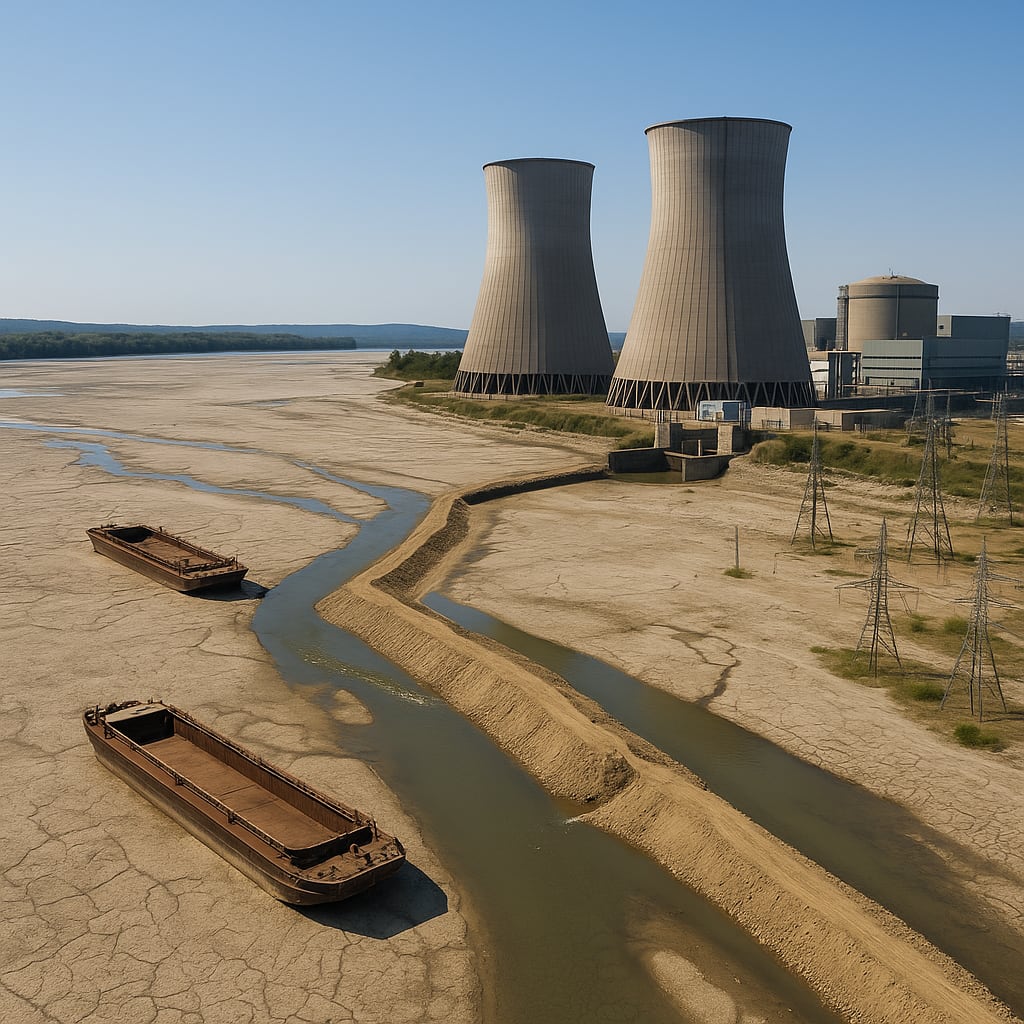
Record-low Danube forces Romania to halt Cernavodă nuclear plant
Narrative Snapshot
Across European and regional outlets, coverage converges on water scarcity in the Danube as the operative constraint and on Cernavodă’s weight in Romania’s power mix, with multiple reports placing its contribution at roughly one-fifth of national electricity. Several accounts foreground the European scope of the drought and heat, linking the Romanian shutdown to historically low river levels across the continent’s major waterways and to pressure on multiple sectors beyond power. Others narrow in on operational details: some emphasize Romania’s reliance on imports during the outage and the sequencing of unit-by-unit shutdowns that culminated in a full halt.
There is also a regional comparative thread. Reports juxtapose Romania’s stop with Hungary’s countermeasures to maintain reactor operations, and one account depicts Hungarian nuclear outages of exceptional extent. Russian outlets place the Danube’s low water in a logistics frame, questioning the river’s viability as a substitute trade route given the closure of Ukrainian seaports. What is most at stake across the coverage is not only Romania’s near-term supply balance, but the resilience of river-dependent energy systems and transport corridors under prolonged heat and drought.
What Happened
Romania halted operations at the Cernavodă Nuclear Power Plant after the Danube fell to record lows, depriving the facility of adequate cooling water. The plant, which typically supplies about 20% of the country’s electricity, had already shut one reactor in late July due to heat and low rainfall before beginning the shutdown of the second unit in mid-August, resulting in a complete halt. Romanian authorities had attempted to avert a total stop, and one report detailed steps including sinking barges near the Bala Canal to redirect flow toward the plant following earlier channel works. With the last operating reactor now offline, Romania has been obliged to import more electricity. The operator does not expect a restart for at least 10 days, according to reporting, while European and regional outlets characterize the event as a rare move tied to exceptional drought conditions affecting rivers across the continent.
Why It Matters
The halt exposes a structural vulnerability in thermal and nuclear generation dependent on river-based cooling during heatwaves and drought. Multiple outlets situate Romania’s decision in a broader European pattern of historically low river levels disrupting energy production, transport, ecosystems, and water supplies. Because the Danube spans or borders ten countries and underpins a major inland transport corridor, water scarcity on this river links power reliability to cross-border logistics and supply chains. Regional dynamics are already visible: Romania is importing electricity during the outage, while neighboring Hungary is taking emergency hydrological measures to keep its Danube-cooled reactors online. Russian reporting underscores that the Danube’s low water also undermines its role as an alternative to closed Ukrainian seaports. For decision-makers, the episode highlights the need to plan for concurrent stresses on generation and transport along shared waterways under prolonged extreme heat.
Diverging Narratives
Accounts align on proximate cause and scale but diverge on emphasis and regional comparison. Several outlets anchor the Romanian halt in a European heatwave-and-drought frame, while others prioritize operational and market impacts, notably Romania’s increased electricity imports and the sequencing from a single-unit reduction to a full shutdown. Coverage varies on mitigation detail: one report notes Romania “tried to avert” the halt, while another specifies the sinking of rock-filled barges near the Bala Canal after military channel works to steer more water to Cernavodă.
Reports differ on historical framing and regional severity. One French outlet notes Romania’s first complete nuclear shutdown since the 2003 heatwave; a Russian outlet cites Serbian authorities describing Danube levels as the lowest in 100–150 years. A sharper contrast emerges over Hungary: German reporting highlights efforts to dam the Danube to keep the Paks plant running, whereas a British account describes Hungary as having shut down all but one Danube-cooled reactor for the first time in 44 years. Russian outlets extend the frame to trade, arguing that the Danube’s shallow water undercuts its reliability as a substitute route amid closed Ukrainian ports.
What Happens Next
Operational recovery hinges on hydrological conditions. Reporting indicates Cernavodă is not expected to restart within 10 days; if Danube flows remain depressed, the outage and associated electricity imports could persist. Analysts should watch operator statements and river gauge trends that would enable a staged restart versus a prolonged halt.
Authorities’ flow-management measures are a second decision point. One account describes Romania redirecting water toward the plant with barges and earlier channel work; the efficacy and potential expansion of such interventions will shape timelines. Regionally, Hungarian actions to dam the Danube to keep Paks online bear on cross-border power availability; outcomes range from maintained generation to further curtailments, as suggested by differing reports.
A third hinge concerns logistics on the Danube. Russian reporting questions the river’s reliability as an alternative to closed Ukrainian ports under shallow-water conditions; watch navigability constraints along key stretches such as around Izmail and Reni and any resulting shifts in cargo flows. Broader drought coverage indicates that continued low river levels could keep pressure on energy production and transport across multiple European basins.