
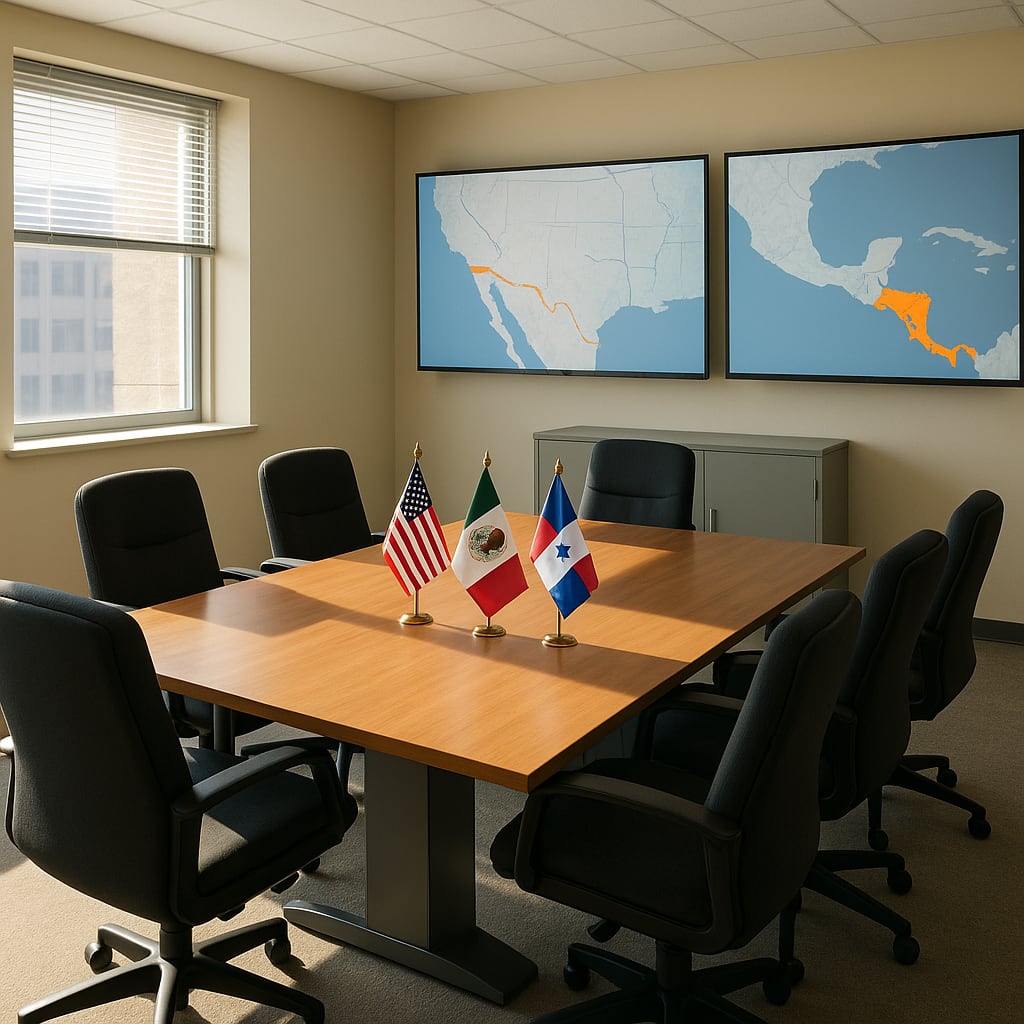
U.S. prepares on-the-ground anti-drug operations with Latin American partners as cross-border exercises expand
Narrative Snapshot
Across outlets, there is alignment that Washington is shifting from a maritime airstrike campaign against suspected trafficking vessels toward a more expansive, coordinated regional posture that includes ground operations and joint military exercises. Latin American and European reporting places emphasis on coalition-building and operational tempo: Clarin highlights a 19-country alliance, pending expansion, and new exercises in Panama, while Le Monde and the Bangkok Post focus on U.S.–Mexico border drills near Ciudad Juárez after Washington labeled the Juárez cartel a foreign terrorist organization with financial consequences.
The framing diverges on intent and implications. Folha de S.Paulo relays the U.S. planning of land operations, then separately warns of “dangerous normalization” of U.S. bombings at sea that have killed over 200 people without judicial process. Telesur English contends that the “Shield of the Americas” (A3C) under SOUTHCOM centralizes regional security coordination in Washington’s hands, drawing on historical analogies to prior U.S. hemispheric doctrines. Clarin’s coverage underscores political signaling from the Pentagon chief in Panama, including criticism of Cuba and rejection of the International Criminal Court, alongside the admission of Colombia into a hemispheric security coalition.
What is most at stake varies by outlet: operational reach “wherever” traffickers operate, according to Clarin’s account of the U.S. defense secretary; the legal and sovereignty questions raised by conducting actions on allied soil, as flagged in Brazilian reporting; the financial and juridical escalation embedded in terror designations, as noted by Le Monde; and the governance consequences of integrating intelligence and military capabilities across borders under U.S. coordination, emphasized by Telesur.
What Happened
U.S. Defense Secretary Pete Hegseth said the U.S. military is preparing to conduct operations on the territory of allied Latin American countries to combat drug-trafficking organizations, according to Folha de S.Paulo and Clarin. Clarin reports this planning is nested in a 19-country alliance and could extend “wherever” drug groups operate, and notes the Trump administration launched aerial bombings on suspected trafficking boats in the Caribbean and eastern Pacific last September, with at least 215 people killed to date. In Panama, Clarin adds, the Pentagon chief promoted regional cooperation against cartels, announced joint exercises to combat trafficking, criticized Cuban influence, rejected the ICC, and received Colombia into a hemispheric security coalition. On the U.S.–Mexico border, Le Monde and the Bangkok Post report joint exercises near El Paso–Ciudad Juárez, weeks after Washington designated the Juárez cartel a foreign terrorist organization, barring its access to the U.S. financial system.
Why It Matters
The reporting indicates a consolidation of a U.S.-led, multi-country security architecture that moves beyond maritime interdiction toward integrated, cross-border operations. Clarin’s description of a 19-country alliance and new exercises, together with Le Monde’s account of terror designations affecting financial flows, signal a blend of military, law-enforcement, and financial tools. Folha de S.Paulo’s critique of extrajudicial lethal force and civilian harm surfaces pressure points for international legal norms and partner legitimacy. Telesur English’s portrayal of the “Shield of the Americas” (A3C) under SOUTHCOM highlights the structural implications of U.S.-coordinated surveillance and intelligence integration across borders.
For decision-makers, the convergence of counter-narcotics and counterterrorism authorities, coalition-building, and expanded domains of operation raises sovereignty, legal process, and accountability questions alongside operational effectiveness. Participation decisions by Latin American governments, the scope of U.S. designations, and the handling of civilian protection will shape the durability and regional acceptance of this security posture.
Diverging Narratives
A security-cooperation narrative features prominently in Clarin, Folha de S.Paulo’s initial dispatch, Le Monde, and the Bangkok Post, emphasizing operational readiness, exercises, and coalition growth. Clarin foregrounds the scale of the alliance, announced drills in Panama, the inclusion of Colombia in a hemispheric coalition, and the U.S. defense chief’s hardline political signals on Cuba and the ICC. Le Monde centers on the legal and financial ramifications of the Juárez cartel’s foreign terrorist organization designation, situating border exercises within a tighter sanctions framework. The Bangkok Post offers concise confirmation of the U.S.–Mexico drills without additional framing.
Countervailing accounts stress sovereignty and rights. Folha de S.Paulo’s follow-up piece characterizes the maritime bombings as a “dangerous normalization,” citing over 200 deaths, including fishermen and civilians, and the absence of accusation, defense, or trial, with Washington’s “narcoterrorist” label serving as sufficient cause for lethal targeting. Telesur English frames the Shield of the Americas/A3C as a systemic expansion of U.S. military control via SOUTHCOM, with cross-border surveillance integrating participating states’ security operations and evoking historical U.S. hemispheric doctrines. These perspectives converge on concerns about legal process and external coordination authority, while differing from operationally focused reports that emphasize coalition mechanics and exercises.
What Happens Next
Key decision points turn on implementation, scope, and consent. First, whether Washington and specific partner governments move from preparation to executing on-the-ground operations will be signaled by formal announcements of joint actions inside allied territories; Clarin’s mention of Argentina among partners and Panama exercises are touchpoints to watch, as are any public authorizations by host governments referenced in Folha de S.Paulo. Second, the breadth of legal authorities may widen if additional cartels receive terror designations, as Le Monde noted with the Juárez cartel; subsequent listings would extend financial restrictions and could justify expanded security measures. Third, coalition architecture could deepen through additional exercises or access arrangements, consistent with Clarin’s reporting on Panama and Colombia’s admission to a hemispheric coalition and Telesur’s portrayal of A3C coordination under SOUTHCOM. Finally, casualty reporting and scrutiny of maritime strikes, highlighted by Folha de S.Paulo and Clarin’s death toll, could catalyze policy adjustments or partner pushback, depending on how civilian harm concerns are addressed.