
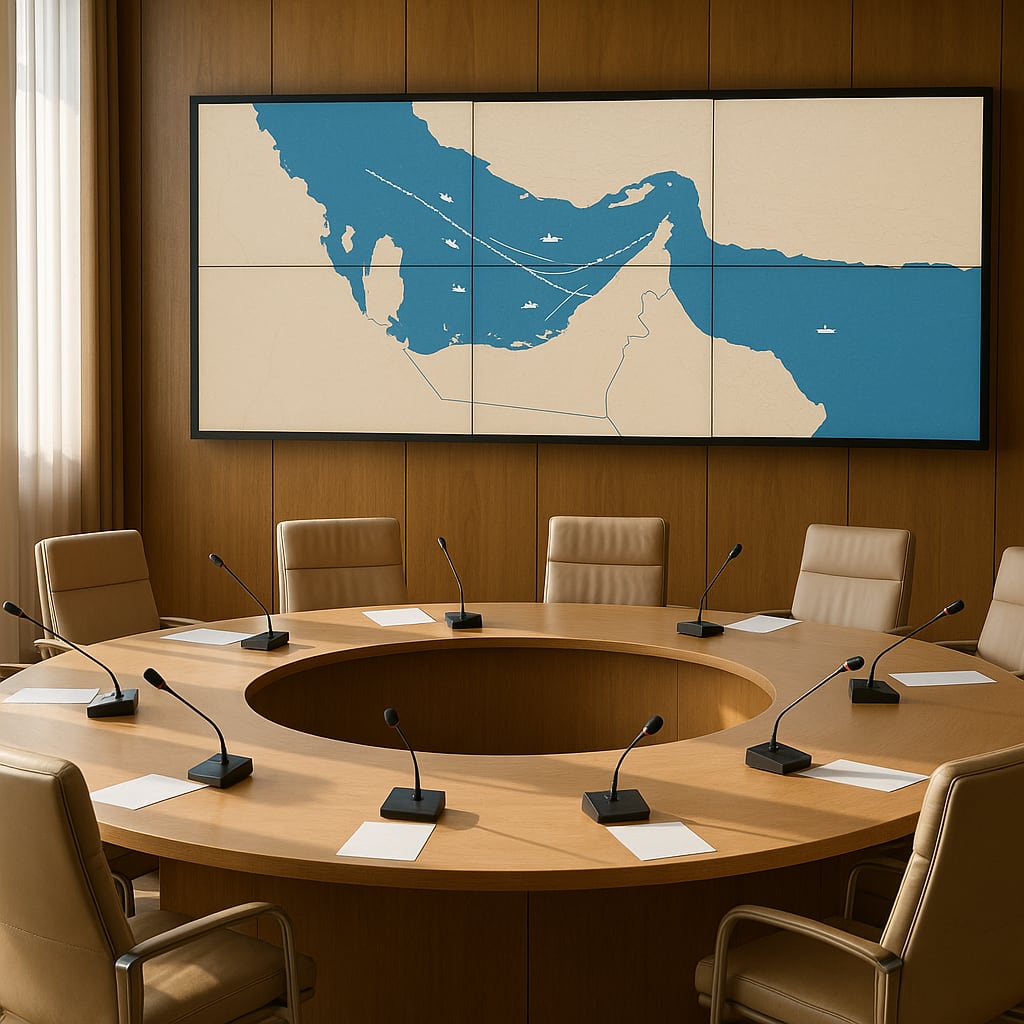
Iran advances parliamentary plan to govern Hormuz as Washington escalates rhetoric and shipping data show steep decline
Narrative Snapshot
Across outlets, there is broad acknowledgment that Tehran is asserting formal authority over the Strait of Hormuz while Washington hardens its stance. Middle East Eye reports an Iranian parliamentary committee has approved the principles of a strategic plan for the strait and Gulf, moving toward domestic legal codification of Iran’s role. France24, CGTN, The Hindu, RT, and Telesur all highlight President Donald Trump’s threat to declare the waterway US territory and Iran’s immediate rejection, with Tehran’s deputy foreign minister reiterating that opening and closing the strait rests with Iran. The operational picture converges in ship-tracking figures cited by Fox News and CGTN: tanker and cargo traffic is far below pre-conflict levels, with some vessels using an “Iranian Unilateral Scheme” rather than the established traffic separation scheme.
The emphases diverge over cause and remedy. Russian and Iranian outlets frame US actions—strikes and a continuing blockade—as the precipitating disruption and as evidence of Washington’s strategic miscalculation, while Canadian authorities position sanctions as a defense of navigation rights. US-aligned media foreground the administration’s shift toward intensified economic pressure and Iran’s economic vulnerabilities over immediate military escalation. Meanwhile, CGTN reports quiet diplomacy, including Omani-facilitated talks on safe routes, indicating a parallel track that contrasts with public threats. A separate RT report on a Saudi-led maritime coalition in the Red Sea and Gulf of Aden situates Hormuz within a broader reconfiguration of regional shipping security as operators seek alternatives.
What Happened
Iran’s parliament advanced a strategic plan to govern security and development in the Strait of Hormuz and the Gulf, with a committee approving core principles and sending them forward for further consideration, according to Middle East Eye. As tensions persisted, President Donald Trump told supporters he would move to declare the strait US territory, a claim Iran rejected; Deputy Foreign Minister Kazem Gharibabadi said the waterway would be opened or closed only under Iran’s command, as reported by France24, CGTN, RT, and The Hindu. CGTN noted US Central Command’s ongoing maritime blockade operations, including rerouting 59 vessels, disabling three, and boarding two by August 12. Canada sanctioned five senior Iranian officials for obstructing navigation rights, CBC reported. Vessel traffic remains sharply depressed: UKMTO data cited by Fox News show AIS-detected transits about 90% below pre-conflict baselines; Kpler recorded 13 crossings on August 13, nine via an “Iranian Unilateral Scheme,” and CGTN reported only two passages on Friday. Diplomatically, CGTN said Iran discussed safe shipping with Oman. Russia’s UN envoy publicly blamed Washington for “ruining” navigation, per Middle East Eye. RT reported Saudi Arabia launched a multinational maritime coalition for the Red Sea and Gulf of Aden.
Why It Matters
The dispute over Hormuz is testing core international maritime norms—freedom of navigation versus a coastal state’s claimed authority over a strategic chokepoint—under conditions of open coercion. Trump’s annexation rhetoric, reported by multiple outlets, departs from established legal frameworks and raises questions about the enforceability and legitimacy of unilateral control claims. Iran’s parliamentary move to formalize governance of Hormuz, alongside operational practices such as an “Iranian Unilateral Scheme” cited by Fox News, indicates a bid to normalize de facto control through domestic instruments and on-the-water procedures. With traffic still deeply suppressed per UKMTO and Kpler, the crisis is reshaping commercial routing choices and risk pricing, while RT’s note of a Saudi-led coalition underscores how regional actors are redirecting security investment toward alternative corridors in the Red Sea and Gulf of Aden. For governments and multilateral bodies, the combination of sanctions coordination (Canada) and ad hoc maritime security arrangements highlights both the utility and the limits of existing institutions to manage acute chokepoint disruptions.
Diverging Narratives
Iran and its media echo chamber portray the current situation as validation of deterrence and sovereignty. Tehran Times warns of a “decisive response” to US challenges, while RT and CGTN amplify Gharibabadi’s claim that only Iran can open or close Hormuz and note the strait’s initial closure amid late-February hostilities. Russian commentary, cited by Middle East Eye, assigns primary blame to Washington for “ruining” navigation through aggression and for trying to fix a self-inflicted problem by prolonging conflict.
US-aligned reporting concentrates on economic leverage and legal order. Fox News highlights the administration’s near-term preference for intensifying economic pressure over expanding military action, and Canada’s sanctions are framed by CBC as protecting navigation rights. At the same time, The Hindu records Trump’s assertions that the strait is under US control—claims Tehran denies—illustrating a sharp rhetorical contest over legal and operational authority. On-the-water data complicate these claims: Fox News cites UKMTO and Kpler showing traffic remains about 90% below normal, with some vessels using an Iranian-devised routing scheme rather than the Hormuz traffic separation system, while CGTN reports as few as two vessel passages on a given day. Finally, CGTN points to ongoing talks with Oman on safe routes, suggesting a diplomatic aperture that coexists uneasily with maximalist public positions and sanctions escalations.
What Happens Next
Three decision points will shape the trajectory. First, Iran’s conditionality for reopening the strait, stated by its Strait Management Authority and reiterated by senior officials, sets a negotiating threshold; absent US movement, CGTN’s blockade statistics and continued low transit counts suggest prolonged disruption. Second, Washington’s choice between sustaining a sanctions-first approach, as described by Fox News, or acting on annexation rhetoric reported by France24, CGTN, RT, and Telesur will signal whether legal contestation remains rhetorical or moves into operational attempts to impose alternative governance. Indicators include further allied sanctions like Canada’s and any formal US legal steps or maritime directives attempting to supersede Iranian schemes. Third, parallel channels—Omani-brokered talks on safe routing reported by CGTN and the Saudi-led Red Sea/Gulf of Aden coalition noted by RT—could either mitigate risk by offering workarounds or harden blocs. Analysts should watch vessel routing patterns reported by UKMTO/Kpler, Iran’s parliamentary follow-through on the strategic plan, and any confirmed incidents at sea, such as the reported drone downing, that could trigger escalatory cycles.