
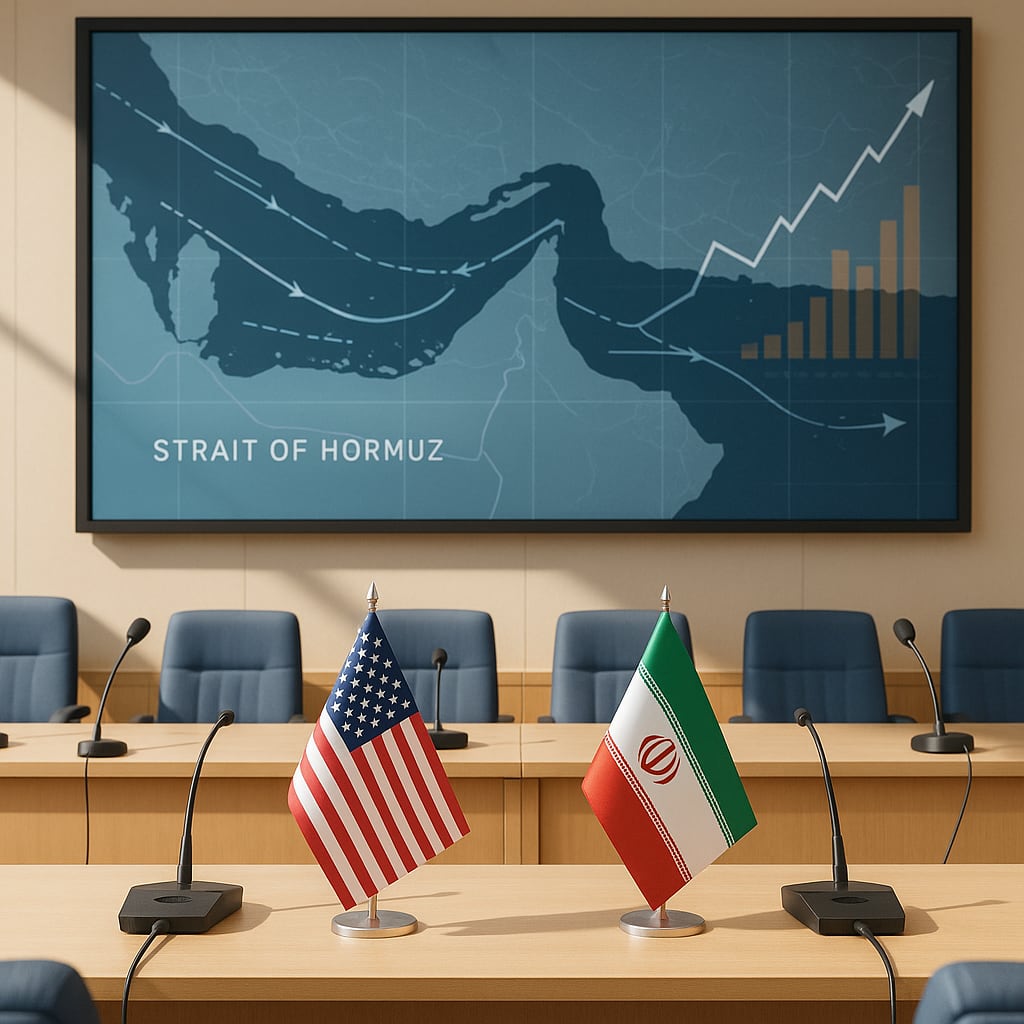
US vows ‘unprecedented’ economic isolation of Iran paired with Hormuz blockade, as Tehran conditions reopening of the strait
Narrative Snapshot
Across outlets, there is broad alignment that Washington is preparing a new round of punitive steps and that senior officials are explicitly coupling financial pressure with physical control over maritime access. Middle East Eye and ANSA quote Treasury Secretary Scott Bessent describing a “combination” of economic isolation and a continued blockade in the Strait of Hormuz that would prevent traffic in or out of Iranian ports, while TASS similarly highlights his reference to a naval blockade alongside sanctions. France24, The Hindu and South China Morning Post converge on the core point that new, tougher measures are imminent.
Iranian statements in The Guardian and France24 emphasize control over Hormuz and condition any reopening on U.S. concessions, including compensation for war damages. The tone within Iranian coverage varies: the IRGC calls the strait a “theatre of war” and signals resolve to keep it closed until demands are met, while President Masoud Pezeshkian is quoted as saying he believes it is the best time for an agreement and that Iran is “victorious and powerful” in the current war.
U.S.-aligned and adversarial outlets diverge on likely trajectories. Fox News platforms an analyst warning of Iranian “kinetic” retaliation as pressure intensifies, whereas RT amplifies an IRGC commander’s assertion that Iran can prolong the conflict until the end of Donald Trump’s term to impose attrition. SCMP adds a domestic U.S. political frame, noting Trump’s stated indifference to electoral timing and his struggle to find an off‑ramp, while maritime incident reporting from Fox, The Guardian and UKMTO foregrounds immediate operational risks in and around the strait.
What Happened
U.S. Treasury Secretary Scott Bessent said Washington will unveil measures next week to impose economic isolation on Iran “like the world has never seen before,” pairing financial actions with what he called a continued blockade in the Strait of Hormuz (Middle East Eye; France24; ANSA). TASS reported he said these steps would be combined with Washington’s naval blockade of Iran. President Donald Trump separately told Fox News the U.S. would hit Iran’s economy “hard” as the war nears six months (Middle East Eye; South China Morning Post).
Iran has kept the Strait of Hormuz closed and issued demands for reopening, including compensation for war damages; talks with Oman were described as “approaching the final stages,” but still subject to conditions (France24, Aug. 9). The IRGC vowed to maintain closure until all conditions are met and called the strait a “theatre of war,” while Tehran rejected Trump’s subsequent threat to declare Hormuz U.S. territory, insisting it “will remain Iranian” (The Guardian; France24, Aug. 15). Amid rising tensions, ADNOC reported two vessels were struck transiting Hormuz with no injuries, an incident the UAE attributed to Iran, and UKMTO noted a vessel fire in the area (Fox News; The Guardian).
Why It Matters
The coupling of intensified sanctions with an asserted maritime “blockade” represents a sharper two‑front approach that, if sustained, tightens the linkage between economic coercion and control of a strategic waterway central to the ongoing conflict (Middle East Eye; ANSA; TASS). Iran’s insistence that Hormuz will remain closed until demands are met, and that the waterway is a “theatre of war,” underscores a contested space where sovereignty claims and operational control are at stake (The Guardian; France24, Aug. 9–15). Trump’s rhetoric about declaring Hormuz U.S. territory further hardens opposing legal and political narratives around who decides access to the strait (France24, Aug. 15).
For decision‑makers, this alignment of pressure tools compresses diplomatic space: Oman’s facilitation is described as “approaching the final stages,” yet reopening remains explicitly conditional (France24, Aug. 9). With the conflict entering its sixth month and Washington signaling additional measures next week, multilateral actors monitoring maritime security and regional governments responding to vessel incidents face escalating operational uncertainty (South China Morning Post; Fox News; The Guardian).
Diverging Narratives
Washington’s message, as carried by Middle East Eye, ANSA, and TASS, emphasizes unprecedented economic isolation reinforced by a blockade posture in Hormuz. U.S. domestic framing in SCMP portrays a White House intent on intensifying pressure irrespective of electoral timelines, and France24 reports Trump’s threat to declare the strait U.S. territory. By contrast, Iranian officials quoted by The Guardian and France24 insist the strait is under Iranian control and will remain closed until U.S. conditions are met, including compensation for war damages, with the IRGC labeling Hormuz a wartime theater.
On the likely course of hostilities, Fox News cites an FDD analyst forecasting Iranian “kinetic” pushback by early fall as sanctions tighten, while RT highlights an IRGC general’s assertion that Tehran can sustain a prolonged conflict to sap U.S. will through attrition. Maritime incidents are reported with differing degrees of attribution: ADNOC and the UAE condemned what they called Iranian attacks on vessels transiting Hormuz, while Oman condemned repeated attacks without assigning blame and UKMTO noted a vessel fire (Fox News; The Guardian). Details of the forthcoming U.S. measures remain undisclosed—TASS explicitly notes Bessent provided no specifics—prompting Japan Times to focus on potential Treasury pressure points without confirming which will be used.
What Happens Next
The first inflection will be the content and enforcement architecture of the U.S. measures expected next week. Bessent’s framing suggests an unprecedented scope, but specifics are pending; analysts will watch which financial “pressure points” Treasury activates and how these align with the stated blockade posture in Hormuz (France24; TASS; Japan Times; Middle East Eye). A second decision point concerns access to the strait: Iran has issued a list of conditions and signaled closure will persist until they are met, even as talks with Oman move forward. Movement on compensation or other demands—or lack thereof—will determine whether discussions reach operational arrangements for shipping (France24, Aug. 9; The Guardian).
A third indicator is escalation timing. Fox News relays expectations of potential Iranian kinetic action as sanctions intensify, while RT reports IRGC willingness to prolong the conflict. Maritime incident rates, official attributions by regional states, and any steps to operationalize Trump’s threat regarding Hormuz will signal which path—escalation, protracted standoff, or conditional de-escalation—takes shape (Fox News; RT; France24, Aug. 15).