
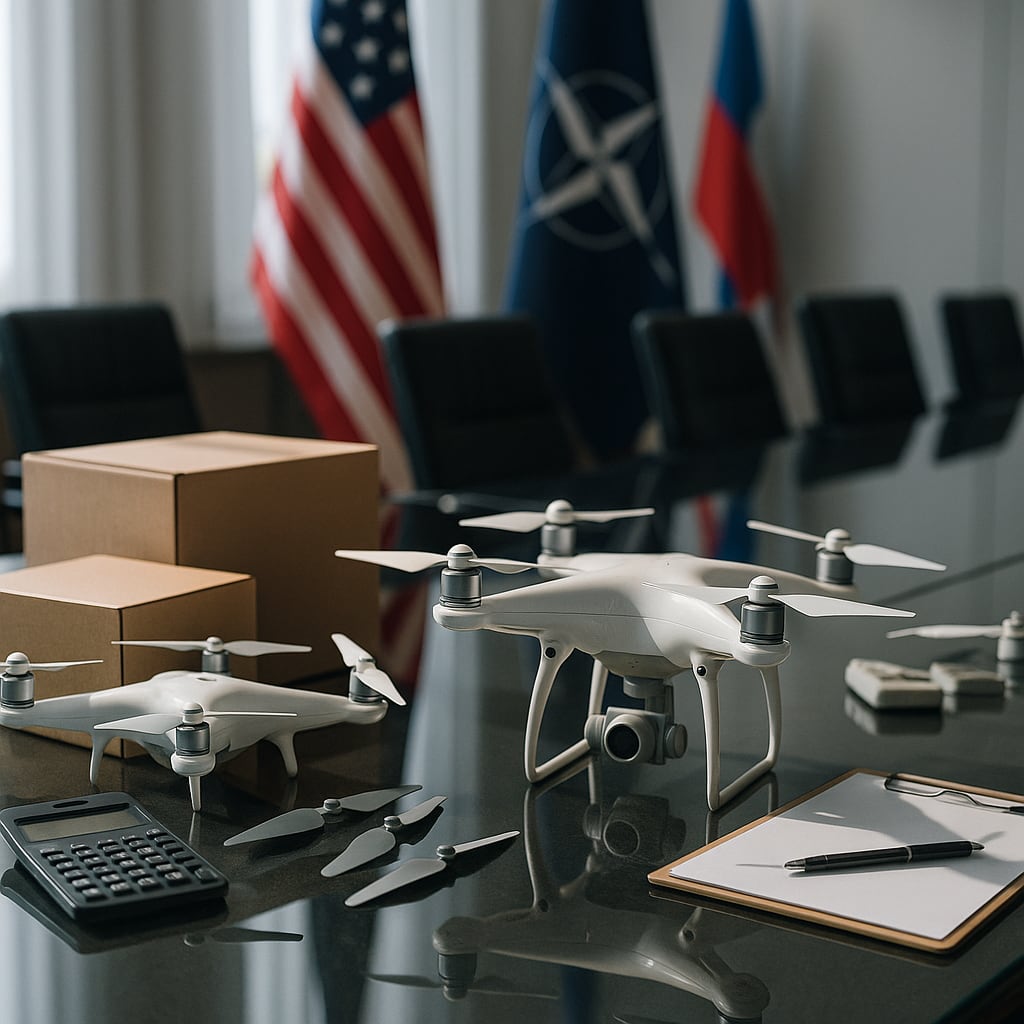
US imposes tariffs of up to 100% on imported drones and components, citing national security
Narrative Snapshot
Across outlets there is broad agreement on scope and rationale: the White House frames the move as reducing US reliance on foreign unmanned systems and protecting national security, with measures reaching up to 100% duties on specified drones and parts and taking effect after a short lead time. French, Indian, Japanese, Brazilian, and Thai coverage converge on those points, emphasizing overdependence on foreign suppliers and China’s dominant position in the sector. Reporting from France24 adds that allied suppliers are in scope, while Japan Times and Le Monde stress the strategic logic of countering China.
Divergence appears around consequences and linkages. Hong Kong-based analysis stresses the tariffs’ potential to deepen US–China trade frictions and complicate shifting production to third countries already strained by prior restrictions. Russian state media threads the measures to two distinct storylines: possible complications for Ukraine’s drone export ambitions and a White House report alleging widespread transshipment through partners. European outlets highlight the national-security justification but also note the allied exposure. Ukrainian reporting situates the timing against a recent announcement of a US–Ukraine drone sale understanding without characterizing effects.
What Happened
President Donald Trump signed a proclamation imposing tariffs on imported drones and components, with rates up to 100 percent, to cut dependence on foreign suppliers and address security risks, according to multiple outlets. France24 reports the measures, covering allies as well as China, take effect in 21 days. CGTN details a 100 percent tariff for drones over 25 kilograms or with specified capabilities such as thermal imaging, and for certain docking stations and critical components, with some less‑sensitive components delayed 180 days. TASS notes a 25 percent ad valorem tariff on smaller drones and other components. RT reports reduced rates for selected partners—15 percent for the EU, Japan, South Korea, Switzerland, and Taiwan, and 10 percent for the UK—and staggered implementation for some items. The Japan Times cites Commerce Secretary Howard Lutnick’s finding that the US is “too reliant” on foreign systems. ANSA and La Repubblica underscore the executive action’s national-security justification.
Why It Matters
The move embeds drones more firmly in the broader US–China techno‑economic rivalry and extends an approach that blends trade tools with security rationales. Outlets in Hong Kong report analysts’ views that the tariffs could produce a “lose‑lose outcome” for both economies and complicate manufacturers’ efforts to shift production through third countries—an adaptation path already strained by earlier restrictions. That intersects with a White House report highlighted by RT alleging widespread transshipment via more than 40 countries, including close partners, underscoring potential friction with allies even as some receive lower rates. The policy also dovetails with US efforts to onshore critical capabilities; Folha de S.Paulo notes the intent to reduce reliance by US companies and public authorities on Chinese technology. In parallel, SCMP reports a US appeals court sent DJI’s Pentagon blacklist challenge back to a lower court, illustrating that trade, procurement, and legal tracks are moving simultaneously and may interact.
Diverging Narratives
US and allied media consistently foreground the stated goals—security and supply‑chain resilience—with France24, Le Monde, The Hindu, Japan Times, and Folha de S.Paulo emphasizing reduced dependence and the targeting criteria for 100 percent tariffs, including weight thresholds and capabilities like thermal cameras and docking stations. CGTN and TASS give granular rate structures and timing, including the 21‑day start, 180‑day delays for some items, and a 25 percent tier for smaller systems; CGTN also notes timing adjustments linked to products the Pentagon exempts from the FCC “Covered List.” Hong Kong’s SCMP frames the decision within intensifying tech‑trade competition and warns of mutual economic costs and supply‑chain complications if production rerouting becomes harder.
Russian state outlets introduce two distinct emphases. RT links the tariffs to Ukraine’s effort to sell “billions of dollars” in UAVs to the US, saying the levies could complicate that push, whereas the Kyiv Independent simply notes the tariffs follow President Zelensky’s announcement of an agreement on US purchases without asserting impact. RT separately highlights a White House report accusing numerous partners of facilitating Chinese transshipment, pointing to a broader enforcement posture. ANSA’s reference to an executive order, alongside other outlets’ “proclamation,” reflects a procedural discrepancy in descriptions rather than substance.
What Happens Next
Implementation hinges on the staged timelines reported by France24 and CGTN: most measures begin in 21 days, with certain components delayed 180 days. Analysts should watch which items qualify for delayed application, including those tied to Pentagon decisions on FCC “Covered List” exemptions cited by CGTN, as that will shape near‑term sourcing options. RT’s reporting of differentiated rates for the EU, Japan, South Korea, Switzerland, Taiwan, and the UK sets up a test of allied responses; any partner‑announced adjustments or consultations would signal how frictions are managed. The Ukraine track bears monitoring: Kyiv Independent’s note of a recent US–Ukraine drone sale understanding, juxtaposed with RT’s warning of complications, makes the tariff classification of specific Ukrainian systems a consequential detail for that deal’s structure. Finally, SCMP’s account of the DJI case returning to a lower court introduces a legal process that could influence procurement perceptions even as the trade measures proceed.