
Trump Administration seeks Supreme Court approval to continue $400 million White House ballroom after appeals court halt
Narrative Snapshot
Across outlets, the legal hinge is consistent: a federal appeals court concluded the White House must secure congressional authorization before proceeding, prompting the administration’s emergency appeal to the Supreme Court. Several non‑U.S. sources foreground the court’s rationale, citing language that the decision to build “belongs to Congress” and that presidents are “temporary” tenants rather than owners of the residence. Others elevate the administration’s justification, including warnings that forcing a president to go “hat-in-hand to Congress” would be “dangerous” and the claim that the project is a security necessity.
Coverage also splits in how it situates the ballroom within a larger project. The New York Times and the Mail & Guardian frame the build as part of President Trump’s broader effort to physically remake Washington in his own style; the South African outlet casts the appeals ruling as a significant check, referencing plans as sweeping as an 80‑meter Independence Arch. By contrast, concise dispatches from Le Monde, Al Jazeera, and the Toronto Star center on the emergency petition and the underlying authorization dispute, emphasizing process over symbolism. The timeline pressure is also explicit: Telesur English reports the D.C. Circuit’s halt takes effect within a week, explaining the urgency of the Supreme Court filing.
What Happened
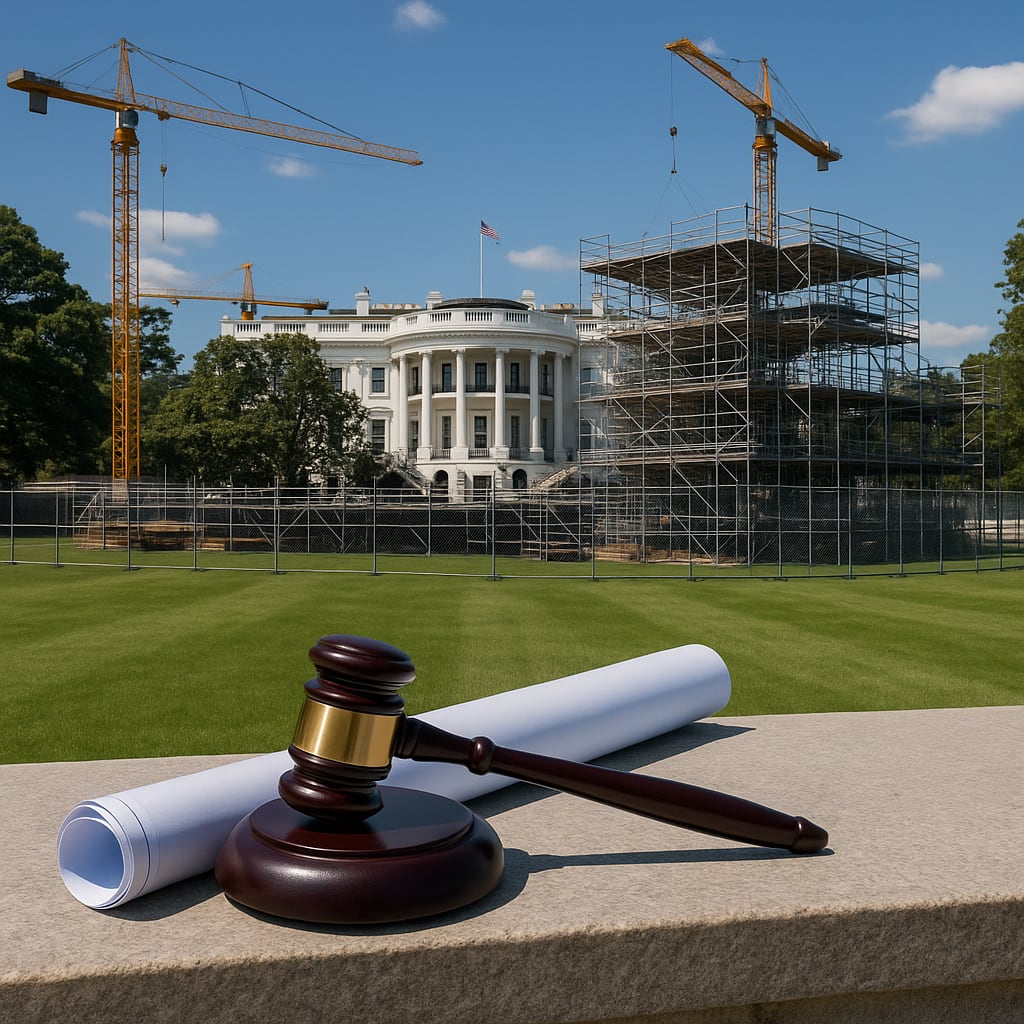
After the U.S. Court of Appeals for the D.C. Circuit ruled on Aug. 7 that work on a new White House ballroom must stop absent congressional authorization, the administration filed an emergency request asking the Supreme Court to allow construction to continue during its appeal. Multiple outlets report the estimated cost at $400 million, and the New York Times adds the planned footprint is roughly 90,000 square feet. In its filings and public messaging, the administration argues it is dangerous to require the president to seek permission from Congress and characterizes the project as a security necessity. The appeals court took the opposite view, stating that whether to build a large ballroom is Congress’s decision and reminding that presidents are temporary tenants of the residence. Foreign and U.S. outlets alike note the Supreme Court petition was submitted on Friday, Aug. 14.
Why It Matters
The dispute tests the boundary between executive stewardship of the White House and Congress’s control over significant federal property changes and spending. The D.C. Circuit’s language that such decisions “belong to Congress,” and that each president is a “temporary tenant,” underscores a separation‑of‑powers reading that could harden a precedent limiting unilateral executive capital projects at the executive residence. The administration’s counter‑arguments, including that it is “dangerous” to force recourse to Congress and that the ballroom is a security necessity, raise a familiar question: how far national security framing can extend executive discretion over major physical alterations. The New York Times and Mail & Guardian situate the ballroom within broader ambitions to remake Washington’s physical and symbolic landscape, suggesting the ruling also serves as an institutional check on that project. For policymakers and institutions, the case signals how emergency litigation on the Supreme Court’s docket can recalibrate norms around public architecture and executive prerogatives.
Diverging Narratives
The administration’s filings and public statements emphasize operational autonomy and security, asserting the project should be handled by the president and the political process rather than “construction through a judicial order,” and warning that requiring the president to go to Congress is “dangerous.” Deutsche Welle reports Justice Department lawyers calling the ballroom a security necessity, adding a protective rationale to the appeal for continued work during litigation. The judiciary’s account, conveyed in Telesur English’s quotations from the D.C. Circuit, stresses that decisions on large‑scale building at the White House rest with Congress and rejects “executive self‑help,” framing the halt as enforcement of constitutional roles. Media emphases reflect these poles. Le Monde and Al Jazeera focus on the legal requirement to obtain authorization; the BBC highlights the administration’s warning about congressional approval; the New York Times and Mail & Guardian embed the case in a broader pattern of efforts to reshape Washington’s built environment, making the ballroom a proxy for the scope of executive imprint.
What Happens Next
The immediate decision point is the Supreme Court’s response to the emergency application. If the Court allows construction to proceed during the appeal, work can resume while the merits are litigated, aligning with the administration’s request reported by the Toronto Star and others. If the Court declines, the D.C. Circuit’s halt stands, and the White House would need congressional authorization to move forward, as noted by Al Jazeera and Telesur English. Timing is consequential: Telesur reports the appeals court’s decision takes effect within a week, making the Supreme Court’s emergency action pivotal. Analysts should watch for indications of whether the Court credits the administration’s security‑necessity framing, highlighted by Deutsche Welle, or reinforces the appeals court’s congressional‑authorization requirement. Any movement toward seeking authorization from Congress would signal a parallel path to resumption under the constraint articulated by multiple outlets.