
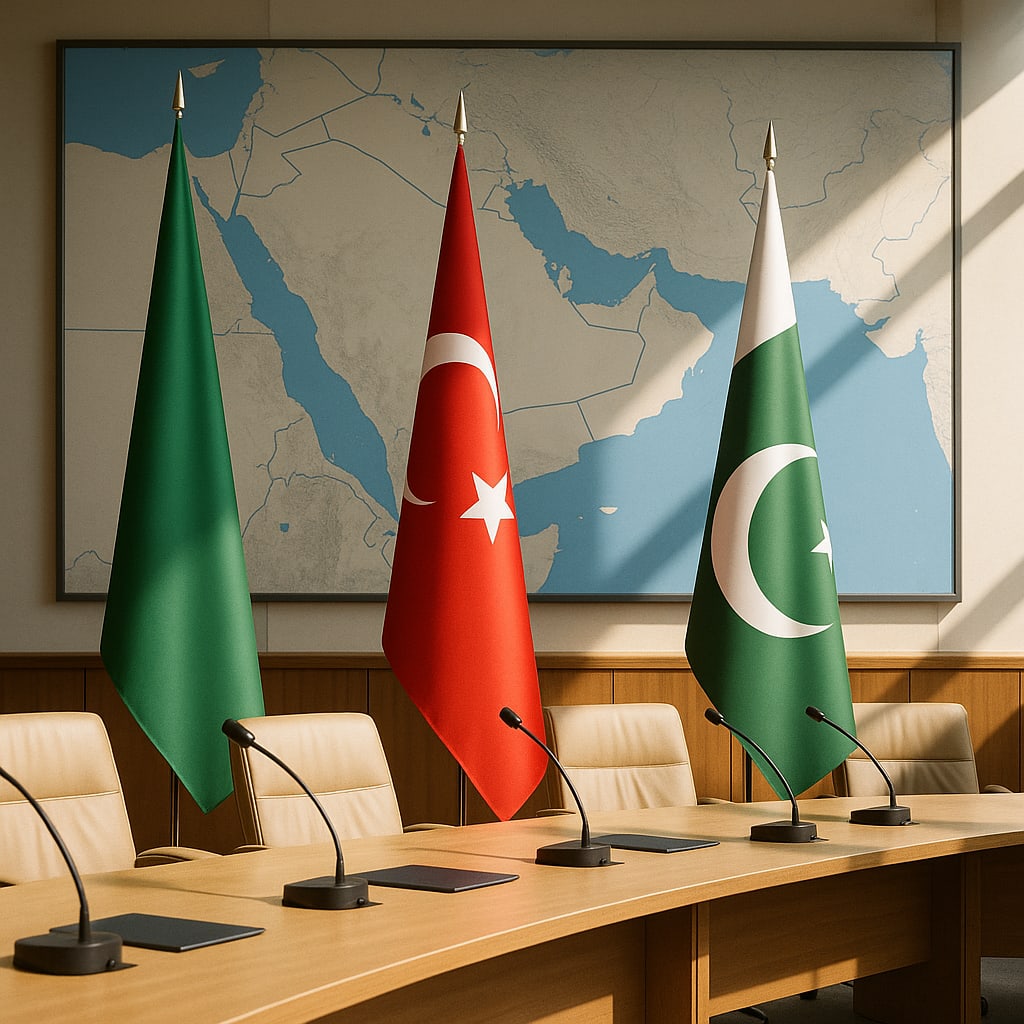
Saudi Arabia, Turkey and Pakistan sign Mecca Joint Defence Agreement with mutual‑defence commitment
Narrative Snapshot
Across outlets, there is agreement that the Mecca Joint Defence Agreement codifies a mutual defence commitment among Saudi Arabia, Turkey and Pakistan, with several reports noting language that treats an armed attack on one as an attack on all. That formalism is balanced by skepticism about whether the pact amounts to a NATO‑style alliance: experts cited by the South China Morning Post argue it falls short due to diverging strategic interests and limited collective capacity, while Middle East Eye underscores uncertainty among Western and Arab officials over how aligned the three capitals are and whether they could support each other in a hot conflict.
Coverage diverges on framing. Analyses in Middle East Eye emphasize the pact’s pragmatism rather than sectarian logic, situating it as an attempt to manage a perceived US pullback. Iranian and Israeli outlets accentuate its systemic implications: Tehran Times relays commentary that it carries a “meaningful message” to Washington, while Haaretz argues the bloc could set rules for the Gulf, Red Sea, and key straits, shifting crisis management away from the United States and potentially nudging Iran toward diplomacy. Regional context is foregrounded differently: Italian and Indian outlets tie the move to the ongoing war involving Iran and missile fire on Gulf oil exporters, while the South China Morning Post presents it as a structural overhaul with external ramifications, including for China.
Membership scope is another point of tension. Turkish President Recep Tayyip Erdogan has said Egypt could join and Pakistan’s ambassador told TASS the pact is open to all, “including Iran,” yet Middle East Eye reports Saudi Arabia opposed Egypt’s inclusion “for now,” highlighting intra‑bloc calibration over how fast and how far to expand.
What Happened
On 7 August 2026, Saudi Crown Prince Mohammed bin Salman, Turkish President Recep Tayyip Erdogan and Pakistani Prime Minister Shehbaz Sharif signed the Mecca Joint Defence Agreement, a mutual defence pact committing each to regard an armed attack on one as an attack on all, according to Al Jazeera English and the South China Morning Post. The Hindu situates the signing amid a broader regional conflagration that has included Iranian missile fire on Gulf oil exporters. The South China Morning Post notes the accord builds on an earlier Saudi‑Pakistan defence agreement concluded in September. On membership, Erdogan told Al Jazeera the pact is open to new members and cited Egypt; Pakistan’s ambassador told TASS that “any country including Iran” can join, describing the initiative as geared to peace and stability. Middle East Eye, citing Saudi sources, reports Riyadh opposed Egypt’s inclusion at this stage.
Why It Matters
Multiple outlets cast the pact as a meaningful reconfiguration of regional security. The South China Morning Post describes it as a structural overhaul that institutionalizes collective defence, while Middle East Eye argues it is designed to manage a perceived US separation from the Middle East. Haaretz suggests the bloc could set crisis‑management rules across the Gulf, Red Sea, and the straits of Hormuz and Bab el‑Mandeb, potentially reducing the American role. Iranian coverage via Tehran Times frames the agreement as a significant development and a pointed message to Washington. For external stakeholders, The Diplomat warns that Pakistan could try to invoke the pact in some form during tensions with India, raising questions for South Asia’s crisis dynamics. The SCMP’s China‑focused analysis signals implications for energy security and great‑power engagement as new intra‑regional frameworks emerge alongside, or in place of, US‑led arrangements.
Diverging Narratives
Whether the pact is an “Islamic NATO” is contested in the reporting. Al Jazeera English and the SCMP’s China piece underscore the mutual‑defence clause, yet the South China Morning Post also stresses expert assessments that it falls short of a NATO‑style alliance given divergent interests and weak collective capacity. Middle East Eye contrasts the pact’s still‑uncertain alignment and wartime credibility with the UAE‑Israel partnership’s clearly communicated depth.
On intent, Middle East Eye contributors argue the agreement is pragmatic rather than sectarian and not an anti‑Iran coalition; one analysis posits it could ultimately provide a foundation that draws in Tehran and Cairo. That line aligns with Pakistani messaging to TASS that the pact is open to “any country including Iran,” even as Iranian media casts it as a message to Washington. Haaretz emphasizes potential rule‑setting autonomy from the United States, while The Hindu notes all three signatories are US allies, implying complementarity rather than a clean break. Membership is another fault line: Erdogan’s openness to Egypt contrasts with Middle East Eye’s reporting that Saudi Arabia blocked Cairo’s inclusion “for now,” indicating internal caution about the pact’s scope and pace. The Diplomat injects a South Asia lens, suggesting Pakistan could seek to leverage the pact in an India crisis, a use case not addressed elsewhere.
What Happens Next
Three decision points emerge from the sources. First, membership expansion: watch for any Saudi shift on Egypt’s accession, given Erdogan’s public openness versus Riyadh’s reported reluctance, and for whether Islamabad’s “including Iran” invitation is echoed by Riyadh and Ankara in official communiqués. Second, operationalization: Middle East Eye and the South China Morning Post raise questions about capacity and alignment; concrete indicators would include joint planning mechanisms, regular exercises, or clarified thresholds for invoking the mutual‑defence clause. Third, external interface: Haaretz suggests the bloc may seek to set maritime and regional crisis‑management rules, while Middle East Eye frames it as managing US separation; signals to track include coordinated positions on Gulf and Red Sea security, and US responses. Regionally, The Diplomat flags a South Asia contingency: monitor whether Pakistan cites the pact during India‑Pakistan tensions and how Riyadh and Ankara characterize its geographic scope in such contexts.