
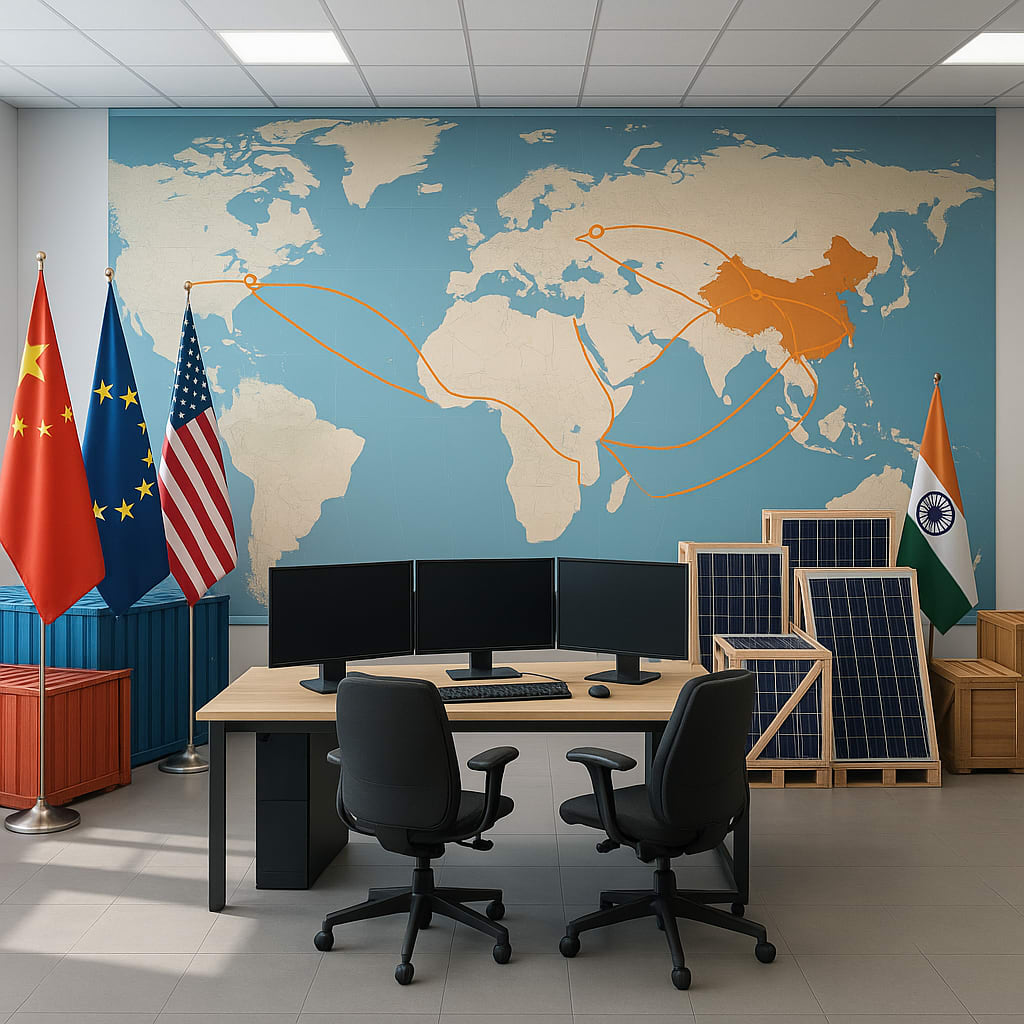
White House report alleges over 40 countries acted as transshipment hubs for Chinese goods to evade U.S. tariffs
Narrative Snapshot
Across outlets, there is consensus that a new White House report alleges widespread transshipment of Chinese goods through third countries after the 2018 Section 301 tariffs, and that the practice is material in scale. Coverage diverges on scope, emphasis, and the policy frame. Latin American and Asian reporting highlights the breadth of countries named, including close U.S. partners and key emerging markets. RT underscores that U.S. allies such as Canada, Japan, South Korea, India, Israel, Taiwan, and the EU appear in the document, while South China Morning Post and Clarín stress the inclusion of nine Latin American economies, with Clarín focusing on Argentina’s appearance and the report’s expansive value estimates. Indian coverage notes geographic specificity, with The Hindu reporting the Pune–Gujarat–Chennai corridor singled out.
U.S. and British outlets compress the narrative to its core claims, but with different inflections. Fox News foregrounds the “Great Transshipment Scam” branding, cites leadership by the White House Office of Trade and Manufacturing Policy, and references an upper-bound revenue loss figure. BBC distills the practice—routing via lower-tariff jurisdictions—without elaborating on actors or remedies. Sectoral reporting adds granularity: Japan Times traces a 32,000-km solar supply chain path blending work in China and Indonesia to reach the U.S. without tariffs, and CGTN situates the report amid new U.S. tariffs on China’s solar-linked inputs and notes frictions and domestic cost impacts.
What Happened
The White House released a 25-page report, “The Great Transshipment Scam,” asserting that after the 2018 Section 301 tariffs on China, Chinese exporters increasingly routed goods through third countries for light processing, repackaging, or relabeling to enter the U.S. under different origins (Fox News; RT; BBC). Fox News attributes the report to the White House Office of Trade and Manufacturing Policy, led by Peter Navarro, and notes the direct U.S. trade deficit with China fell in 2019–2020 as flows shifted. The report names more than 40 countries as elevated transshipment risks, including nine in Latin America—Mexico, Panama, Colombia, Brazil, Argentina, Chile, Peru, Costa Rica, and the Dominican Republic (South China Morning Post; Fox News)—as well as U.S. allies in North America, Europe, and Asia (RT). The Hindu says India is cited, with the Pune–Gujarat–Chennai belt identified. Clarín and Al Jazeera relay large-scale value and loss estimates.
Why It Matters
The report links tariff policy to origin-avoidance behavior that implicates partners across multiple regions, testing the alignment of U.S. trade enforcement with alliance management and regional diplomacy. RT highlights the inclusion of close allies, while South China Morning Post lists Latin American economies, signaling that any enforcement response could reverberate through North American, transatlantic, and Western Hemisphere supply chains. The Hindu’s reference to specific Indian corridors indicates that origin rules and verification may become more geographically targeted. Sector-specific pathways matter: Japan Times documents a solar-industry route blending production in China and Indonesia, intersecting with CGTN’s coverage of new U.S. tariffs on solar-linked components. Al Jazeera’s “tens of billions” framing and Fox News’ upper-bound loss figure underscore fiscal stakes, while Clarín’s wide band for the value of implicated goods underscores the scale of trade at issue. Collectively, the coverage points to tightening scrutiny of rules of origin within an expanding tariff regime.
Diverging Narratives
Outlets align on the existence of a White House report alleging widespread transshipment but frame its meaning differently. Fox News emphasizes an explicit administration narrative—branding it a “scam,” placing Peter Navarro at the helm, and citing up to $26 billion in losses—while Al Jazeera describes “tens of billions” in annual revenue losses. Clarín reports a broader range—$40–$303 billion—but specifies this as the value of goods linked to China, not necessarily fiscal losses, highlighting different metrics in circulation. RT stresses that the list implicates U.S. allies and notes that since returning to office, President Trump has expanded tariffs to much of the world and, last month, imposed new tariffs on imports from 60 countries over alleged forced-labor failures, situating transshipment within a widening levy landscape. By contrast, BBC opts for a concise description of the mechanism without cataloging those named. Regional outlets add texture: South China Morning Post notes some Latin American governments had recently acted against Chinese interests yet were still named, and The Hindu reports a granular naming of an Indian industrial belt. Japan Times’ account of a long-haul solar route shows how origin-avoidance can be engineered at the supply-chain level, while CGTN underscores friction with partners and cost pressures on U.S. consumers and businesses amid newly announced tariffs on China’s solar supply chain.
What Happens Next
Three decision tracks emerge from the reporting. First, U.S. tariff and enforcement trajectory: RT notes recent expansion of tariffs to 60 countries and CGTN reports fresh measures on China’s solar-related inputs, signaling continued use of tariffs; analysts should watch whether the White House translates the report’s risk list into targeted origin verifications or additional sectoral duties, particularly where Japan Times documents workarounds in solar. Second, partner-country responses: South China Morning Post and Clarín identify nine Latin American economies, and RT lists several U.S. allies; monitor whether named governments publicly contest inclusion, tighten customs-origin checks, or engage Washington on carve-outs to avoid spillovers. Third, geography-specific scrutiny: The Hindu reports the Pune–Gujarat–Chennai belt is cited; watch for administrative inspections, data requests, or compliance guidance focused on such corridors. Indicators will include subsequent White House or agency actions referencing the report, sector-focused import alerts, and diplomatic statements from governments listed as elevated-risk hubs.