
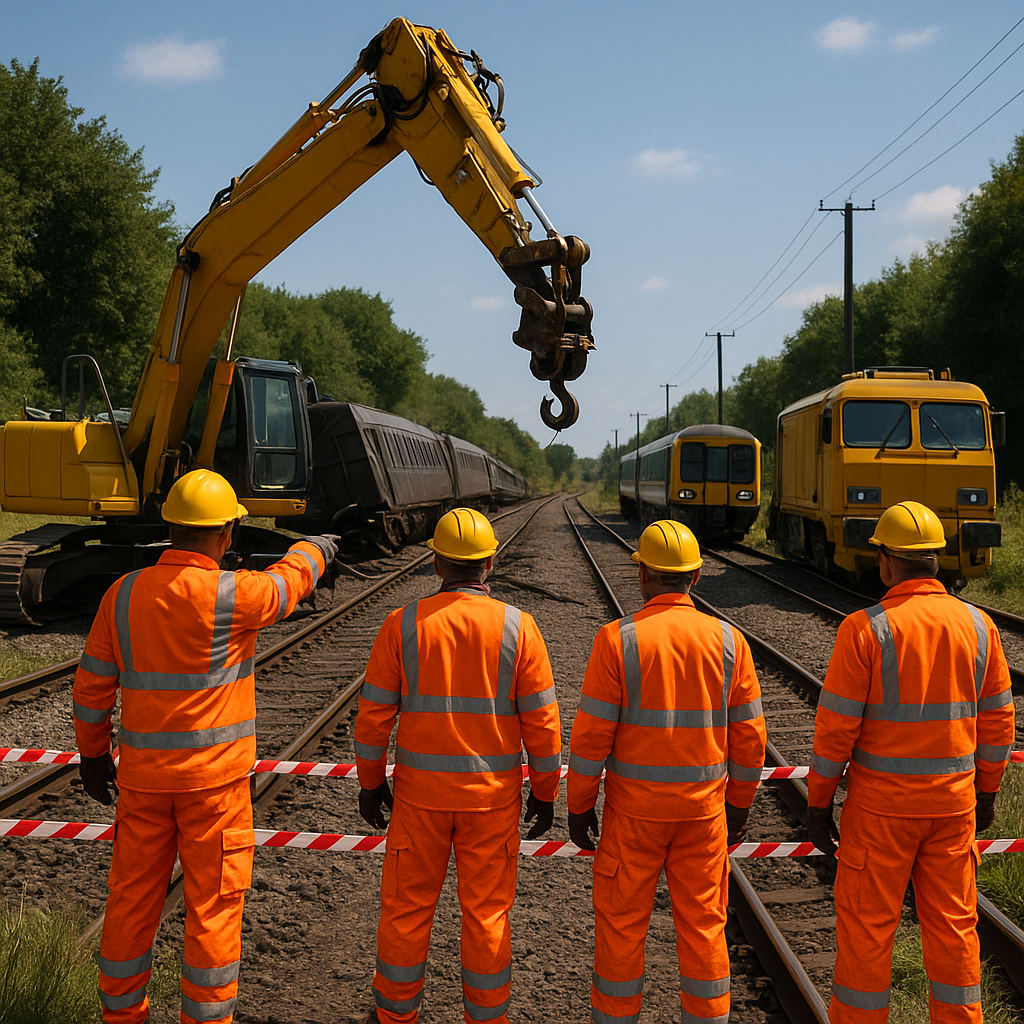
Two passenger train derailments in England within 24 hours prompt emergency response and service disruption
Narrative Snapshot
Across outlets, coverage converges on the severity of the first derailment near Lewes, with multiple sources describing overturned carriages. The South China Morning Post, The Hindu, and Clarín each report at least three cars or wagons on their sides, a detail echoed in the Associated Press dispatch carried by the Toronto Star. UK domestic reporting from the Guardian initially prioritizes operational impact and rapid response, emphasizing route closures rather than casualty figures.
Injury reporting diverges. Early accounts flagged the absence of official tallies even as eyewitnesses observed bleeding at the scene, as the South China Morning Post noted. Al Jazeera later quantified “at least 11” injured with two seriously hurt, while The Hindu similarly highlighted two severe injuries. Clarín reported “dozens” trapped, a claim not substantiated or repeated by the other outlets.
Causality remains uniformly unsettled. Both The Hindu and Clarín underline that the cause is unknown, with Clarín situating the incident against a backdrop of heat but still stressing the lack of an official explanation. The following day’s coverage by the Guardian and AP/Toronto Star explicitly frames a second derailment near Wickford as occurring a day after the Lewes incident, linking the two temporally without asserting a shared cause.
What Happened
A Southern Rail passenger service derailed near Lewes in East Sussex on 13 August 2026, just before 4pm, prompting a rapid deployment of paramedics, fire crews, and air support, and leading to the closure of several rail routes, according to the Guardian. Multiple outlets reported the train had flipped or that at least three carriages were overturned, with aerial footage showing emergency services attending to passengers in fields alongside the line, as detailed by the South China Morning Post and the Associated Press (via the Toronto Star). Initial reports noted no official injury figures, though an eyewitness saw bleeding, the South China Morning Post reported. Subsequently, Al Jazeera said at least 11 people were injured, two seriously, a point The Hindu reinforced by noting two severe injuries. The following day, a Greater Anglia train derailed near Wickford in Essex, described by the Guardian and AP/Toronto Star as the second derailment in two days. The cause of the first incident remained unknown, per The Hindu and Clarín.
Why It Matters
The incidents affected two different operators and corridors on consecutive days, disrupting Southern services near a tourist hub and later impacting the Greater Anglia network, as reported by the Guardian and AP/Toronto Star. The immediate policy relevance stems from the operational strain evidenced by route closures and the scale of the emergency response mobilized, including multiple ambulances and helicopters observed at the first scene, as the South China Morning Post described. International attention, reflected in coverage from Al Jazeera, The Hindu, and Clarín, underscores how casualty information and cause attribution shape external perceptions of safety and reliability.
For decision-makers responsible for rail operations and public communication, the back-to-back nature of events heightens the urgency of transparent injury reporting and timely service-restoration updates, both of which were focal points in coverage. With causes not yet identified, as The Hindu and Clarín noted, the informational gap leaves operators and authorities managing uncertainty while maintaining passenger confidence and continuity of service.
Diverging Narratives
Accounts diverge most clearly on the human toll. While early reporting emphasized the absence of official injury data, with the South China Morning Post noting no immediate official figures even as an eyewitness observed bleeding, Al Jazeera later reported at least 11 injuries with two serious, and The Hindu affirmed two severe injuries. Clarín’s assertion of “dozens” of passengers trapped is unique among the sources presented, not corroborated by UK or other international outlets cited here.
There is alignment that multiple carriages overturned, but emphasis differs: UK domestic coverage (the Guardian) foregrounded network disruption and the speed of the emergency response, while AP/Toronto Star, the South China Morning Post, and The Hindu centered visible severity—flipped cars, aerial footage, and on-scene medical activity. On causality, reporting is consistent in stating that the cause is unknown. Clarín situates the Lewes derailment against heat conditions yet still underscores the absence of an official explanation, a framing not echoed elsewhere. The second derailment is framed primarily by timing—“a day after” the first—without speculation about linkage, per the Guardian and AP/Toronto Star.
What Happens Next
Key uncertainties identified across reports will shape the next phase. First, official casualty tallies and condition updates could reconcile the gap between early accounts lacking formal figures and later reports of at least 11 injured with two serious, as carried by Al Jazeera and The Hindu. Second, authoritative statements on causation—currently unknown per The Hindu and Clarín—will determine whether the narrative remains incident-specific or shifts as new facts emerge.
Operationally, the reopening of closed routes noted by the Guardian and service adjustments following the second derailment flagged by AP/Toronto Star will signal the pace of normalization. Analysts should watch for operator and authority communications that either maintain the incidents as discrete events tied only by timing, as current coverage suggests, or introduce new information that changes that framing. Visual evidence and on-scene details highlighted by the South China Morning Post may also be supplemented by formal updates that clarify discrepancies in early reporting.