
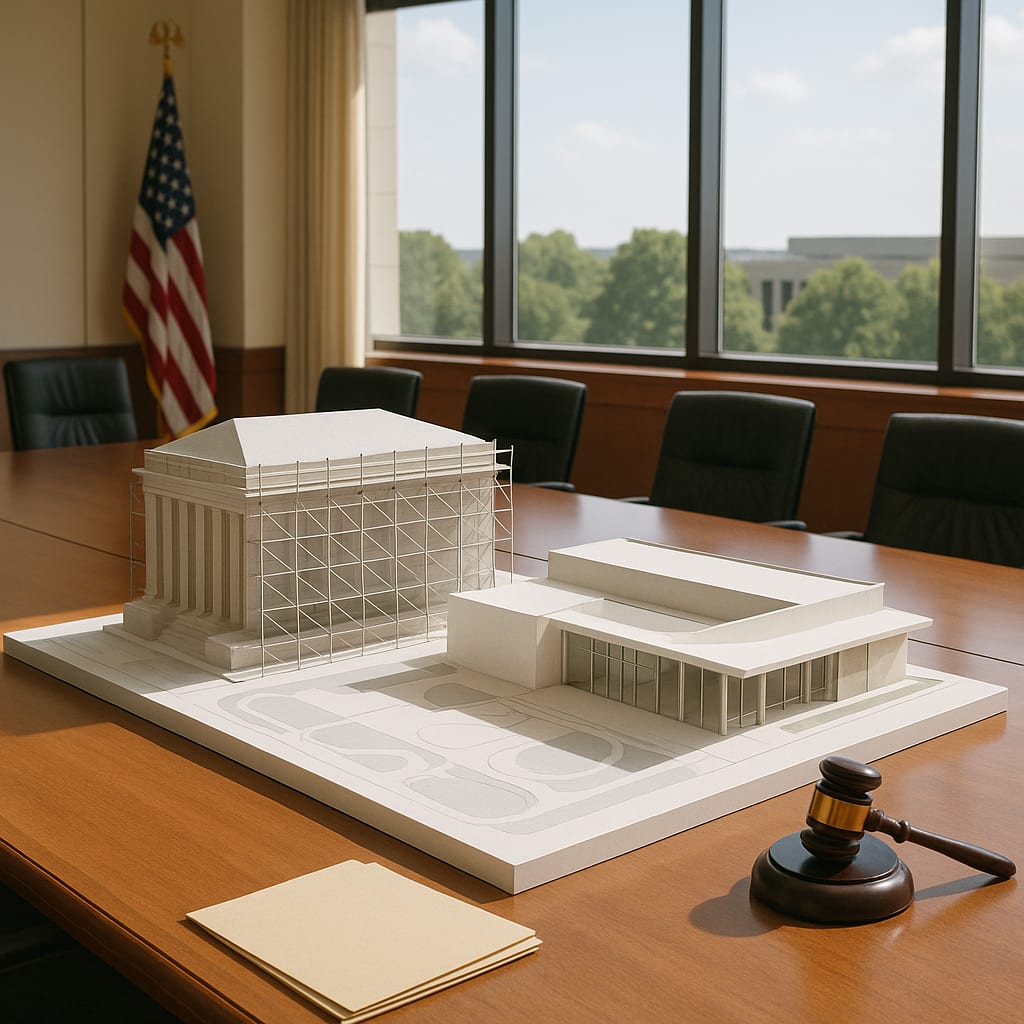
Kennedy Center board moves to restore Trump inscription and pursue two-year closure, prompting new court review
Narrative Snapshot
Across outlets there is broad agreement on the core actions: the Kennedy Center board voted to proceed with a two‑year closure for renovations and to add language crediting President Donald J. Trump on the building’s facade. Where they diverge is in framing and in the scope of reported steps. The New York Times and South China Morning Post emphasize that the board’s move will be tested again in federal court, while the Guardian adds that the Center must submit its plan to the judge within a week and highlights an operational carve‑out keeping the Reach open for limited programming.
Several outlets stress legal maneuvering. CBC reports the judge previously found the addition of Trump’s name illegal and blocked a two‑year closure; Deutsche Welle describes the new step as designed to circumvent that ruling, potentially triggering fresh litigation. RT likewise presents the latest vote as a workaround, recounting the prior renaming attempt struck down in May and the removal of Trump signage in June.
Only Fox News details a broader honors package and the board’s vote counts, reporting separate resolutions to name the grounds “President Donald J. Trump Plaza” and to add an endowment‑linked inscription if a fund reaches $100 million, alongside the inscription crediting Trump with the renovation. Al Jazeera English foregrounds political backlash among trustees, while the Guardian characterizes the board as largely aligned with the president and frames the Reach’s continued operation as an active memorial to John F. Kennedy.
What Happened
Trustees of the John F. Kennedy Center for the Performing Arts voted to proceed with a two‑year renovation shutdown and to add the inscription “Restored and Renovated by President Donald J. Trump” to the facade, according to CBC and the South China Morning Post, which cited trustee Rep. Joyce Beatty and her lawyers. The New York Times reports the decision will be reviewed by U.S. District Judge Christopher Cooper, who earlier faulted the board for not thoroughly evaluating the president’s plan. The Guardian adds the Center has until next week to present its plan and that the main building would close while the Reach remains open for limited programming. Fox News reports the board also seeks to name the grounds “President Donald J. Trump Plaza” and to inscribe a future endowment credit, and that Democrats Sen. Sheldon Whitehouse and Reps. Beatty and Rick Larsen opposed both measures. CBC notes Judge Cooper previously blocked the two‑year closure and found Trump’s name had been added illegally; RT reports the judge ruled the board lacked authority to alter the congressionally established name and that Trump signage came down in June.
Why It Matters
The dispute goes to the heart of governance for federally chartered cultural institutions: how far a presidentially influenced board can go in altering the identity or physical presentation of a center whose name and purpose are set by Congress. CBC and RT point to a judicial finding that the board lacks authority to change the congressionally established name, while the New York Times and Guardian note renewed judicial scrutiny of the board’s evaluation process. Deutsche Welle frames the action as an attempted end run that could entrench legal conflict over institutional naming, credit, and closure authority. Operationally, the Guardian’s account of a limited‑programming carve‑out at the Reach underscores near‑term continuity risks for Washington’s performing arts ecosystem during a prolonged closure. For decision‑makers, the case tests boundaries between executive‑aligned trustees and statutory mandates, with potential precedent for how donor or presidential credits can be displayed without crossing into de facto renaming.
Diverging Narratives
Outlets differ most on characterization and breadth of the board’s actions. Legal‑process‑focused coverage from the New York Times, the South China Morning Post, and CBC centers on the imminent return to Judge Cooper’s courtroom and his prior rulings against both the two‑year closure and the initial name addition. Deutsche Welle and RT sharpen that lens by describing the new inscription and related steps as a workaround designed to avoid the judge’s prohibition on altering a congressionally fixed name. RT alone provides a timeline of the December renaming vote, the May ruling, and June removal of signage.
Substantively, Fox News reports the most expansive honors package and provides vote counts, including plans to designate the grounds “President Donald J. Trump Plaza” and to add an endowment‑contingent inscription, details absent from other outlets. The Guardian emphasizes board alignment with Trump and an operational approach that keeps the Reach open as an active JFK memorial, while Al Jazeera English highlights condemnation by trustees. Together, these accounts surface unresolved questions that will drive the next phase: whether an inscription, plaza naming, and partial closure survive legal scrutiny distinct from a formal renaming, and how the court will assess the board’s process in light of its earlier critique.
What Happens Next
The immediate decision point is judicial review. The Guardian reports the Center must submit its plan to Judge Cooper within a week; the New York Times notes he previously faulted the board’s evaluation. Analysts should watch whether the court distinguishes between a prohibited renaming and permissible crediting language, and whether it accepts the operational plan to close the main building while keeping the Reach open.
A second track concerns the scope of honors. Fox News reports proposed steps to name the grounds “President Donald J. Trump Plaza” and to add an endowment‑linked inscription. Key indicators include whether trustees formally adopt these additional measures and whether plaintiffs or the court view them as functionally equivalent to renaming. Finally, funding and operations bear monitoring: Fox News cites a $100 million endowment threshold for additional inscription, and the Guardian notes limited programming plans at the Reach, both of which may influence judicial and stakeholder assessments of intent and impact.