
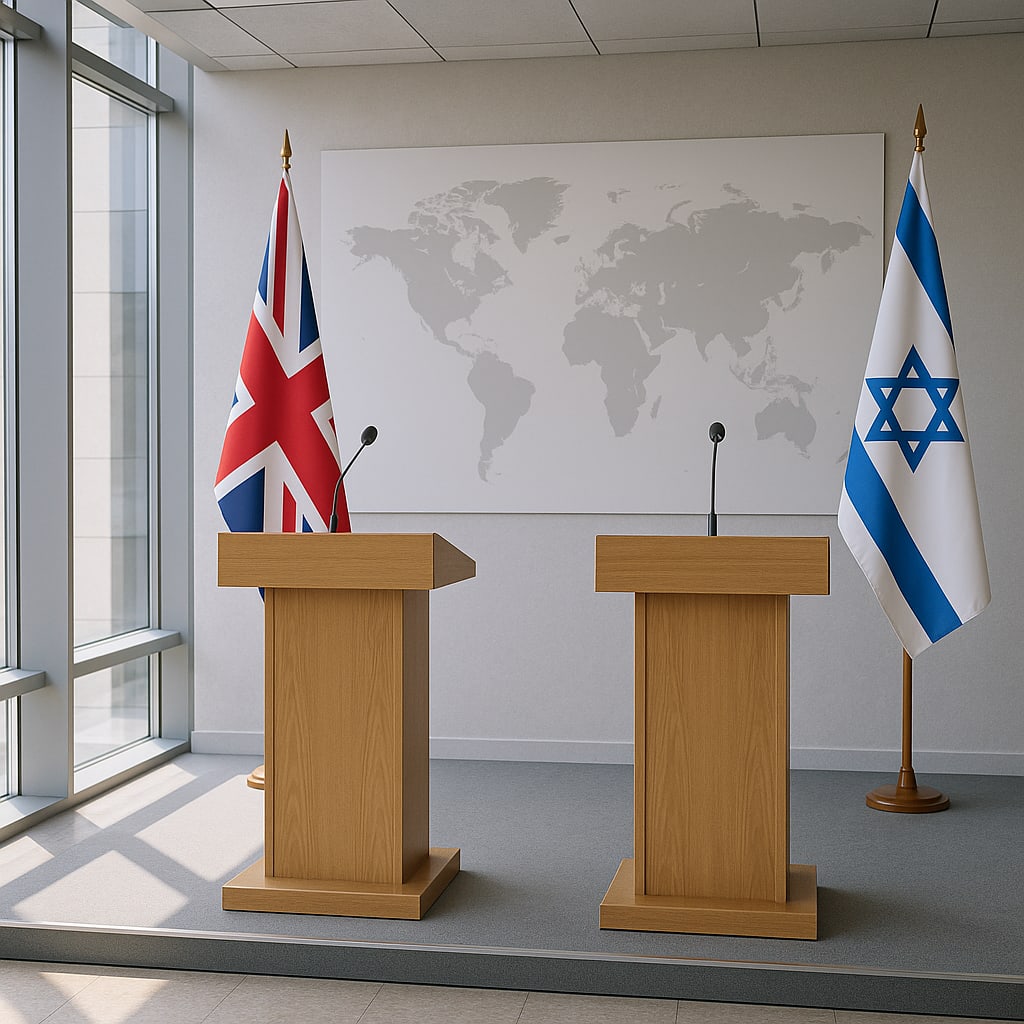
Netanyahu calls UK ‘Islamic Republic of Britain’ in Army Radio podcast; London labels remark ‘completely unacceptable’
Narrative Snapshot
Across outlets, the wording of Benjamin Netanyahu’s remark and the venue are uncontested, as is the linkage to a 2024 quip by U.S. Vice President JD Vance. Agreement also extends to the broader context of strain with the UK’s new Labour government, with multiple reports noting that London is weighing or preparing measures against Israel and that Downing Street has formally protested the comment.
The coverage diverges on emphasis and framing. The Guardian highlights criticism from an Israeli political rival and characterizes the line as playing into a far-right Islamophobic trope about Britain’s small Muslim population. Israeli outlets add distinct domestic angles: Haaretz situates the exchange within UK pressure over the Gaza war and West Bank settler violence, while the Times of Israel notes the podcast was reportedly recorded at a private studio tied to a Likud vendor rather than at Army Radio’s base.
Regional and state-linked outlets broaden the stakes. Middle East Eye presents the episode as an attack on a government that has historically provided arms, intelligence sharing, and diplomatic protection to Israel, and describes Israel’s actions in Gaza as genocide. Al Jazeera English underscores mounting bilateral tension. RT foregrounds the Labour government’s potential measures and supplies contextual data on UK Muslim demographics and Pakistan’s nuclear status to frame the “first Islamic republic with nuclear weapons” line.
What Happened
During an interview for Israel’s Army Radio published on 14 August 2026, Israeli Prime Minister Benjamin Netanyahu referred to the United Kingdom as “the Islamic Republic of Britain” and joked it could become the first “Islamic republic” with nuclear weapons, echoing a 2024 remark by U.S. Vice President JD Vance, according to Israeli and UK outlets. The Times of Israel reported the podcast was filmed at the studio of a Likud vendor rather than at Army Radio’s base. Haaretz noted Netanyahu made the quip while contrasting Israel’s efforts to prevent a nuclear-armed Iran with what he suggested the UK was becoming, amid new British Prime Minister Andy Burnham’s pledge to apply more pressure on Israel over the Gaza war and West Bank settler violence. On 15 August, the British government called the comment “completely unacceptable,” said it had raised the matter with Jerusalem, and an Israeli spokesman downplayed the remark as a Vance quote, the Times of Israel reported. RT and Middle East Eye said the UK’s Labour government is weighing or preparing measures, including sanctions, against Israel.
Why It Matters
The episode lands at a sensitive moment in UK–Israel relations. Haaretz reports Prime Minister Burnham has vowed to increase pressure on Israel over the Gaza war and settler violence, while RT and Middle East Eye indicate the Labour government is weighing or preparing measures, including sanctions. Middle East Eye stresses that this recalibration comes after years of British arms sales, intelligence sharing, and diplomatic backing, suggesting a potential shift in a historically supportive posture. The formal UK protest reported by the Times of Israel signals that rhetoric from Jerusalem can now carry direct diplomatic costs with a key European partner.
The exchange also intersects with Israel’s Iran messaging. As Haaretz recounts, Netanyahu juxtaposed efforts to prevent a nuclear-armed Islamic Republic of Iran with a quip about Britain, inviting scrutiny of how adversary-focused narratives are used in allied contexts. The Guardian’s framing of the remark as drawing on Islamophobic tropes introduces a norm-focused dimension salient for European governments. Together, these threads underscore a risk of accelerated policy distancing from London at a time when Israel faces mounting pressure over its conduct in Gaza and the West Bank.
Diverging Narratives
Outlets differ most on interpretation and consequence. The Guardian situates the remark within Islamophobic discourse and reports criticism from an Israeli political rival who accused Netanyahu of attacking an ally and presiding over a “horrific diplomatic failure.” By contrast, the Times of Israel’s follow-up centers on official reactions: London’s “completely unacceptable” rebuke and Jerusalem’s effort to contextualize the comment as a quotation of JD Vance. It also underscores a domestic procedural wrinkle by noting the podcast’s recording location at a Likud vendor’s studio.
Haaretz places the remark in a policy frame, tying it to Burnham’s stated intent to increase pressure over the Gaza war and settler violence. Middle East Eye emphasizes the asymmetry between Netanyahu’s attack and the UK’s record of support—arms, intelligence, and diplomatic protection—and characterizes Israel’s campaign in Gaza as genocide. RT sets the episode against the Labour government’s consideration of measures, while adding census-based figures on the UK’s Muslim population and noting that Pakistan—the Islamic Republic of Pakistan—has had nuclear weapons since the 1990s, challenging the “first” formulation. Al Jazeera English highlights the broader drift toward tension without adding prescriptive judgment. An unresolved question across accounts is how, if at all, the remark will alter UK decisions on sanctions or other measures.
What Happens Next
The primary inflection point is London’s policy response. Middle East Eye reports the UK is preparing sanctions, while RT says the Labour government is weighing measures; Haaretz and Al Jazeera describe intensifying pressure. Analysts should watch for formal UK announcements specifying instruments and scope, which would clarify whether the protest escalates into concrete penalties.
A second decision point is Israel’s diplomatic handling. According to the Times of Israel, an Israeli spokesman has downplayed the remark as a Vance quote. Further clarification or contrition could limit fallout, whereas additional rhetorical escalations may harden UK positions. Tracking statements from Netanyahu’s office and Israel’s embassy in London will indicate direction.
Domestically, the Times of Israel’s report about the Army Radio podcast being recorded at a Likud vendor’s studio raises a media-governance question. Any response from Army Radio or the IDF regarding venue protocols would signal whether this becomes a civil–military media issue, potentially affecting future government communications choices. Finally, additional UK–Israel diplomatic signals—such as further démarches—will indicate whether the dispute remains contained or widens into broader bilateral friction.