
Belgium: Construction Workers Unearth €9m Gold Cache on Job Site
Narrative Snapshot
Across outlets, the human-interest frame is prominent but unevenly weighted. UK and US coverage centers the 18-year-old worker, identified as Kobe, with first-person recollections of mistaking the hoard for €1 coins before recognizing a bar, lending vividness to an otherwise procedural story drawn from local broadcasters (The Guardian; Fox News). BBC’s account is notably spare by comparison, limiting itself to the basic discovery.
There is divergence on setting and physical context. Multiple reports situate the dig beneath or near a former brewery in Sint-Gillis-Dendermonde during sewer works (The Guardian; Fox News; Clarín, Aug 15). Others emphasize a residential property, locating the cache “in the walls of a cellar” or a house basement during renovation (BBC; Folha de S.Paulo). Spanish-language coverage goes further on inventory, citing “nearly 50” ingots and a bucket of coins or, more generally, “tens of ingots and hundreds of coins” (Clarín, Aug 15; Clarín, Aug 14), while Anglophone pieces largely avoid counts.
Legal handling is framed through different lenses. Fox News stresses compliance and chain-of-custody—immediate police notification and transfer to a “high-security federal government vault”—and asserts the workers do not get to keep the gold. Italian coverage entertains another pathway, reporting the trove would be distributed among the workers if unclaimed (La Repubblica). Argentine reporting foregrounds the underlying question—who is entitled to the find—without resolving it (Clarín, Aug 14). Monetary framing tracks audiences: €9m anchors the valuation, with conversions to dollars and reais where relevant (Fox News; Folha de S.Paulo).
What Happened
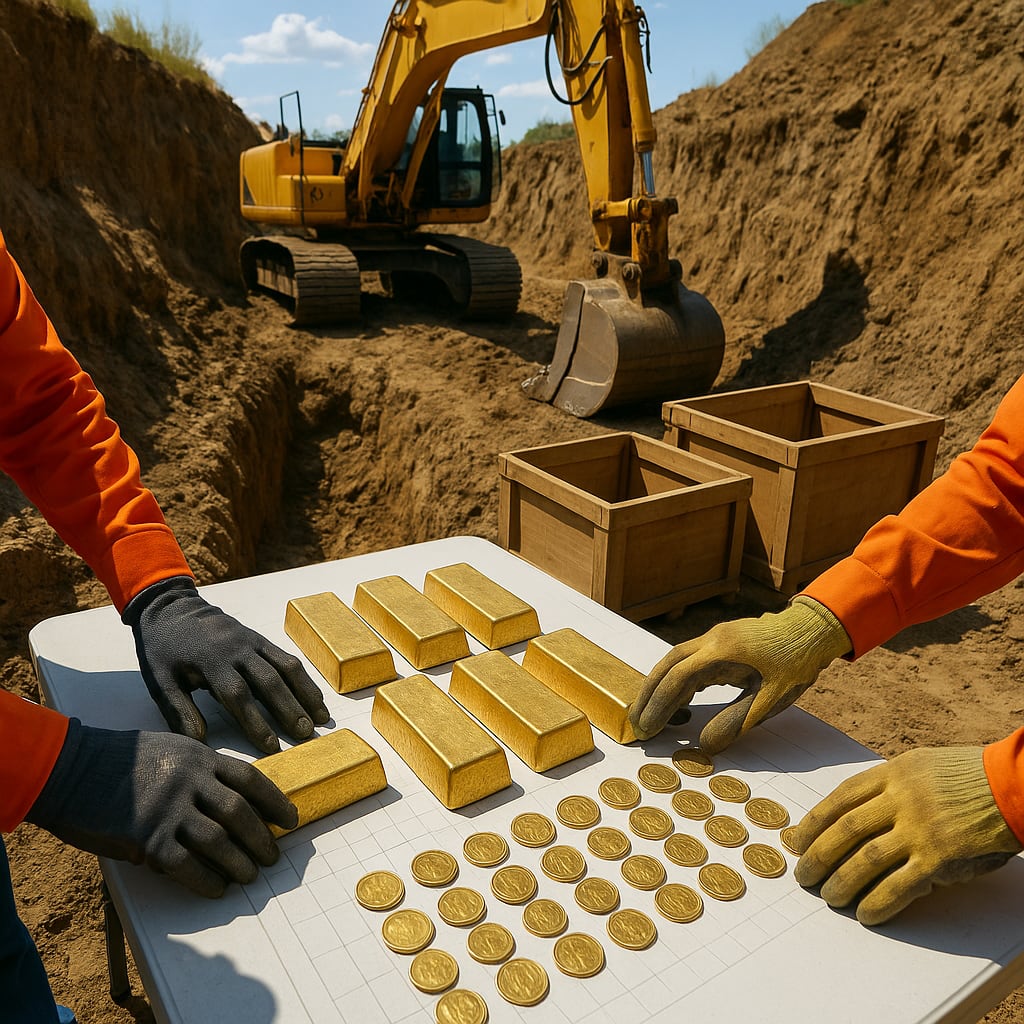
A construction crew in Sint-Gillis-Dendermonde, Belgium, uncovered a cache of gold during excavation work. Several outlets place the works beneath or adjacent to a former brewery as crews laid a new sewer, when an 18-year-old worker, Kobe, first spotted what he thought were coins before realizing one item was a gold bar (The Guardian; Fox News). Other accounts emphasize that the hoard was sealed within the walls of a cellar in a Belgian property during building works (BBC; Folha de S.Paulo). The trove consisted of coins and bars, with one report specifying nearly 50 ingots and a bucket full of coins and another referencing tens of bars and hundreds of coins (Clarín, Aug 15; Clarín, Aug 14). Local police cataloged the find and moved it to a high-security federal government vault (Fox News). Estimates place the value around €9 million (BBC; The Guardian; Clarín, Aug 15).
Why It Matters
The discovery tests how Belgian authorities operationalize rules for found treasure during public works and private renovations, from immediate reporting to secure custody. Coverage documents a clear procedural step—police cataloging and federal vault storage—suggesting institutional capacity to secure high-value finds (Fox News). At the same time, public-facing interpretations of entitlement vary, with some reporting that workers would not keep the gold and others that they may share it if unclaimed, and a broader debate flagged in Spanish-language media (Fox News; La Repubblica; Clarín, Aug 14). For policymakers and municipal project leaders, the case underscores the importance of clear guidance to contractors and temporary workers on notification protocols and rights. It also highlights the need for consistent public communication on ownership adjudication to maintain incentives for disclosure in infrastructure and renovation contexts that incidentally surface valuable or sensitive materials.
Diverging Narratives
Two factual contours are reported differently: where exactly the trove was embedded and the legal disposition if no claimant emerges. Location is variously described as a former brewery worksite during sewer installation (The Guardian; Fox News; Clarín, Aug 15) and as the walls of a cellar in a house under renovation (BBC; Folha de S.Paulo). Those accounts are not mutually exclusive—BBC links cellar walls with sewer works—but they emphasize different facets of the site. Inventory is similarly uneven: Spanish-language coverage quantifies ingots and coins, while other outlets keep to an aggregate valuation without counts (Clarín, Aug 15; Clarín, Aug 14).
On ownership, Fox News states the workers do not get to keep the find, whereas La Repubblica reports that, if unclaimed, it would be distributed among the workers. Clarín’s earlier report highlights that the discovery sparked a debate over rights without taking a position (La Repubblica; Fox News; Clarín, Aug 14). All agree authorities have physical custody, but the end-state—return to an owner, state retention, or worker distribution—remains unresolved within the reporting set.
What Happens Next
Two decision tracks will determine outcomes. First is provenance and claims assessment. Police have cataloged and secured the hoard in a federal vault, positioning authorities to evaluate any claimant’s evidence; a validated claim would resolve possession accordingly (Fox News). Absent a claimant, reported end-states diverge: some coverage indicates non-retention by workers, while another outlet reports potential distribution among them (Fox News; La Repubblica). Analysts should watch for formal statements from Sint-Gillis-Dendermonde police or Belgian federal authorities clarifying applicable rules and any claim window.
The second track is factual consolidation. Conflicting descriptions of the site and inventory suggest further official detail could narrow discrepancies. Confirmation of the exact location context and an authoritative inventory would inform jurisdictional responsibility and, potentially, the ownership framework. Public updates on catalog results, chain-of-custody documentation, and any announced legal proceedings would be key signals.