
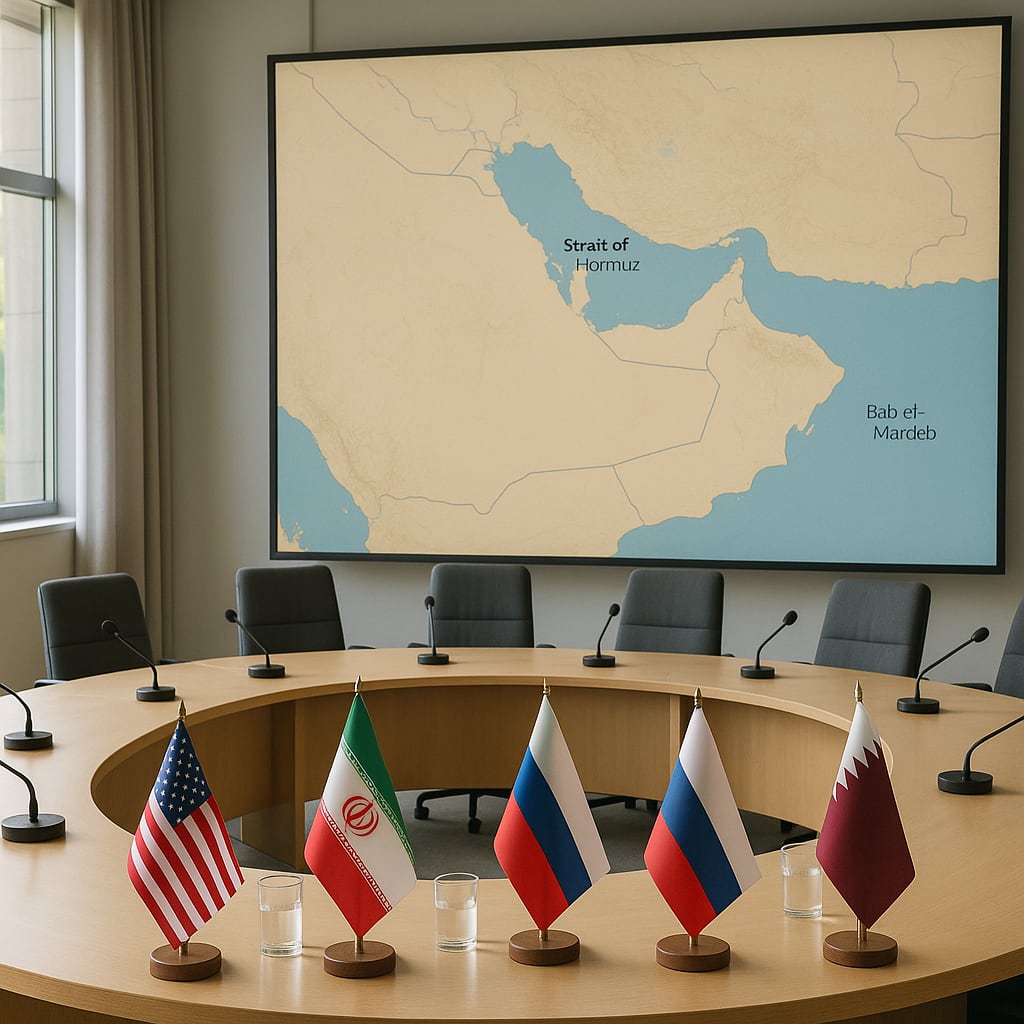
Tehran rebuffs Trump’s vow to claim the Strait of Hormuz as U.S. territory amid competing accounts of control and navigation
Narrative Snapshot
Across outlets, the center of gravity is not the statement itself but competing assertions of authority and the status of navigation. Iranian officials and media-aligned reporting foreground sovereignty claims: Kazem Gharibabadi’s insistence that only Iran can open or close the strait is carried by Middle East Eye and IRNA, while CGTN amplifies the army chief’s declaration that U.S. forces have been expelled from the Gulf and barred from returning. U.S. and European outlets emphasize Trump’s domestic framing—Haaretz highlights his appeal to accept high gas prices, and Le Monde notes he would “never apologize” for triggering war despite oil-price effects—contrasted with Iran’s dismissal of his remarks as “delusions,” reflected by NBC and Haaretz.
Where control on the water is concerned, accounts diverge sharply. Telesur reports Trump asserting a U.S. “blockade,” whereas the Bangkok Post characterizes the waterway as blockaded by Iran, and Qatar’s statements via TASS call for a return to pre-war conditions and immediate resumption of freedom of navigation in line with international law. Russia’s UN envoy, cited by Middle East Eye, blames U.S. “aggression” for having “ruined” navigation, while Argentina’s Clarín reports new drone attacks on Emirati tankers and a UAE accusation of Iranian piracy—pointing to contested facts and attribution at sea.
Several sources widen the aperture to a second chokepoint. Fox News frames escalating Houthi attacks in the Bab el-Mandeb, including reported fatalities on an Egyptian-owned vessel, as a growing strategic problem potentially prompting a U.S. posture shift along Africa’s Red Sea coast. Al Jazeera poses the feasibility question directly—“Can he?”—linking the declaratory threat to an unresolved war context and ongoing maritime disruptions rather than to an executable policy.
What Happened
At a rally in New York State, President Donald Trump said he would declare the Strait of Hormuz U.S. territory “after we finish defeating Iran,” adding that the United States was enforcing a blockade allowing no ships through without Washington’s approval, according to Telesur. Haaretz reported that he tied this to asking Americans to accept higher gas prices, and Le Monde noted he said he would “never apologize” for triggering the war with Iran despite oil market impacts. Iran’s deputy foreign minister Kazem Gharibabadi replied that only Iran can open or close the strait, as reported by Middle East Eye and IRNA, while NBC cited Tehran’s call for Washington to “accept the reality of defeat.” Russia’s UN envoy criticized U.S. policy for “ruining” freedom of navigation (Middle East Eye). Qatar, via TASS, urged a return to pre-war conditions and immediate restoration of navigation. Clarín reported drone attacks on two Emirati ADNOC ships, with the UAE accusing Iran of piracy. CGTN quoted Iran’s army chief saying U.S. forces have been expelled from Gulf waters. Al Jazeera questioned the plausibility of Trump’s territorial claim, and Fox News detailed lethal Houthi attacks intensifying risk at Bab el-Mandeb.
Why It Matters
The episode concentrates several structural pressures on maritime order. First, it spotlights the collision between unilateral claims and widely invoked navigation norms, with Qatar publicly anchoring its position in international law and calling for a reset to pre-war conditions (TASS). Second, cross-theater spillover is evident: Fox News’ reporting on Bab el-Mandeb underscores how a second chokepoint, influenced by Iran-aligned Houthis, can compound risk even as Hormuz remains contested. Third, external actors are staking positions that will shape any multilateral response: Russia’s UN envoy attributes navigation disruption to U.S. “aggression” (Middle East Eye), signaling a contentious Security Council environment, while Gulf messaging prioritizes de-escalation and reopening of sea lanes (TASS).
For decision-makers, the combination of declaratory escalations (Telesur, Le Monde, Haaretz) and active incidents at sea (Clarín; Fox News) raises operational and legal questions about escorts, rules of engagement, and coalition coordination, with oil market exposure explicitly invoked by U.S. and European coverage.
Diverging Narratives
The starkest split concerns control and coercion. Trump’s claim of a U.S. “blockade” (Telesur) contrasts with the Bangkok Post’s portrayal of the strait as blockaded by Iran and with Tehran’s assertion that it alone can determine Hormuz’s status (Middle East Eye; IRNA). Russia’s envoy argues U.S. actions destroyed navigation freedom (Middle East Eye), while Clarín reports the UAE accusing Iran of piracy after drone strikes on Emirati tankers, reflecting competing attributions for maritime insecurity. Qatar’s call to avoid using Hormuz as political pressure and to restore navigation (TASS) implicitly distances GCC messaging from either maximalist stance.
Legal authority and feasibility are also contested. Al Jazeera questions whether a U.S. territorial claim is even possible, while Le Monde and Haaretz emphasize Trump’s political framing and tolerance for economic costs, not legal grounding. Iran’s messaging, including the army chief’s assertion that U.S. forces are expelled and barred from return (CGTN), seeks to establish a deterrent narrative. Simultaneously, Fox News highlights a widening theater of risk at Bab el-Mandeb, where Houthi attacks and reported fatalities suggest the limits of naval power alone and raise questions about alternative basing and partnerships along the Red Sea coast.
What Happens Next
Key decision points emerge on four fronts. First, any follow-through on Trump’s stated intent to declare Hormuz U.S. territory, including the reported plan for a ceremony (Haaretz; Telesur), will signal whether the threat remains rhetorical or shifts into formal policy, which Al Jazeera already questions on feasibility grounds. Second, Iranian enforcement behavior bears watching: officials claim sole authority over the strait (Middle East Eye; IRNA) and say U.S. forces are expelled (CGTN); evidence of operational rules, closures, or interdictions would clarify intent. Third, navigation conditions will be shaped by incident patterns and attribution—drone strikes on ADNOC ships and UAE piracy accusations (Clarín) versus Qatar’s push to restore freedom of navigation and return to pre-war status (TASS). Fourth, spillover at Bab el-Mandeb could drive U.S. posture adjustments, with Fox News citing consideration of deeper ties along Africa’s Red Sea coast; concrete basing or access agreements would mark that shift.