
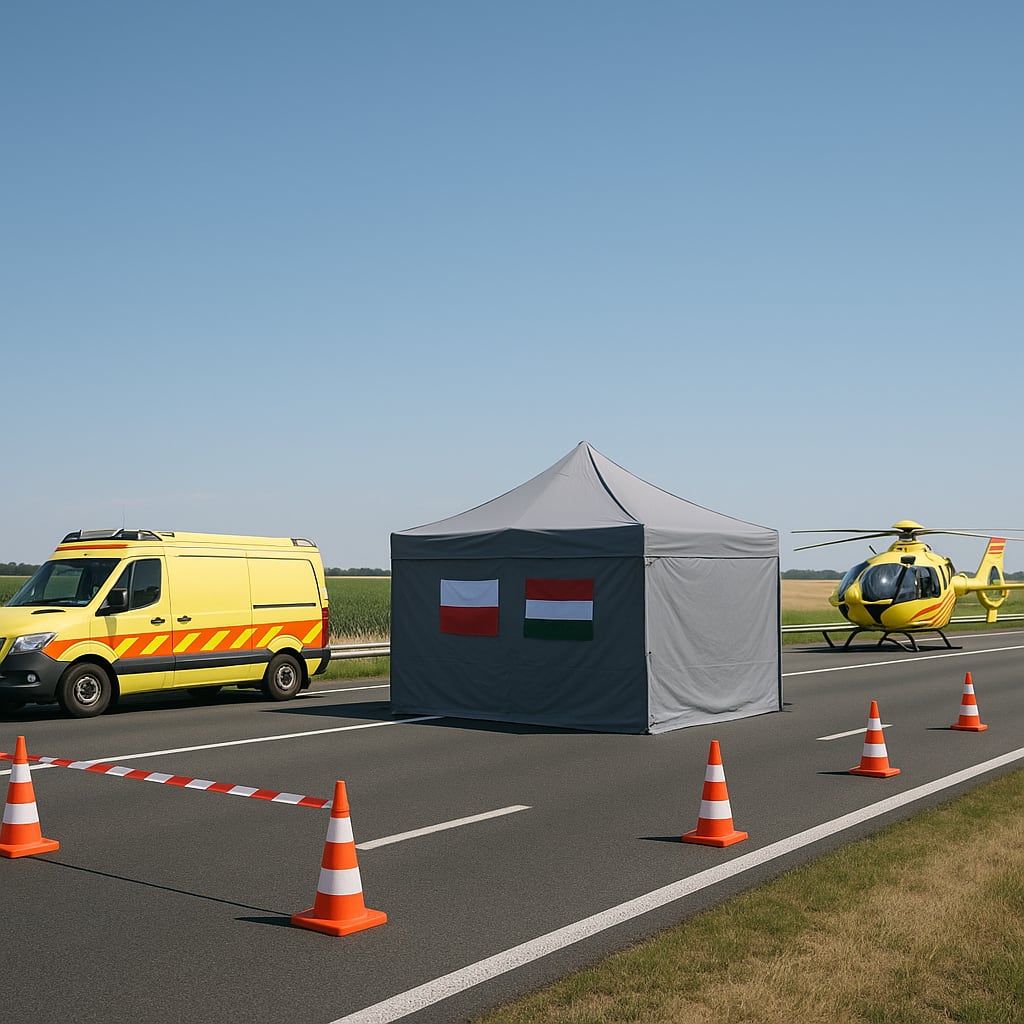
Twelve killed, at least 10 injured as Poland-registered tourist bus overturns on Hungary’s M3 motorway
Narrative Snapshot
Across outlets, the basic contours of the crash are consistent: a Poland-registered bus carrying Polish nationals left the M3 motorway near Mezőkeresztes in eastern Hungary, overturned in a roadside ditch, and resulted in 12 deaths with at least 10 people seriously injured, as reported by The Hindu, Al Jazeera English, France24, and CBC News. Several outlets add legal and political dimensions. Deutsche Welle and CBC say the driver was arrested or taken into custody, while La Repubblica and ANSA note Prime Minister Viktor Orbán publicly labeled it a “tragic incident.” France24 underscores scale and response, calling it the worst such crash in over two decades and reporting Prime Minister Donald Tusk’s plan to dispatch a Polish emergency aircraft to Budapest.
Where outlets diverge is in characterizing the passengers and journey, the injury toll beyond the immediate 10, and the probable cause. The Guardian and Deutsche Welle describe the group as pilgrims, even as other reports refer to tourists; Le Monde says the bus traveled from Serbia to Poland, whereas The Guardian says it was returning from Bosnia and Herzegovina. The BBC’s reference to “dozens more” seriously injured sits against multiple reports specifying 10 serious injuries. On causation, The Guardian cites early indications the driver likely fell asleep, echoed by the South China Morning Post’s reference to a police statement, while other outlets refrain from attributing cause.
What Happened
Hungarian police said a Poland-registered tourist bus ran off the M3 motorway near Mezőkeresztes around 1 a.m. local time on Sunday, overturning in a ditch and killing 12 people while injuring at least 10 others (The Hindu; Al Jazeera English; The Guardian; France24). CBC News and the South China Morning Post place the site roughly 140 kilometers east of Budapest, and local police described the vehicle as having “gone off the straight road into a ditch and overturned” (The Guardian). The driver survived and was taken into custody, with Deutsche Welle reporting an arrest and CBC noting he was held by police. Le Monde cites Hungary’s disaster management office saying the coach carried 57 passengers and two drivers, traveling between the Balkans and Poland, while The Guardian and Le Monde differ on whether it was returning from Bosnia and Herzegovina or transiting from Serbia. Orbán called it a tragic incident, and Poland’s Donald Tusk said an emergency aircraft would be sent to Budapest (La Repubblica; ANSA; France24).
Why It Matters
The incident has immediate cross-border implications: the victims are Polish nationals on a Poland-registered bus in Hungary, and Warsaw’s dispatch of an emergency aircraft to Budapest underscores the need for rapid bilateral coordination in medical evacuation, consular support, and victim repatriation (France24). The reported arrest or custody of the driver suggests Hungarian authorities are moving quickly on the legal track, while parallel official messaging by Orbán signals high-level political attention to the consequences (Deutsche Welle; CBC News; La Repubblica; ANSA). Several outlets frame the crash as Hungary’s deadliest of its kind in more than 20 years, indicating a likely focal point for national road-safety scrutiny and public accountability (La Repubblica; France24). For decision-makers, the combination of mass casualties, a transnational itinerary through the Balkans, and divergent early indicators on cause points to the practical demands of multinational crisis response even as investigative findings are still forming.
Diverging Narratives
Key uncertainties center on the journey profile, the injury count beyond the initial 10, and causation. Le Monde reports the coach was traveling from Serbia to Poland with 57 passengers and two drivers, while The Guardian states it was returning from Bosnia and Herzegovina. Both accounts place the bus on a regional route linking the Balkans to Poland, but they give different origin points. On casualties, multiple outlets specify 10 people seriously injured alongside the 12 fatalities (The Hindu; Al Jazeera English; The Guardian; France24; CBC News), whereas the BBC says “dozens more are seriously injured,” implying a higher tally. Regarding cause, The Guardian cites early reports that the driver probably fell asleep, and the South China Morning Post attributes a similar assessment to police, but other outlets refrain from assigning a cause. Characterization of the passengers also varies: Deutsche Welle and The Guardian refer to pilgrims, while several sources describe tourists, a distinction with potential implications for consular and ecclesiastical community responses.
What Happens Next
Two decision points emerge from reported positions. First, Hungarian authorities’ investigation will determine formal findings on cause and any charges; outlets noting the driver’s custody or arrest and the early suggestion of fatigue place the focus on forensic reconstruction and driver responsibility, with official confirmation or revision of preliminary assessments being the critical signal (Deutsche Welle; CBC News; The Guardian; South China Morning Post). Second, Poland’s deployment of an emergency aircraft indicates planned cross-border medical and consular operations; the scale and timing of evacuations and assistance will depend on Hungarian coordination and the evolving injury assessments (France24). Analysts should watch for authoritative casualty updates resolving the “10 serious” versus “dozens” discrepancy, definitive statements reconciling the route origin accounts from Le Monde and The Guardian, and whether Hungarian officials, amid characterizations of the crash as the worst in decades, announce any broader public-safety messaging or measures (La Repubblica; France24).