
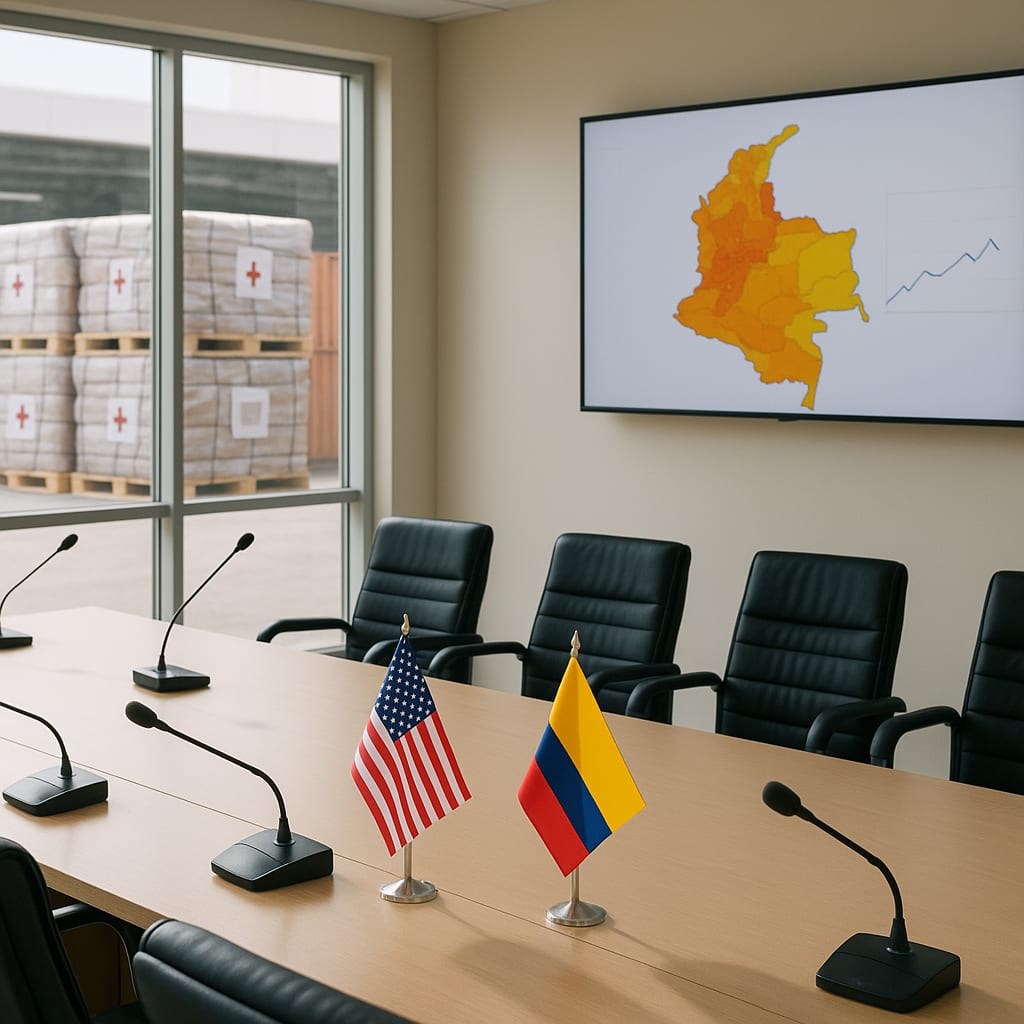
Colombia’s president asks Trump to suspend U.S. tariffs as earthquake recovery begins
Narrative Snapshot
Coverage converges on the request for tariff relief and the recent uptick in U.S. duties, while outlets differ in what they foreground as context. South China Morning Post, Le Monde, and Telesur English emphasize the mechanics—tariffs rose from 10 percent to 12.5 percent in late July, with exceptions including coffee and oil—placing the bilateral ask in a trade-policy frame. Al Jazeera adds the only reconstruction cost figure, reporting an expected $6.4 billion bill, treating tariffs as a renewed pressure point on an already strained economy.
Other reporting centers the human toll and operational realities: France24 highlights at least 300 deaths and names Cali and Pereira among the hardest-hit cities; Toronto Star/AP cites at least 289 deaths. Clarin stresses presidential messaging that pairs thanks for U.S. humanitarian assistance with the argument that tariff relief would speed recovery, framing the U.S. alliance as necessary for reconstruction.
What Happened
Colombia’s new president, Abelardo de la Espriella, asked U.S. President Donald Trump to suspend tariffs on Colombian goods as the country responds to a deadly earthquake. He said on X that he spoke with Trump for ten minutes, thanked him for economic aid and U.S. rescue teams, and urged a temporary halt to “high” duties to ease pressure on affected businesses (Telesur English; Clarin). The request follows a late-July increase in U.S. tariffs on most Colombian products from 10 percent to 12.5 percent, with exemptions for items such as coffee and oil (South China Morning Post; Le Monde; Telesur English, which dates the change to July 24). Fatality estimates reported by outlets range from at least 289 to about 300, with rescue operations ongoing and significant damage in cities including Cali and Pereira (Toronto Star/AP; France24; Le Monde). Al Jazeera reports reconstruction is expected to cost about $6.4 billion.
Why It Matters
The appeal links disaster response to trade policy, testing whether a close bilateral relationship can translate into rapid, temporary market access relief. The tariff shift in late July—exempting coffee and oil but covering many other exports—intersects with a shock that Telesur English reports has triggered an “economic emergency” and a new “miracle fund” to channel domestic and international resources into rebuilding hospitals, schools, roads, airports, and other infrastructure. Al Jazeera’s $6.4 billion reconstruction estimate underscores the scale at stake for fiscal and external financing. For U.S.–Colombia ties, the episode probes the elasticity of tariff policy in crisis conditions and the extent to which humanitarian cooperation, already noted through U.S. rescue support, extends into trade measures (Clarin; Telesur English). For multilateral and donor actors, Colombia’s emergency mechanisms signal a centralized vehicle for aid absorption that could shape coordination with trade partners.
Diverging Narratives
Outlets align on the core facts of the request and the late-July tariff increase, but they diverge in emphasis and framing. Trade-focused pieces specify the rate change and sectoral carve-outs: South China Morning Post and Le Monde note the move from 10 to 12.5 percent with exceptions for coffee and oil; Telesur English gives the date of July 24 and reproduces the president’s appeal for “temporary” suspension. Al Jazeera characterizes the duties as “renewed U.S. tariffs” and is alone in advancing a $6.4 billion reconstruction figure, sharpening the economic stakes.
Human-impact coverage varies in detail and counts. France24 cites at least 300 deaths and names Cali and Pereira; Toronto Star/AP reports at least 289; Telesur English’s earlier dispatch recorded 265 dead alongside hundreds missing and thousands injured as of August 13, indicating evolving tallies. Clarin places diplomatic tone at the center, highlighting thanks for U.S. aid and describing the U.S. alliance as a necessity for reconstruction—language less pronounced in other outlets that keep to procedural or casualty updates.
What Happens Next
Two decision tracks emerge. First is Washington’s choice on tariff suspension: De la Espriella requested a temporary halt to the late-July increase; any U.S. move to pause or modify duties—whether across-the-board or limited to sectors not already exempted, such as those outside coffee and oil—would directly affect Colombian exporters identified in SCMP, Le Monde, and Telesur English. Analysts should watch for White House or USTR statements and Federal Register notices signaling action or inaction.
Second is Bogotá’s deployment of emergency authorities. Telesur English reports the activation of an economic emergency and a “miracle fund” to finance public infrastructure recovery; subsequent decrees, funding inflows, and project prioritization will reveal implementation capacity. Ongoing rescue operations and updated damage assessments, including whether Al Jazeera’s $6.4 billion estimate is revised, will shape both the domestic fiscal response and the urgency of the tariff request. Continued U.S. humanitarian support, referenced by Clarin and Telesur English, is another indicator of bilateral engagement intensity.