
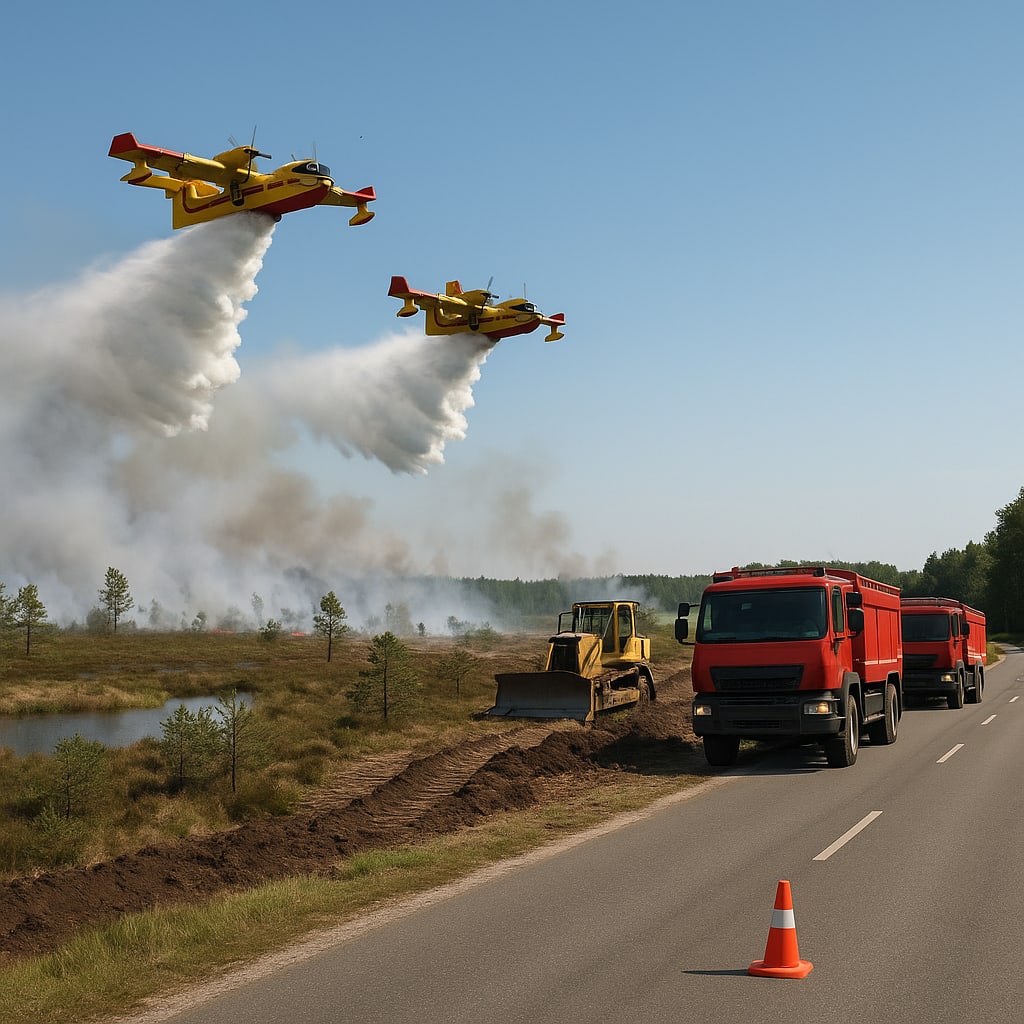
EU aircraft join effort as Belgium battles record High Fens wildfire; evacuations near German border
Narrative Snapshot
Across outlets, the scale and location are uncontested: multiple reports call it Belgium’s largest wildfire in modern history or on record, burning in the High Fens reserve near the German border and triggering evacuations. France24 emphasizes shifting winds and extreme heat complicating operations, while the Japan Times highlights the peatland and pine-forest ecology that makes suppression difficult. Asian and European outlets converge on the operational frame: hard-to-access terrain, surging fire growth over 24–48 hours, and the critical role of aerial support.
Numbers and emphasis vary. CGTN and France24 report more than 2,700 hectares burned by late Saturday, with CGTN citing EU aircraft deployments and European Forest Fire Information System data comparing the blaze to a 2011 benchmark. The Japan Times puts the total at roughly 3,000 hectares by Sunday; an AP account in the Toronto Star notes more than 27 square kilometers. Evacuation figures range from “hundreds” (France24) to 600 (Al Jazeera), and Deutsche Welle adds that some residents in Germany’s Monschau were evacuated even as authorities kept the fire from crossing the border.
Coverage from Canada and Asia situates the incident within a broader season of simultaneous fires and constrained aerial resources. CBC reports surging demand on the Canadair water-bomber manufacturer amid North American and European wildfires, while the Toronto Star highlights concurrent Indonesian blazes. The through-line is operational capacity: Belgium’s reliance on EU reinforcements and cross-border crews appears as a test of pooled European response at a time of widespread fires and heat-related stress, with DW separately noting low river levels affecting German shipping.
What Happened
The fire broke out Friday in the High Fens nature reserve in eastern Belgium and expanded rapidly in difficult, boggy terrain. Regional authorities mobilized more than 250 firefighters and emergency personnel overnight into Sunday, with reports of army and local farmers assisting on the ground. By Saturday afternoon, officials in Liège province said the burn area had reached 2,700 hectares, up from 1,600 earlier that day, and by Sunday some outlets reported roughly 3,000 hectares affected. EU reinforcements arrived with three helicopters and two water-bomber aircraft to provide crucial air support. Belgian villages received evacuation orders, with hundreds of residents—about 600 in some accounts—leaving as winds shifted and smoke spread; tourists and a children’s summer camp also departed the area. On the German side, authorities evacuated parts of Monschau, but the fire had not crossed the border as of Sunday.
Why It Matters
The incident is a live test of Europe’s ability to surge assets across borders under heat-stressed conditions. Multiple outlets report EU aircraft and crews augmenting Belgium’s response, while firefighters from Germany and Luxembourg support containment—an operational expression of European solidarity with immediate cross-border implications for public safety. The blaze’s setting in peatlands underscores a specific suppression challenge: smoldering, hard-to-access terrain that can tie down resources and extend campaign timelines.
Capacity constraints feature in the background. CBC’s reporting on global demand for water bombers suggests a tight market for aerial firefighting assets as North America and Europe confront parallel wildfire seasons. Deutsche Welle’s note on low river levels and potential shipping shortfalls in Germany points to climate-related stressors compounding emergency management and economic planning. EFFIS-based comparisons establishing this fire as Belgium’s largest on record add a data-driven reference point likely to inform future national and EU-level preparedness, asset pre-positioning, and mutual aid planning.
Diverging Narratives
Discrepancies are largely about scale and pacing rather than direction. CGTN and France24 cite 2,700 hectares burned by late Saturday, while the Japan Times reports roughly 3,000 hectares by Sunday; an AP account in the Toronto Star uses a square-kilometer figure consistent with those tallies. Evacuation estimates vary, with “hundreds” in several European reports and 600 in Al Jazeera’s account. These gaps reflect different update cutoffs and official releases rather than contradictory facts.
Outlets also weight risk differently. Deutsche Welle foregrounds the German angle—partial evacuations in Monschau and the border remaining intact—whereas Al Jazeera and France24 stress the fire’s spread toward German towns amid heat and shifting winds. Asian coverage (SCMP, Bangkok Post) emphasizes access challenges and the doubling of the burn area over 24 hours, sharpening the argument for air support. CGTN provides the most detailed equipment and benchmarking data, including EFFIS figures and a comparison to 2011. North American reporting widens the aperture to aerial asset supply and concurrent international fires, positioning the Belgian incident within a broader season of demand on limited fleets rather than focusing solely on local operations.
What Happens Next
Three decision points will shape the trajectory. First, border containment: Deutsche Welle reports the fire had not crossed into Germany; if Belgian and German crews hold that line, evacuations may stabilize on the German side, whereas a breach would trigger cross-border suppression priorities and expanded relocations. Second, aerial asset sufficiency: CGTN and France24 describe EU aircraft already engaged. Additional EU deployments—or, conversely, drawdowns due to competing fires—would signal the operational ceiling for rapid reinforcement at a time of elevated global demand noted by CBC. Third, evacuation and access management in peatland terrain: SCMP and Bangkok Post stress hard-to-reach areas; if ground crews can secure perimeters despite access constraints, authorities may shift from reactive evacuations to phased returns, while persistent hotspots would prolong restrictions.
Analysts should watch official burn-area updates from Liège province, any requests for further EU assets, reports on wind and heat shifts affecting flight operations, and German local advisories around Monschau as indicators of whether the incident moves toward containment or escalates across the border.