
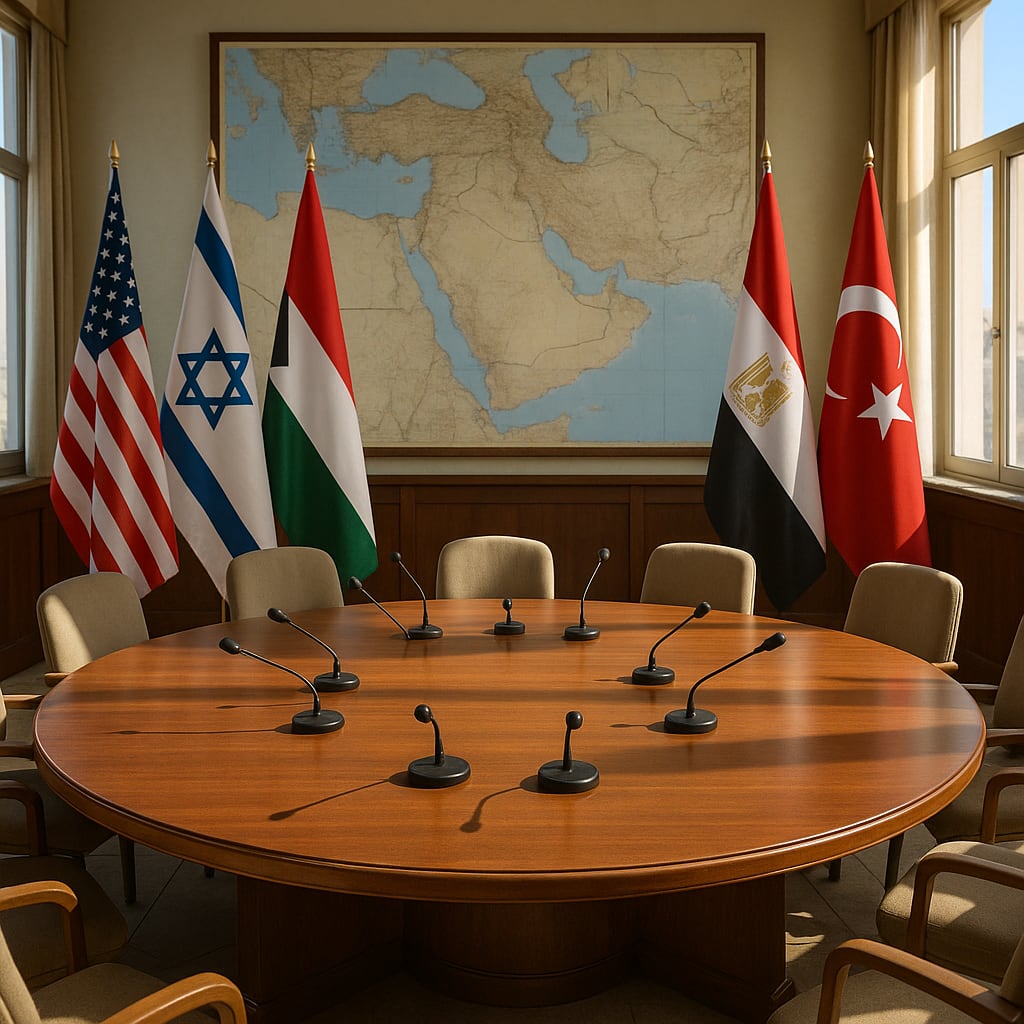
Hamas asks US-backed Board of Peace to compel Israeli compliance as Kushner meets Hamas and mediators in Cairo
Narrative Snapshot
Across outlets, there is broad agreement that Jared Kushner and Trump’s Gaza envoy Nickolay Mladenov held rare, direct talks with Hamas representatives in Cairo alongside Egyptian, Qatari, and Turkish mediators, and that Hamas publicly appealed to the US-backed Board of Peace and mediators to press Israel to implement agreed steps. Chinese and Hong Kong coverage concentrates on the mechanics and sequencing of the 15-point roadmap—immediate cessation of military operations, Hamas disarmament, Israeli withdrawal, and governance by a technocratic Palestinian administration—while noting concurrent Israeli airstrikes.
Israeli and Western reporting foreground continued Israeli operations and political resistance in Jerusalem. Netanyahu has already rejected the US plan as “unacceptable,” and Israeli officials are cited as wary of US pressure to halt targeted killings of Hamas militants. In contrast, Iranian and Qatari-linked outlets amplify Hamas’ claims of Israeli violations and its approval of the plan’s next phase, while RT—citing Axios—highlights Hamas’ reaffirmation of a demilitarization pledge conditioned on Israeli withdrawal and a permanent ceasefire.
Regional diplomacy also figures differently. European and Gulf coverage note that the United Arab Emirates and Saudi Arabia criticized Israel’s rejection as US envoys consulted in Cairo, whereas Israeli and Russian reports stress Washington’s limited leverage and the domestic political headwinds facing Netanyahu ahead of elections. What is most at stake across the coverage is the credibility of a ceasefire-to-disarmament sequence under an external guarantor and whether Israeli security doctrine—particularly targeted strikes and conditions for withdrawal—can be reconciled with that sequence.
What Happened
Hamas said it asked the US-backed Board of Peace and mediators to compel Israel to implement obligations under the ceasefire roadmap’s first phase and approve the second phase, as Trump’s envoys met Hamas and regional intermediaries in Cairo. Multiple outlets report Kushner and Gaza envoy Nickolay Mladenov conferred with Egyptian, Qatari, and Turkish mediators, with Hamas officials present at parts of the talks. A Palestinian source told Al Jazeera that Hamas briefed Kushner on alleged Israeli violations; Kushner was cited as rejecting any displacement of Gaza’s residents. Israeli airstrikes in Gaza continued, and an Israeli official expressed concern over a US demand to end targeted assassinations. Netanyahu, who previously deemed the US 15‑point roadmap “unacceptable,” was due to meet Kushner. Iranian and Chinese outlets reported Hamas’ approval of the roadmap’s second phase, while RT, citing Axios, said Hamas reaffirmed willingness to demilitarize in exchange for Israeli withdrawal and a permanent ceasefire.
Why It Matters
This episode tests whether an externally guaranteed ceasefire-to-disarmament framework—anchored by a US-backed Board of Peace and regional mediators—can override entrenched vetoes in Israeli and Palestinian politics. The reported contours of the plan would shift Gaza’s security and civilian governance to a technocratic Palestinian administration as Israeli forces withdraw, requiring Hamas to cede arms and Israel to curtail targeted killings and other operations. Israeli press and Haaretz note Washington’s leverage may be constrained, especially ahead of Israel’s October elections, raising questions about the enforceability of US conditions.
Regionally, Egypt, Qatar, and Türkiye are positioned as implementers, while Gulf Arab statements condemning Israel’s rejection indicate a broader Arab stake in de-escalation. If Hamas’ stated acceptance of a second phase and a demilitarization pathway under external guarantees holds, it would test whether non-state actors can transition via phased compliance rather than comprehensive surrender—an important precedent for conflict termination templates in the region.
Diverging Narratives
Hamas frames the impasse as Israeli noncompliance with the first-phase obligations and seeks guarantor intervention; it publicly accepts the roadmap’s next phase and, per RT’s relay of Axios, reiterates readiness to demilitarize if Israel withdraws and a permanent ceasefire is secured. Russian state media simultaneously notes Hamas has not disclosed detailed terms. Chinese and Hong Kong outlets emphasize a structured, mediator-driven implementation process and highlight US assurances against displacement, portraying a technocratic transition as the endpoint.
Israeli and UK reporting underscores continued Israeli strikes and official anxiety about US requests to halt targeted assassinations, situating the talks within Israel’s hard security lens. Netanyahu’s prior rejection—no pullback until Hamas surrenders and opposition to a Palestinian state—frames the deal as politically untenable in Jerusalem, a view echoed in analyses of domestic electoral pressures. Iranian coverage characterizes Israel’s campaign in maximalist terms while affirming Hamas’ approval of the plan’s second phase. European and Gulf coverage point to regional displeasure with Israel’s stance during active US shuttle diplomacy. These accounts diverge on feasibility and sequencing—whether disarmament must precede Israeli pullback, proceed in lockstep, or is unattainable without a broader political outcome.
What Happens Next
The immediate decision point is Netanyahu’s response to US pressure in the scheduled meeting with Kushner. If Israel signals willingness to adjust tactics—especially on targeted assassinations—and accept initial steps toward withdrawal tied to verifiable Hamas moves, mediators could activate the second-phase roadmap Hamas says it has approved. If Israel maintains rejection, sustained air operations and a stalled roadmap are likely, which mediators will read through any change in strike tempo or public redlines from the Prime Minister’s Office.
A second hinge is whether Hamas undertakes “tangible steps” on disarmament, as relayed by RT from Axios, to trigger reciprocal Israeli measures. Analysts should watch for verifiable de-escalatory indicators: announcements from the Board of Peace or Mladenov on compliance benchmarks; outcomes from Hamas’ meetings with Egyptian intelligence; and coordinated statements from Egypt, Qatar, and Türkiye on sequencing. Regional signaling—such as renewed Gulf statements—and US messaging, amid reports of waning leverage, will indicate whether external guarantors can translate diplomatic engagement into enforceable commitments.