
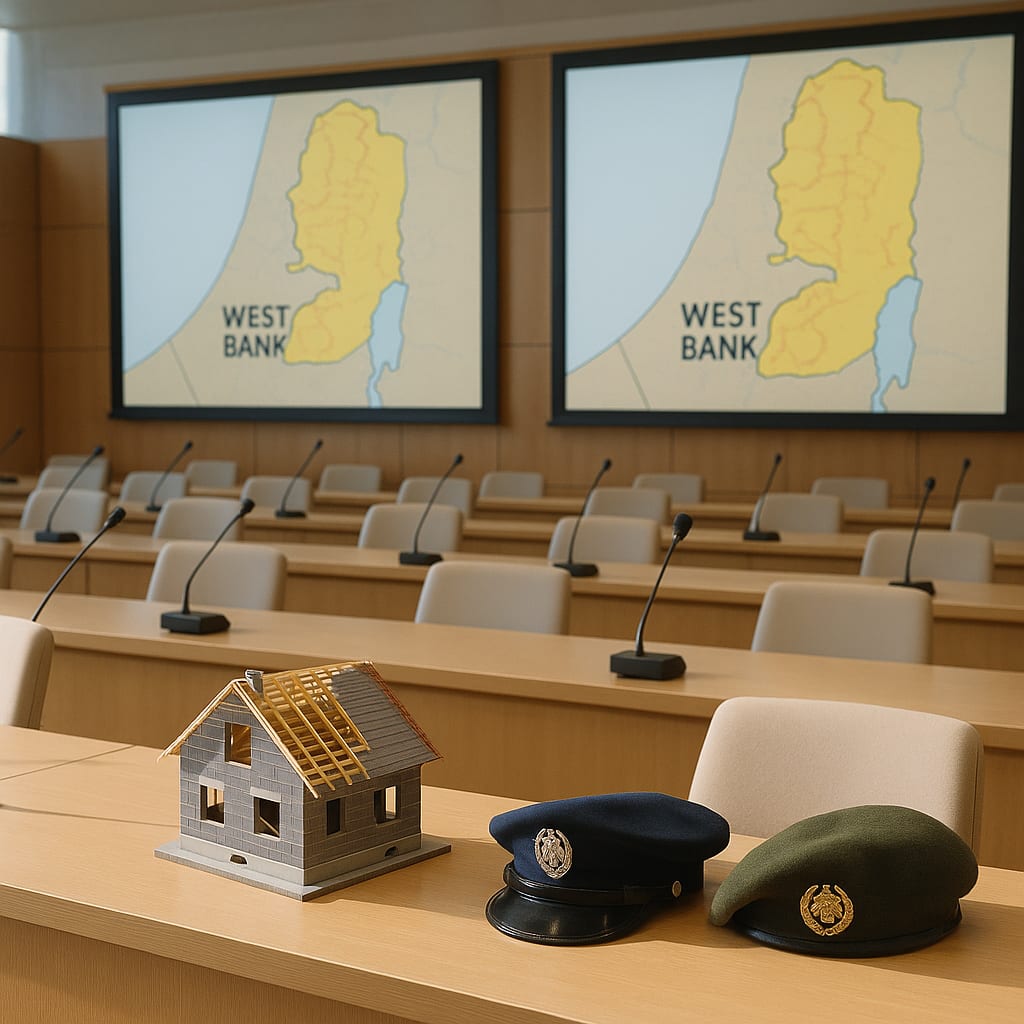
International pressure and internal rifts intensify over settler siege in Qusra as Israel weighs shifting West Bank policing; U.S. envoy condemns separate home seizure
Narrative Snapshot
Coverage converges on a basic picture of sustained settler intimidation of Palestinian residents in Qusra and an Israeli state response widely portrayed as inconsistent or inadequate. Israeli and international outlets diverge over emphasis: some focus on the policy levers now in play, others on the lived impact on besieged Palestinians, and still others on the structural logic of settlement expansion.
Israeli reporting highlights an emergent debate inside the security establishment. The Times of Israel and the New York Times both track Defense Minister Israel Katz’s push to shift civilian law enforcement in the West Bank from the army to the police, framing this as a response to failures exposed by the Qusra siege. France24 and the Toronto Star foreground the humanitarian consequences—families isolated for days, deliveries blocked—and stress visible military inaction. From outside Israel, Al Jazeera and IRNA (via the OIC) situate the violence within legal and normative claims, citing UN Special Rapporteur Francesca Albanese’s contention that Israel is outsourcing coercion to settlers.
U.S. angles split the spotlight: Fox News centers the U.S. ambassador’s forceful condemnation and an instance where Israeli forces did remove settler trespassers from a Palestinian American’s home under construction, while the Times of Israel reports U.S. pressure on Prime Minister Benjamin Netanyahu to issue a public denunciation of settler violence in Qusra. Haaretz provides a countervailing Israeli analysis: the uptick in violence and outpost activity is linked to an effort to normalize annexation but remains policy-contingent and reversible, challenging a narrative of inevitability advanced by extremists. Palestinian and regional outlets, including Al-Quds News and IRNA, underscore continuity since Oslo and frame recent events as part of a longer arc of dispossession and international law violations.
What Happened
Multiple outlets report that Palestinian residents in Qusra, near Nablus, were besieged by Israeli settlers, leaving several homes cut off from food and supplies for days. France24 cites residents of three houses under siege since Sunday and reports that the Israeli military had not removed the settlers, a picture echoed by the Toronto Star’s depiction of families huddled indoors. The Times of Israel adds that activists attempting to deliver food were blocked.
In parallel, the New York Times and the Times of Israel report that Defense Minister Israel Katz urged a shift of civilian law enforcement responsibilities in the West Bank from the army to the police. The Times of Israel also reports U.S. efforts to press a publicly silent Prime Minister Netanyahu to condemn the violence in Qusra. Separately, Fox News reports U.S. Ambassador Mike Huckabee condemned settlers who seized a Palestinian American’s home under construction; the IDF evicted them and made one arrest. The OIC warned of escalating settler “crimes,” and Al Jazeera reports UN Special Rapporteur Francesca Albanese’s assertions that Israel is outsourcing coercion to settlers, alongside new tents pitched for an illegal outpost.
Why It Matters
The episode exposes strain in Israel’s civil–military approach to the occupied West Bank. Katz’s call to transfer protection of Palestinian civilians to the police, reported by the New York Times and the Times of Israel, signals a contested reassessment of who is responsible for basic law enforcement amid settler violence. France24’s account of military inaction and the Toronto Star’s depiction of extended sieges point to capacity or will gaps that have legal and diplomatic consequences.
Internationally, pressure is mounting across distinct constituencies. The Times of Israel reports U.S. diplomacy urging a prime ministerial condemnation, while Fox News spotlights a U.S. ambassador publicly branding settler attackers “terrorists” and crediting Israeli forces for intervention in a separate incident. The OIC, via IRNA, frames Qusra in international law terms, and Al Jazeera amplifies the UN rapporteur’s claims of state responsibility for settler coercion. Haaretz’s analysis that current policies are normalizing annexation while remaining reversible links immediate security choices to longer-run territorial and governance trajectories.
Diverging Narratives
Accounts differ on enforcement and accountability. Fox News reports decisive Israeli action in one case—IDF eviction of settlers and an arrest after a U.S.-flagged complaint—while France24 states the army did not move to remove settlers besieging Qusra homes. These are distinct episodes, but the juxtaposition underscores uneven enforcement across incidents.
On causation and remedy, Israeli outlets emphasize institutional mechanics: Katz’s proposed handover to police and U.S. efforts to extract a public condemnation from Netanyahu (Times of Israel; New York Times). France24 casts visible governmental paralysis as a key variable, citing the prime minister’s inability to condemn filmed violence. Al Jazeera centers structural responsibility, relaying the UN rapporteur’s view that Israel is outsourcing coercion to settlers and, in the context of a new outpost, using settlers to advance ethnic cleansing—claims presented as her assessment. Haaretz argues that rising violence and settlement moves aim to normalize annexation but are outcomes of specific, reversible government policies, contesting the idea of inevitability. Regional narratives from IRNA and Al-Quds News stress international law breaches and a post-Oslo continuum of expropriation, framing Qusra as symptomatic of entrenched dispossession.
What Happens Next
Several decision points will shape trajectories. First is whether the prime minister issues the public condemnation the Times of Israel says Washington is seeking. A clear denunciation could signal political alignment with enforcement against settler abuses; continued silence would reinforce the paralysis described by France24 and sustain international criticism.
Second is implementation of Katz’s proposal to shift civilian law enforcement from the IDF to the police. If operationalized, as reported by the New York Times and the Times of Israel, analysts should watch for measurable changes in response times, arrests, and protection for besieged families; if stalled, responsibility will remain diffused amid ongoing gaps flagged by multiple outlets.
Third is enforcement against emergent outposts and active sieges. Al Jazeera’s report of tents for a new illegal outpost and France24’s account of unremoved besiegers set benchmarks: dismantlement and prosecutions would indicate a turn toward deterrence; tolerance would validate UN and OIC critiques of state-enabled coercion. Finally, any further U.S. embassy-mediated interventions of the sort described by Fox News will be a barometer of bilateral engagement on specific protection cases.