
Five years after Taliban takeover, Kabul celebrations meet global scrutiny over rights, isolation, and refugee policy
Narrative Snapshot
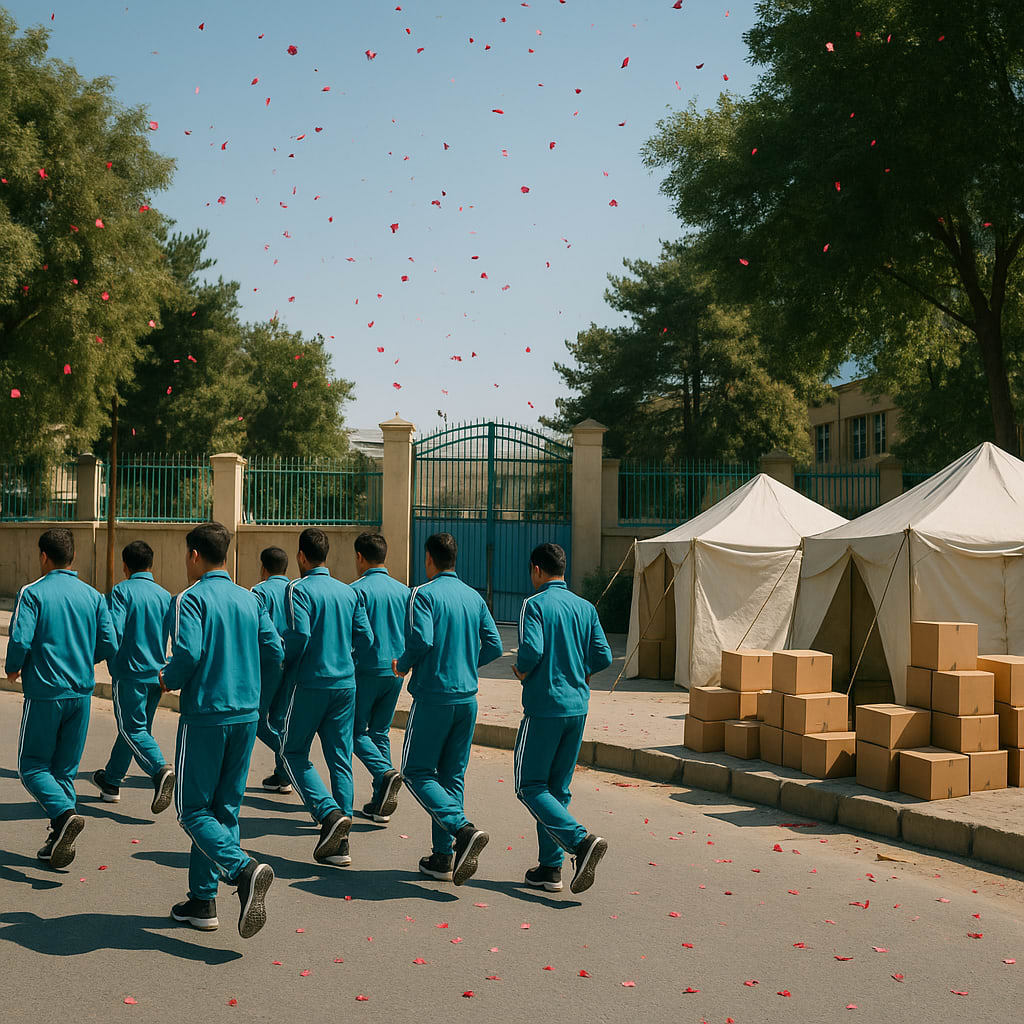
Coverage converges on the symbolism of choreographed anniversary events in Kabul while diverging on what those images represent. Regional and photo-led reporting describes pageantry and tightly managed public displays that highlight the authorities’ message of calm and control. The Hindu reports flowers dropped from military helicopters over an all-male athletes’ parade, a detail that Al Jazeera’s photo essay sets against a “carnival-like” atmosphere of flags and patriotic music. Chinese state media at CGTN echoes the emphasis on restored security, yet pairs it with sober metrics on lingering humanitarian distress.
European outlets foreground the costs of rule for women and girls and Afghanistan’s isolation. France24 juxtaposes the authorities’ claim of a “more secure and ‘free’ Afghanistan” with “suffocating restrictions,” economic hardship, and continued pariah status. ANSA cites a UN estimate that 2.4 million girls are denied secondary education, while Le Monde publishes both an op-ed urging a “leap forward” in support for Afghan women and field reporting on the daily fear and invisibility women describe under current edicts. Corriere della Sera amplifies Malala Yousafzai’s message that there is “nothing to celebrate.”
Anglophone coverage links the anniversary to unresolved protection obligations toward Afghans who worked with Western missions and to the broader politics of asylum. The Guardian details threats against a former Afghan police worker after a UK Ministry of Defence leak exposed his identity, alongside a rejected resettlement application. Al Jazeera notes that Europe’s rightward turn clouds prospects for Afghans seeking refuge. In the United States, Fox News publishes an appeal from veterans’ and faith-based groups to complete resettlement efforts for Afghan partners. The New York Times frames the authorities as entrenched but facing strains that “crack their veneer of stability,” a note of fragility largely absent from the celebratory set pieces.
What Happened
On the fifth anniversary of their return to power, the authorities in Kabul staged rallies and patriotic displays, including flower drops from military helicopters and a parade of athletes that excluded women due to a nationwide ban on women’s sport. Official messaging stressed restored security and national calm, echoed in CGTN’s summary of “Victory Day” themes and France24’s account of a “more secure and ‘free’ Afghanistan.” Countervailing coverage highlighted ongoing restrictions and isolation. ANSA relayed a UN figure that 2.4 million girls remain barred from secondary schooling, while CGTN put the number at more than 2.6 million and reported nearly 22 million people in urgent need of humanitarian aid. European reporting tracked Afghans’ difficult paths to safety and integration, from France24’s profiles of refugees rebuilding lives in France to Al Jazeera’s warning of tightening European asylum politics. The Guardian detailed a threatened former police worker whose UK resettlement was refused after a Ministry of Defence data leak. Le Monde published Afghan women’s testimonies and an op-ed calling for stronger international support, and Corriere della Sera carried Malala Yousafzai’s anniversary message rejecting celebrations.
Why It Matters
The anniversary crystallizes a policy impasse: governments face pressure to engage a de facto authority that touts security gains while maintaining restrictions that complicate recognition, aid conditionality, and the reopening of normal diplomatic channels. France24 and CGTN both underscore persistent international isolation, even as CGTN notes a consensus that open conflict has ebbed. Education bans and prohibitions on women’s sport, reported by ANSA and The Hindu, reinforce barriers to normalization and shape how multilateral bodies and donors calibrate assistance. At the same time, CGTN’s estimate of 22 million people needing urgent aid underscores the stakes for humanitarian access absent formal recognition. For host nations, Al Jazeera’s account of Europe’s rightward shift, the Guardian’s case study of UK resettlement failures, and Fox News’ call to fulfill U.S. commitments frame a credibility test toward local partners and a long-term integration challenge illustrated by France24’s reporting from France.
Diverging Narratives
Outlets differ in weighting the regime’s security narrative against rights-based critiques. Al Jazeera’s visuals and The Hindu’s event details capture orchestrated patriotism and public order, which CGTN contextualizes as evidence of “restored security.” France24, Le Monde, and Corriere della Sera emphasize constraints on women and girls and international ostracism, presenting these as defining features of the past five years rather than aberrations. Numerical portraits of schooling restrictions vary—ANSA cites 2.4 million girls denied secondary education while CGTN reports more than 2.6 million—reflecting different UN-derived tallies but reinforcing the same conclusion of systemic exclusion. The New York Times introduces a stress point—threats “cracking” a veneer of control—that is largely absent from celebratory accounts, marking a tension between visible order and latent vulnerability. On displacement and obligations, Al Jazeera’s focus on Europe’s political climate contrasts with France24’s bottom-up view of integration hurdles in France; the Guardian’s reporting on a threatened UK-linked former police worker and Fox News’ advocacy for U.S. follow-through highlight distinct national debates over responsibility, process, and pace rather than disagreement about the risks Afghans face.
What Happens Next
Three decision tracks will shape outcomes. First, on women’s rights and education, authorities can maintain current bans—signaled by the male-only parade reported by The Hindu and schooling figures in ANSA and CGTN—or take incremental steps to reopen secondary education and public life for women. Analysts should watch official decrees and school access policies, as France24 and CGTN link restrictions to ongoing isolation. Second, on external engagement and assistance, donors must balance isolation with humanitarian need, which CGTN places at nearly 22 million people. Signals include aid pledges, operational access for agencies, and any conditionality tied to women’s rights cited across European coverage. Third, host-country protection regimes face tests: Europe’s rightward shift noted by Al Jazeera, the UK’s handling of leak-exposed applicants reported by the Guardian, and U.S. resettlement efforts urged in Fox News will be shaped by administrative decisions, court outcomes, and program expansions. The broader economic trajectory—whether asserted security translates into livelihoods, as framed by CGTN—remains a core indicator alongside the New York Times’ warning signs of strain.