
Belgium’s High Fens wildfire becomes a cross‑border test of Europe’s fire season
Narrative Snapshot
Across outlets there is broad agreement on the basic parameters: a fast‑moving wildfire in Belgium’s Hautes Fagnes/High Fens has burned roughly 3,000 hectares since August 14–16, triggered large‑scale evacuations, and threatened the nearby German border. European and international coverage converge on the fire’s exceptional scale for Belgium and on the mixed effect of cooler, wetter weather that slowed but did not stop the blaze. The Guardian and Folha de S.Paulo foreground the unprecedented nature and the tactical respite from rain, while CGTN and France24 detail the operational picture, including aircraft and crews sent from neighboring states.
Where coverage diverges is in framing and emphasis. Deutsche Welle anchors the episode in Europe’s “severe wildfire seasons” and links to heat and drought driven by human‑induced climate change, a line echoed in France24’s expert interview calling for resilience and better‑funded support. Le Monde moves that frame into Belgian politics, reporting debate over the country’s preparedness for climate change. Other outlets stay operational: CBC and Bangkok Post track fresh flare‑ups and evacuations around Athens and in Germany’s Monschau; France24 and Telesur stress the wider European footprint, including deaths in Greece and Spain; Al Jazeera situates the UK’s military deployment within continent‑wide strain.
A second area of divergence is temporal: several reports on August 17 describe the fire pressing toward Germany and prompting evacuations, while CGTN on August 18 notes it was no longer spreading toward Monschau and had been contained where crews could access it. That sequencing highlights the dynamic risk profile of a peatland‑forest interface fire under shifting winds and intermittent rain, even as responders sought to “encircle” the blaze, as Le Monde reported.
What Happened
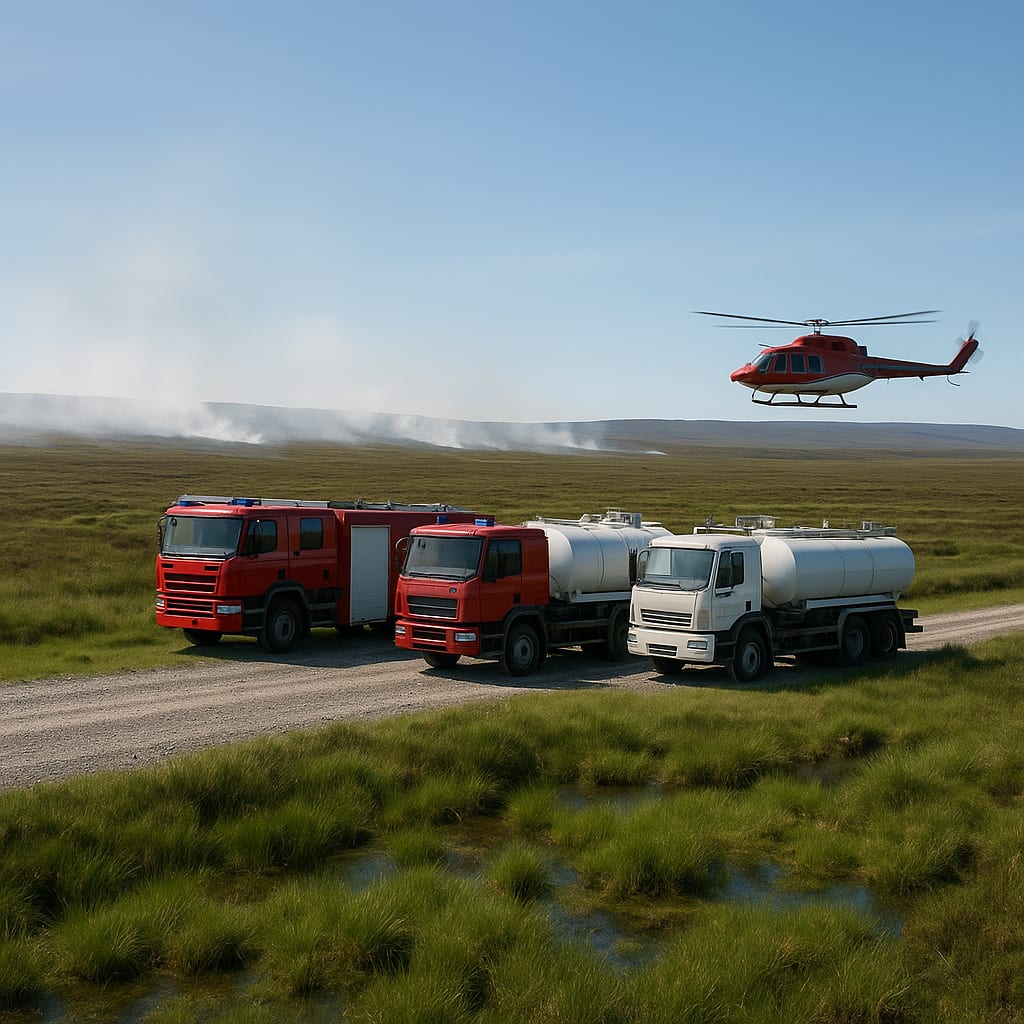
A wildfire ignited in Belgium’s High Fens nature reserve near the German border and, by August 17–18, had burned about 3,000 hectares, described as the country’s largest in modern records or in a century by multiple outlets. The Guardian reported King Philippe’s visit after a weekend of intense firefighting. France24 and CGTN said hundreds of firefighters, assisted by aircraft from Germany, the Netherlands, Norway and Sweden, worked alongside local crews; Telesur added support from Luxembourg and the Royal Netherlands Air Force. RT reported Belgium activated the EU Civil Protection Mechanism. Rain and cooler weather provided some relief, according to Folha de S.Paulo and the Bangkok Post, but CGTN noted the fire continued to spread in inaccessible areas. Evacuations occurred on both sides of the border, including around 600 residents in Belgium and about 30 in Monschau, Germany, per CGTN. The episode unfolded alongside lethal fires in Greece and Spain and UK military deployment amid wider European blazes, as reported by France24, Telesur, CBC, and Al Jazeera.
Why It Matters
The incident tests Europe’s capacity to manage high‑impact fires outside traditional Mediterranean hotspots, underscoring a northward shift in risk that Deutsche Welle links to climate‑driven heat and drought. Operationally, assistance from Germany, the Netherlands, Norway and Sweden, and reported activation of the EU Civil Protection Mechanism, illustrate reliance on pooled aerial assets and cross‑border surge capacity described by France24 and CGTN. Strategically, Le Monde’s account of debate over Belgium’s climate preparedness, together with France24’s expert call for greater resilience and funding, point to domestic policy choices on land management, peatland restoration, firebreaks, and multi‑agency coordination in regions not historically resourced for large wildfires. The broader European picture—UK military domestic deployment and Greece’s ongoing investigations—signals national security and public safety implications when concurrent hazards stretch firefighting fleets, civil protection budgets, and mutual‑aid agreements. For decision‑makers, this is a stress test of EU mechanisms, national readiness in non‑Mediterranean zones, and the adequacy of climate adaptation spending.
Diverging Narratives
Outlets differ most on interpretive framing. Deutsche Welle places the fires within a climate attribution context, citing studies on anthropogenic drivers, while France24’s expert analysis emphasizes building resilience and funding for extreme seasons; both move beyond incident response to structural capacity. Le Monde translates this into a domestic policy critique, reporting a debate over Belgium’s unpreparedness for climate change. By contrast, CGTN and France24’s dispatches concentrate on tactical containment—what areas are accessible, how many aircraft are flying, and the status of evacuations—highlighting the mechanics of crisis management rather than its causes.
A second tension is temporal and geographic. Several August 17 reports, including the Guardian, CBC, and RT, describe the fire advancing toward Germany and triggering evacuations near Monschau. By August 18, CGTN reports containment in accessible sectors and that spread toward Monschau had ceased, illustrating how quickly operational assessments can shift with rain and wind. Finally, scope varies: Telesur links the fires to a broader wave of extreme weather, tallying fatalities in Greece and Spain and pairing the story with floods elsewhere, while Al Jazeera keys on the UK’s military deployment as evidence of strain. These lenses—structural climate risk, national preparedness, operational status, and pan‑regional crisis—shape what stakeholders take away from the same set of events.
What Happens Next
Two decision tracks emerge. First is operational containment. CGTN reports authorities have contained the fire where accessible, while Le Monde cites firefighters’ intent to “encircle” the blaze. Outcomes will hinge on weather trends noted by multiple outlets and on whether international air support from Germany, the Netherlands, Norway, Sweden, and Luxembourg remains in place or is scaled back. Indicators to watch include updated perimeter maps, reopenings of closed roads, and any fresh evacuation orders or returns.
Second is policy recalibration. Le Monde’s reporting on Belgium’s preparedness debate, coupled with France24’s expert emphasis on resilience and funding, points to near‑term choices on resourcing peatland and forest management, interagency coordination, and use of EU civil protection tools—RT says Belgium activated the mechanism. Regionally, France24 and Al Jazeera’s accounts of simultaneous fires suggest continuing pressure on shared aerial fleets and national militaries. Analysts should monitor whether Greece’s probes into deadly blazes, noted by CBC, prompt prevention measures or legal changes that influence EU‑wide wildfire governance.