
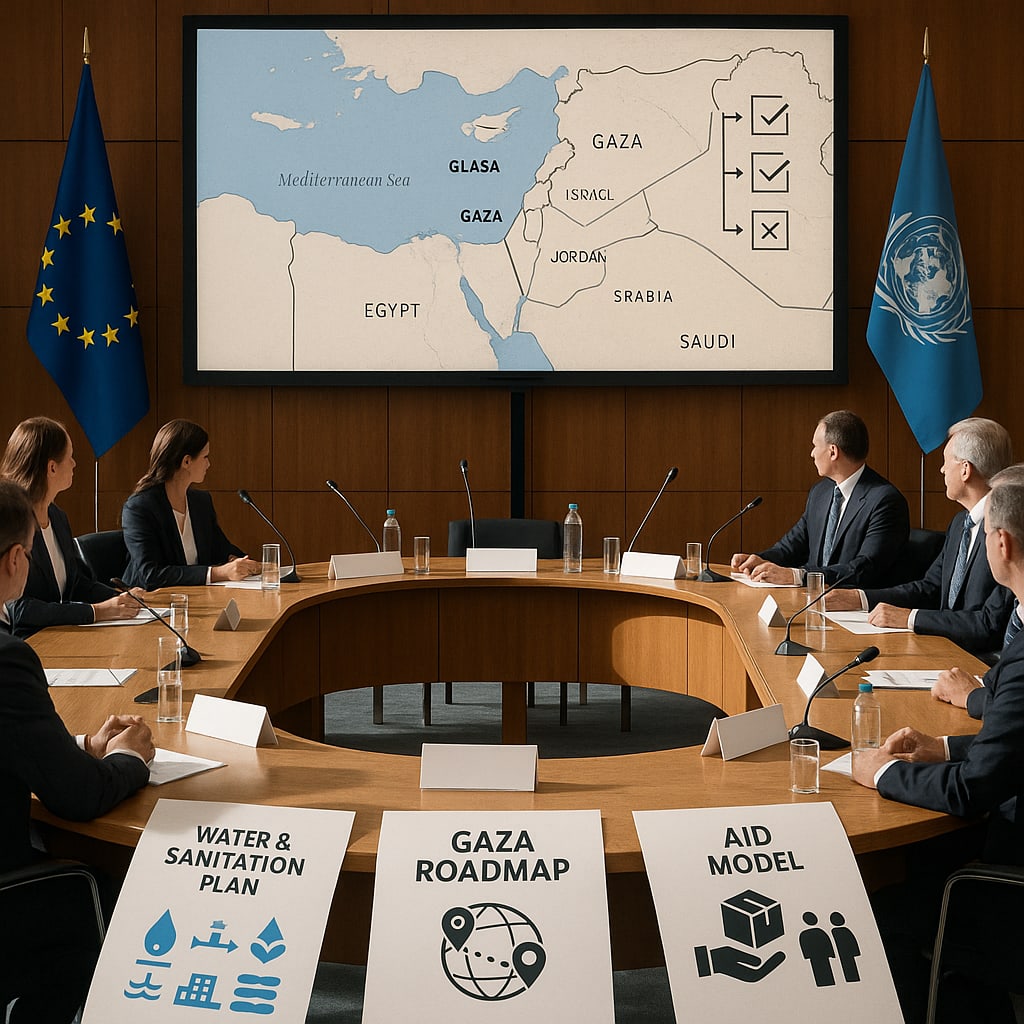
Kushner’s rare Hamas meeting is followed by tough talks with Netanyahu over a US-backed Gaza roadmap
Narrative Snapshot
Across outlets, there is broad agreement that Jared Kushner’s direct engagement with Hamas in Cairo was unusual and intended to restart a stalled US-backed plan linking Hamas disarmament to an Israeli pullout from Gaza. British and US coverage emphasizes the rarity of the contact and Israel’s prior rejection of the plan, framing Kushner’s subsequent Jerusalem visit as an effort to overcome that impasse. Israeli reporting centers on Prime Minister Benjamin Netanyahu’s red lines—no withdrawal before disarmament—and on operational continuity in Gaza, even as some accounts note parallel humanitarian steps. Arab and regional outlets capture skepticism in both Israeli and Palestinian constituencies and highlight Hamas’s conditions on sequencing and withdrawal. Russian and Chinese reports underscore the absence of a breakthrough, continued Israeli military posture, and the emergence of process tools—verification, working groups, and a conflict-resolution mechanism with Egyptian participation—that could structure next steps. What is most at stake in this coverage is whether verification and sequencing arrangements can bridge a political gap that both sides acknowledge but define differently.
What Happened
Hamas leaders traveled to Cairo and held a rare meeting with US envoy Jared Kushner, joined by Trump’s Board of Peace officials Nickolay Mladenov and Tony Blair, as mediators from Egypt, Qatar, and Turkey engaged (Haaretz; Middle East Eye). Multiple outlets reported Hamas reaffirmed support for the US plan and disarmament commitments first signaled in late July, while Israel had publicly rejected the roadmap (Le Monde; RT; BBC; South China Morning Post). Kushner then met Netanyahu in Jerusalem for hours; Israeli officials said there was no breakthrough as Netanyahu reiterated no IDF withdrawal until Hamas fully disarms and operations would continue (The Guardian; NBC; New York Times; TASS). Some accounts said Kushner and Netanyahu agreed a US general would verify disarmament, and announced two working groups on demilitarization and sanitation/water (France24; The Hindu; CGTN; Middle East Eye). Additional reporting described consideration of shifting from a phased to a wholesale disarmament framework (The Times of Israel).
Why It Matters
The sequence-and-verification architecture emerging from these talks could recalibrate the mechanics of Gaza ceasefire implementation. Reports of an American general verifying disarmament and of new working groups on demilitarization and public health indicate a more operational US role and a process infrastructure to translate commitments into steps (France24; The Hindu; Middle East Eye). Israeli insistence on maintaining positions and operations until disarmament is complete narrows the space for phased reciprocity, prompting US interlocutors to contemplate framework changes already approved by Hamas but rejected by Israel (TASS citing Axios; The Times of Israel; Le Monde). Conditionality on reconstruction—linking aid to demilitarization—ties humanitarian recovery to security benchmarks and signals donor caution (Al Jazeera; RT; Haaretz). With Netanyahu publicly resistant and under domestic pressure, and Hamas attaching conditions to its pledges, the viability of any roadmap hinges on enforceable verification and dispute-resolution mechanisms, including reported Egyptian participation (CGTN; TASS citing Axios).
Diverging Narratives
Accounts diverge on the degree of progress and on rules governing Israeli operations. Several outlets say talks produced no breakthrough and reaffirmed Israel’s refusal to withdraw until full disarmament, with operations in Gaza continuing (The Guardian; CGTN; New York Times). Others highlight “deep and constructive” discussions, agreement on a US verification role, and the launch of technical working groups, suggesting procedural gains even absent policy convergence (France24; The Hindu; Middle East Eye). On targeted killings, Israeli and Russian coverage indicates continuity of Israel’s approach, while one report cites Kushner’s opposition and an absence of agreement on their continuation (Haaretz; TASS; Middle East Eye). Reconstruction is framed conditionally by Kushner—no rebuilding before demilitarization—with amplification in regional and Russian outlets, while a Palestinian outlet notes Trump signaling “positive progress” on weapons transfer and saying it would be better if Israel did not attack Gaza (Al Jazeera; RT; Al-Quds News; ANSA). Finally, sequencing is contested: Hamas is reported to have reaffirmed disarmament pledges while demanding Israeli withdrawals and a permanent ceasefire, as the US side weighs abandoning a phased approach in favor of a wholesale handover to meet Israel’s conditions (RT citing Axios; The Times of Israel).
What Happens Next
Key decisions will turn on verification, sequencing, and operational posture. If the reported appointment of a US general to verify disarmament is formalized, a monitored pathway could open for initial steps; absent that, Israel’s position of no withdrawal before full disarmament leaves little room for phased reciprocity (France24; The Hindu; New York Times). The Board of Peace’s potential shift from a phased to a wholesale disarmament framework would test Hamas’s stated commitments and Israel’s demand for front-loaded security guarantees; watch for any formal articulation of a revised framework and Hamas’s reaction (The Times of Israel; Le Monde). Israeli targeting policy is another hinge point: continued targeted killings would signal primacy of unilateral security measures; any limits would indicate deference to emerging process constraints, a point on which reporting is mixed (Haaretz; TASS; Middle East Eye). Finally, the announced working groups and a reported conflict-resolution mechanism with Egyptian participation will matter if they develop mandates, membership, and timelines; movement there would indicate whether procedural scaffolding can bridge political gaps (Middle East Eye; TASS citing Axios; CGTN).