
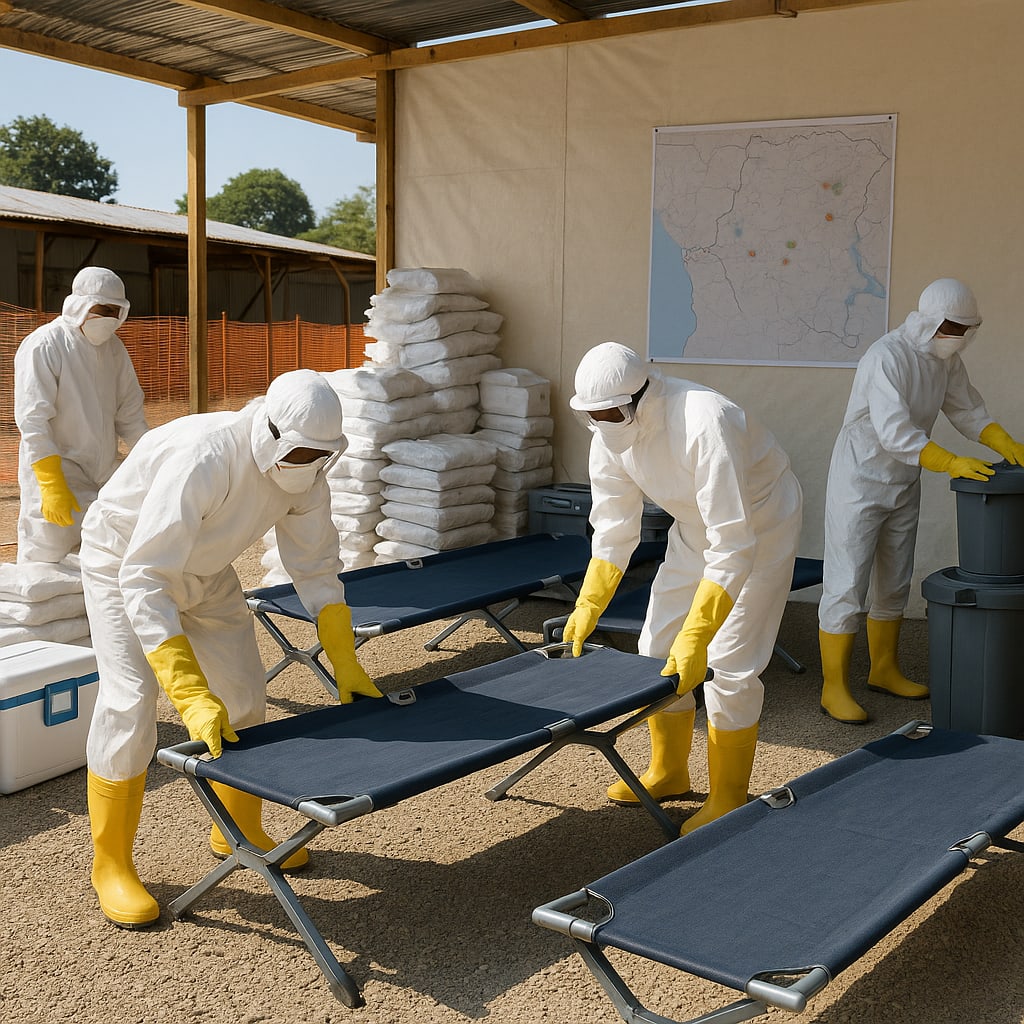
DR Congo’s Ebola outbreak becomes the country’s deadliest, with 2,325 deaths and nearly 5,000 cases
Narrative Snapshot
Across outlets, the basic contours are consistent: national figures report 2,325 deaths from 4,945 confirmed cases, and multiple sources emphasize the exceptional pace of spread. European and Latin American coverage largely fixes on the milestone of “deadliest in the country’s history,” while several Anglophone and international outlets also situate the episode within global Ebola history. Telesur and CGTN explicitly note it is now the second-deadliest Ebola outbreak worldwide after West Africa in 2014–2016.
Different angles emerge on operational constraints. CGTN underscores surveillance shortfalls, citing that 60–70% of new cases were not previously listed as contacts, and relays a UN call to scale safe burials, treatment capacity, and management. France24 points to spread into a sixth province alongside efforts to counter mistrust. Clarin highlights patient mortality before reaching care and scant preventive measures in Bunia, the epicenter.
There is variation in how the human toll is quantified. Deutsche Welle cites a UN estimate of one death every 30 minutes; CGTN puts the rate at nearly one every 28 minutes over the prior week. The Hindu adds outcome data absent elsewhere—over 1,000 recoveries and 730 people in hospital or isolation—while Telesur introduces a 47% case-fatality rate. A smaller subset of outlets brings in forward-looking elements: France24 notes two vaccines entering early human trials, and Telesur relays a WHO warning that the current trajectory could rival West Africa’s.
What Happened
Government figures released August 17 show 2,325 deaths and 4,945 confirmed Ebola cases in the Democratic Republic of the Congo, surpassing the country’s 2018–2020 outbreak toll of 2,299 deaths. The epidemic, declared May 15 in Ituri province, has spread to a sixth province, according to France24. WHO leadership and multiple outlets describe a pace that is outstripping response efforts; UN estimates put recent mortality at roughly one death every 28–30 minutes. Telesur cites a 47% case-fatality rate, while The Hindu reports over 1,000 people recovered and 730 still in hospital or isolation. CGTN identifies the Bundibugyo strain and reports that 60–70% of new cases were not previously on contact lists, signaling surveillance gaps. The UN humanitarian chief urged doubling safe-burial teams and tripling treatment capacity and announced an additional $30.5 million from the Central Emergency Response Fund.
Why It Matters
Ebola control depends on rapid case identification, exhaustive contact tracing, safe burials, and surge clinical capacity; the reported reality that most new cases are arising outside known contact lists indicates stress on core outbreak-control norms. The UN’s explicit call to dramatically expand safe-burial teams, treatment capacity, and experienced management, paired with an emergency CERF allocation, places this response squarely within multilateral humanitarian mechanisms and tests how quickly they can scale in a complex setting. With the outbreak now the deadliest in DR Congo’s history—and, per Telesur and CGTN, the second-deadliest globally—it becomes a consequential benchmark for WHO’s incident management and member-state support. France24’s note on vaccines entering early human trials highlights an R&D track running in parallel to field operations, but the near-term trajectory hinges on operational fixes and public trust rather than future tools.
Diverging Narratives
Outlets converge on the gravity of the situation but frame its significance differently. European and Latin American sources emphasize the national milestone of “deadliest in the country’s history” with succinct tallies (ANSA, Le Monde, Bangkok Post), while Telesur and CGTN extend the frame to global ranking and historical comparison with West Africa’s 2014–2016 epidemic. On tempo, phrases like “exceptional pace” (Toronto Star) and “fast-spreading” recur, but only CGTN quantifies surveillance gaps—60–70% of new cases not on contact lists—shifting attention from aggregate numbers to system performance. Human-impact metrics also vary: Deutsche Welle cites a UN figure of one death every 30 minutes; CGTN refines this to nearly one every 28 minutes over the last week, and The Hindu balances mortality with recovery and hospitalization data. France24 introduces two early-stage vaccine trials and spread to a sixth province, while Clarin foregrounds access and prevention deficits in Bunia, contrasting national-scale reporting with conditions in the epicenter.
What Happens Next
Two decision points are explicit. First, whether authorities and partners meet the UN’s operational targets—doubling safe-burial teams and tripling treatment capacity—will shape transmission at funerals and case outcomes; watch for announcements of team deployments, bed counts, and management reinforcements consistent with CGTN’s report. Second, surveillance performance must improve; the current 60–70% of new cases arising outside contact lists is a critical indicator. Analysts should track shifts in that proportion, as well as WHO and government updates on contact-tracing throughput.
Geographic containment is another hinge. France24’s note on spread to a sixth province suggests risk of further expansion absent stronger community trust; look for reporting on community engagement efforts and any stabilization in provincial caseloads. Finally, France24’s reference to two vaccines entering early human trials introduces a longer arc; near-term relevance will be signaled by trial readouts and any move toward targeted use, but the immediate trajectory will be determined by whether the response catches up to the outbreak’s current pace.