
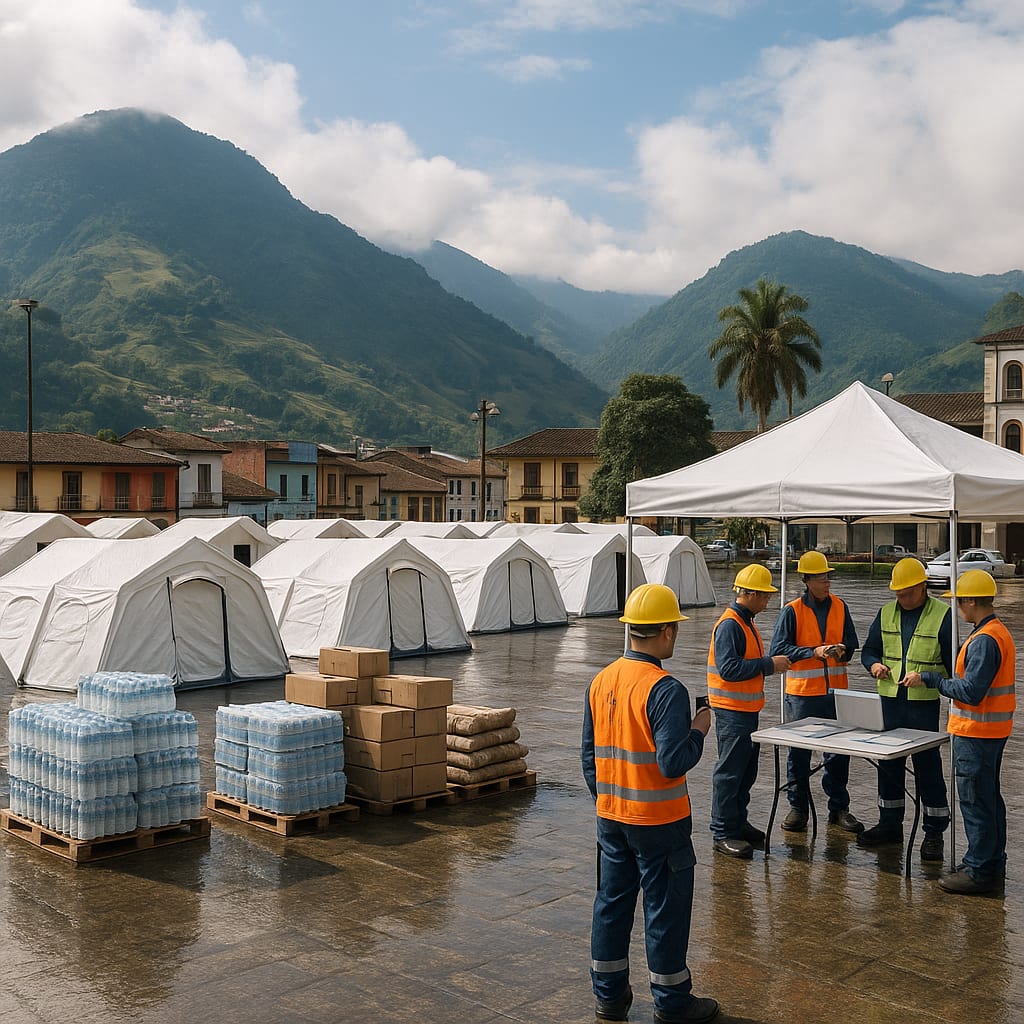
Colombia shifts from rescue to recovery after Aug. 10 earthquake as aid arrives and strains deepen
Narrative Snapshot
Latin American outlets foreground the human texture of loss and coping. Telesur English centers immediate hardships—downpours swamping Pereira’s improvised encampments and a week-long, citizen-led surge of donations to the Bogotá Red Cross—while also tracking official tallies and geographic spread released by Colombia’s disaster agency. Clarin narrows the lens to Cali’s unresolved sites and body counts, and notes when formal rescues end and neighbors return to sift for personal effects. Folha de S.Paulo depicts residents combing rubble for scrap metal, a stark indicator of livelihood pressures emerging alongside humanitarian needs.
Chinese state media pairs granular operational disruption with geopolitical relief optics. CGTN anchors coverage in the breakdown and workaround of death-management systems in Cali and details Beijing’s shipments and emergency cash, describing the quake as Colombia’s largest this century. Western outlets emphasize the pivot to recovery and the role of private philanthropy; Al Jazeera situates the policy turn toward shelter and rebuilding, while AP reporting in the Toronto Star and Le Monde spotlights Shakira’s commitment to school reconstruction in hard-hit Chocó.
What is most at stake across accounts is the state’s capacity to manage fatalities and displacement under deteriorating weather, to coordinate selective foreign assistance amid controversy, and to stabilize critical infrastructure—hospitals, schools, and morgues—whose impairment shapes both the pace and equity of recovery.
What Happened
A powerful earthquake struck western Colombia on Aug. 10, with outlets reporting magnitudes between 7.4 and 7.5 and an epicenter near San José del Palmar in Chocó. The disaster agency’s Aug. 16 update, cited by Telesur English, listed 294 dead, 3,935 injured, and 320 missing across 15 departments; Clarin reported on Aug. 17 a national death toll of 289 with 143 missing and detailed 130 deaths in Cali, where searches persisted at four locations with 19 bodies still unrecovered. CGTN documented morgue damage in Cali that forced transfers to Palmira and delays for families. Telesur English described rains soaking tents in Pereira’s Olaya Herrera Park. Volunteers delivered supplies en masse to the Bogotá Red Cross. The government moved to declare an economic emergency to unlock up to $450 million from the World Bank, according to Telesur English. China announced and dispatched relief including generators, water purification vehicles, and tents, per CGTN. Venezuela activated its Simón Bolívar Brigade to assist, Telesur English reported. AP coverage in the Toronto Star and Le Monde said Shakira pledged to help rebuild at least 10 schools in Chocó.
Why It Matters
The response is a test of Colombia’s disaster governance and fiscal agility. The finance ministry’s move to declare an economic emergency to access World Bank financing signals reliance on exceptional legal tools and multilateral credit to create rapid fiscal space, while Telesur English’s figures on destroyed and damaged homes, plus thousands of affected facilities, indicate a nationwide reconstruction burden. Critical public services buckled under stress: CGTN’s reporting on Cali’s disabled morgue and Clarin’s accounting of unresolved search sites underscore how infrastructure fragility can cascade into justice, health, and dignity concerns.
Internationally, relief has become a vector of diplomatic presence. China paired cash with in‑kind shipments, positioning Beijing as an early, visible responder, according to CGTN. Venezuela’s activation of a specialized brigade adds a regional dimension of operational solidarity. Private philanthropy—Shakira’s school rebuilding pledge reported by AP and Le Monde—intersects with public reconstruction mandates, particularly in Chocó, which multiple outlets identify among the hardest‑hit regions.
Diverging Narratives
The record diverges on metrics and framing. Telesur English’s Aug. 16 update from the disaster agency lists 294 fatalities and 320 missing nationwide, while Clarin’s Aug. 17 live coverage cites 289 deaths and 143 missing, and CGTN earlier put the toll above 280. Even the magnitude varies: Telesur English repeatedly cites 7.4, whereas CGTN reports 7.5 and describes the event as the country’s largest this century. Such differences reflect publication timing and sourcing choices rather than explicit contradiction, but they point to a moving baseline that complicates cross‑outlet comparisons.
Emphases also diverge on external assistance and domestic capacity. Telesur English reports a controversy in which De la Espriella barred Mexican army rescuers while permitting teams from the U.S., Israel, Ecuador, and El Salvador, highlighting gatekeeping of foreign responders; other outlets in this set do not echo or develop that dispute. CGTN features Chinese aid logistics and the morgue’s operational workaround. Clarin details site‑specific search operations in Cali, while Folha de S.Paulo surfaces informal survival strategies as residents scavenge rubble for metal. Western pieces focus on the transition to recovery and on private commitments, such as Shakira’s school rebuilding, rather than on the mechanics of foreign search-and-rescue access.
What Happens Next
Several decision points will shape trajectories. First, whether and how the government’s economic emergency is enacted and operationalized will determine the speed of disbursing up to $450 million in World Bank financing and reallocating Colombia’s disaster fund, as described by Telesur English. Second, international assistance flows require coordination: CGTN says Chinese relief was scheduled to land in Bogotá around midday Tuesday; how those generators, water units, and tents are allocated to worst‑affected departments named by Telesur English—Chocó, Valle del Cauca, Risaralda, Caldas, and Quindío—will be a test of logistics and equity. Third, foreign responder access remains a live management issue after Telesur English’s report on selective acceptance; watch for clarifications on additional team deployments, including Venezuela’s activated brigade. Finally, operational benchmarks—the completion of searches at the four Cali sites noted by Clarin, restoration of morgue capacity cited by CGTN, and weather‑resilient sheltering in Pereira tracked by Telesur English—will signal whether the response can transition into steady‑state reconstruction, including school projects highlighted by AP and Le Monde.