
U.S. and Canada hold last-minute talks to avert up to 50% U.S. tariffs on Canadian goods
Narrative Snapshot
Across outlets, the urgency and breadth of the prospective measures are treated as givens, but the emphasis differs. U.S. coverage from NBC details how duties “up to 50%” would span diverse categories—hockey sticks, building materials, clothing, and dairy—while the New York Times underscores the political tradeoffs by asking “at what cost” a deal might be reached by the Tuesday midnight deadline. Canadian reporting in the Toronto Star highlights sectoral irritants—alcohol and autos—as focal points in talks, anchoring the dispute in issues that recur in bilateral bargaining.
Coverage also splits between economic and political lenses. CBC focuses on operational consequences for U.S. entrepreneurs with Canadian supplier ties, who say sustained tariffs would force them to sever longstanding relationships. Al Jazeera frames the moment as a race against both the clock and domestic politics, and Argentina’s Clarín adds that the tensions are prompting protests in Canada, situating the tariff threat within a “historical commercial relationship” under visible public pressure. The Toronto Star’s AP-based account threads in the decades-long wrangles over softwood lumber and access to Canada’s protected dairy market, delineating the familiar terrain on which last-minute bargaining is occurring.
What Happened
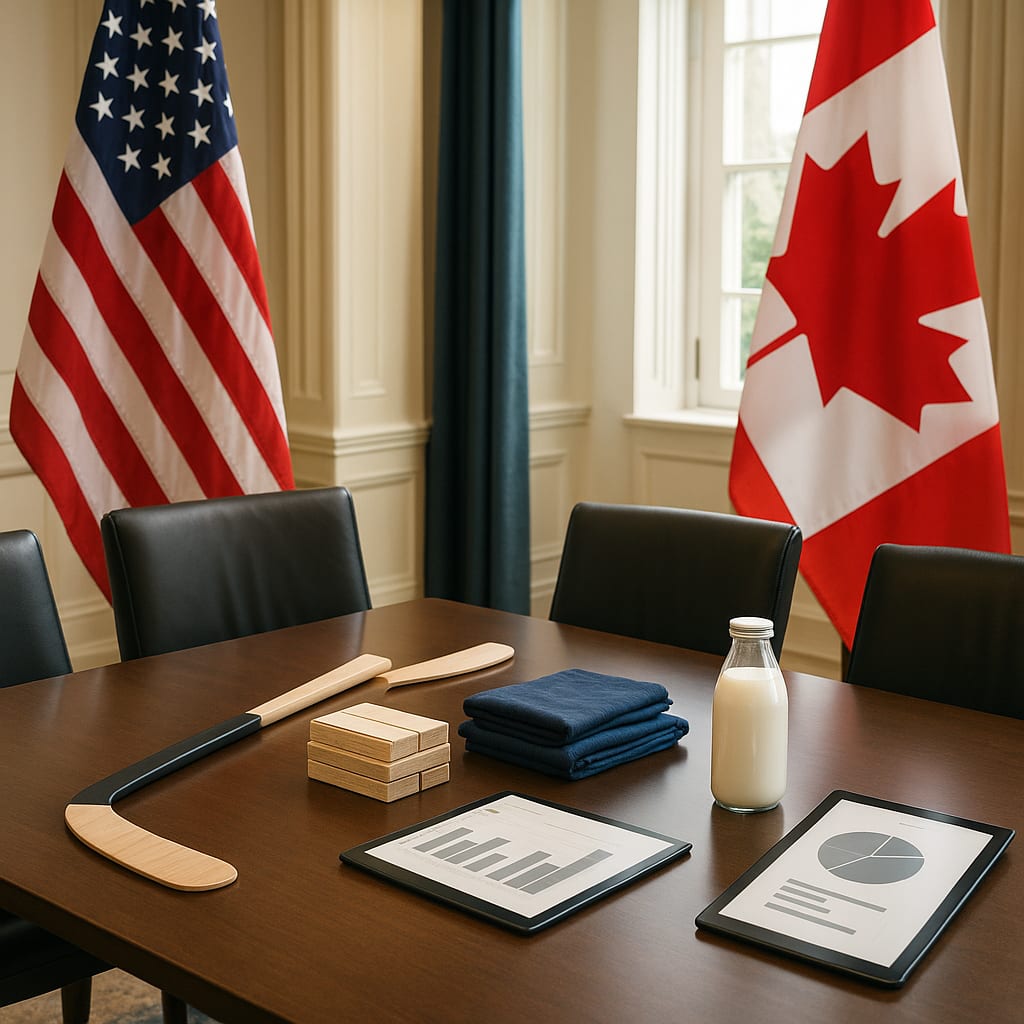
Canadian negotiators stayed in Washington on Monday for talks as a deadline approached for new tariffs proposed by U.S. President Donald Trump. Reporting across outlets indicates the measures could reach up to 50 percent and cover a wide range of Canadian goods, with NBC citing hockey sticks, building materials, clothing, and dairy among those at risk. The Toronto Star relays an AP account framing the effort as an attempt to stop 50 percent tariffs on about $20 billion of Canadian exports, while also pointing to long-running disputes over softwood lumber and U.S. access to Canada’s protected dairy sector as enduring fault lines. The New York Times notes a Tuesday midnight cutoff for a possible deal. Al Jazeera describes a last-ditch push for a reprieve. CBC reports U.S. business owners warn that sustained tariffs would force them to abandon Canadian suppliers despite longstanding relationships.
Why It Matters
The coverage collectively situates this episode within a long arc of bilateral economic frictions that repeatedly resurface around politically sensitive sectors, notably dairy and softwood lumber. The threatened measures’ breadth, spanning everyday consumer items and key inputs, signals potential diffusion of costs across integrated cross-border supply chains and retail markets, amplifying pressure on firms that have cultivated durable, cross-border partnerships. CBC’s reporting that U.S. entrepreneurs would be compelled to break ties if 50 percent tariffs persist underscores how quickly commercial relationships can be repriced when trade policy escalates. Al Jazeera’s and Clarín’s emphasis on domestic politics and protests indicates that any agreement will be judged not only on economic outcomes but also on its political defensibility. The New York Times’ question—“at what cost?”—captures the structural bind: avoiding immediate pain may require concessions in sectors that have driven disputes for decades.
Diverging Narratives
Outlets converge on the immediacy and magnitude of the risk but diverge in framing stakes and leverage. NBC anchors attention on the breadth of exposure by naming product categories that would be newly taxed at high rates, suggesting a wide economic footprint. The New York Times foregrounds the bargaining dilemma, emphasizing the deadline and the prospect that averting tariffs could carry politically sensitive costs. Canadian reporting in the Toronto Star highlights sector-specific irritants—alcohol and autos—in addition to long-standing disputes in dairy and lumber, pointing to where concessions or carve-outs might be negotiated. CBC centers downstream impacts on U.S. businesses, making the case that economic pain would not be confined to Canada.
International perspectives add a social and political dimension. Al Jazeera frames the negotiations as a scramble constrained by time and politics, while Clarín reports protests in Canada and public demands for a response to Trump’s tariff threat, emphasizing pressure on Ottawa. Unanswered questions run through the coverage: whether a reprieve will be secured by the deadline; what concessions, if any, would underpin it; the precise scope of goods to be covered; and whether the reported $20 billion exposure will define the final tariff sweep.
What Happens Next
Two decision points dominate the next steps. First is whether negotiators can secure a reprieve by Tuesday midnight, as described by the New York Times and Al Jazeera. Signals to watch include statements from Canadian officials remaining in Washington (Toronto Star) and any White House or U.S. trade announcements indicating a pause or conditional delay. Second is the scope and design if tariffs proceed: NBC’s list of targeted categories and the Toronto Star’s identification of alcohol and autos as irritants outline likely areas where carve-outs or deferrals could emerge, or where duties might immediately bite.
Downstream indicators include business responses documented by CBC: if tariffs are imposed and sustained, watch for U.S. entrepreneurs announcing supplier shifts away from Canada. Clarín’s reporting on protests suggests domestic political reactions in Canada will also shape follow-on negotiating space and the durability of any interim arrangement.