
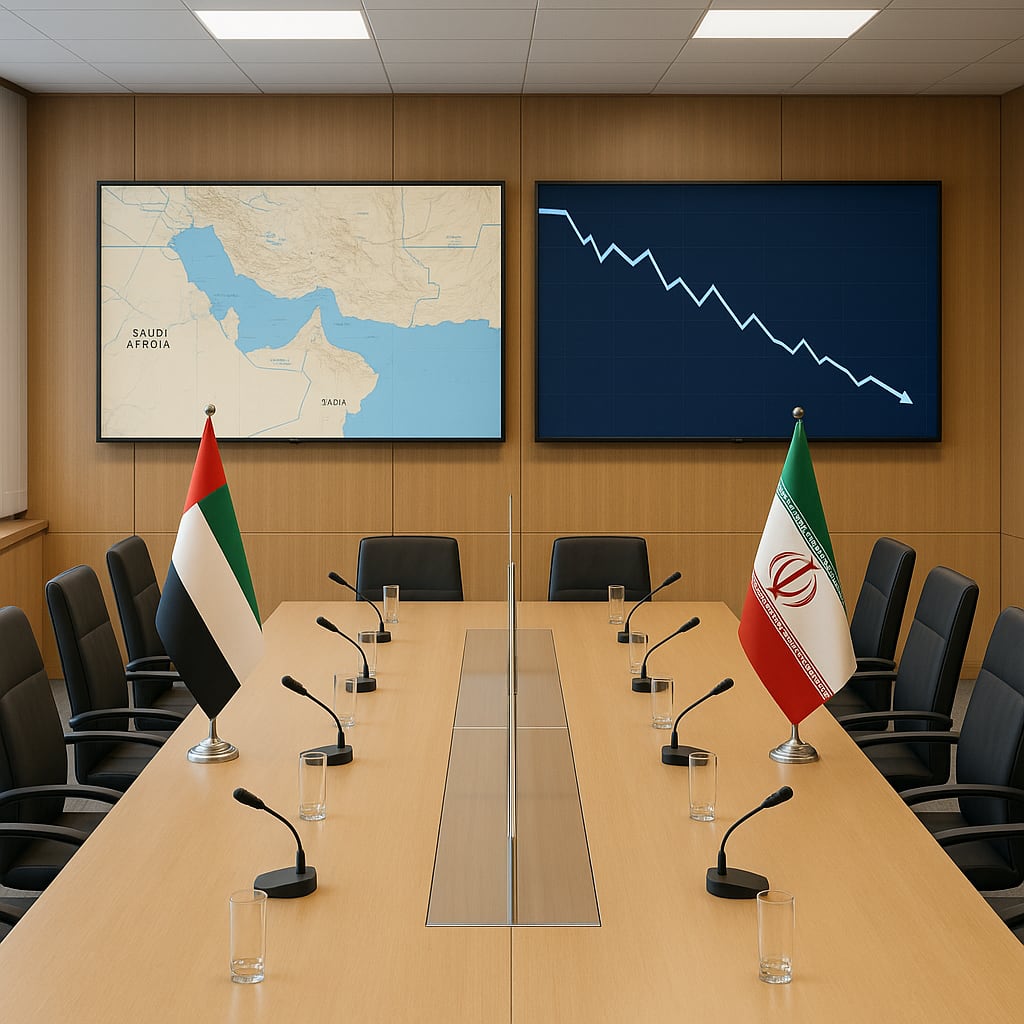
UAE halts all trade and financial transactions with Iran after detecting ballistic missiles
Narrative Snapshot
Across outlets there is consensus that the United Arab Emirates has suspended all trade, commercial exchanges, and financial transactions with Iran until further notice, with Abu Dhabi linking the move to missiles it says originated in Iran and were aimed at maritime navigation before falling into the sea. Coverage repeatedly flags the breadth and open-ended nature of the halt, while some reports emphasize that the UAE has framed the step as a response to escalations undermining regional and international peace and security.
What is most at stake, according to multiple analyses, is Iran’s use of the UAE as a commercial and financial hub. The New York Times notes the Emirates’ role in Iranian sanction evasion, which Tehran denies, and Al Jazeera argues the embargo could close a key “economic escape route” for Iran. Canadian and Argentine outlets similarly stress the isolating effect of the UAE’s decision.
Tehran’s counter-narrative is twofold. First, Iran denies launching missiles at the UAE and characterizes the episode as a false flag operation, as reported by Al Jazeera. Second, official Iranian media situate the moment in a wider recalibration of Gulf security, highlighting commentary that the Strait of Hormuz order is shifting and publicizing outreach to Iraq and China on regional security and opposition to unilateralism.
Several reports locate the decision within a deteriorating maritime and littoral security environment. The UAE Defense Ministry’s focus on missiles targeting navigation sits alongside concurrent accounts of Houthi ballistic strikes on Yemen’s Red Sea port of Mocha, which damaged civilian infrastructure and halted port operations, and of sharply curtailed vessel movements through the Strait of Hormuz amid combative U.S.-Iran rhetoric. Together, these threads shape how different outlets frame risk to shipping and coastal infrastructure as a driver of Emirati policy.
What Happened
The UAE announced it was halting all trade, commercial exchanges, and financial transactions with Iran, effective immediately and until further notice, following the detection of two ballistic missiles the Emirati Defense Ministry assessed originated in Iran and were aimed at maritime traffic before falling into the sea. TASS first reported the freeze on August 18, citing Emirati identification of launches from Iran, followed by UAE and international outlets on August 19 carrying the Foreign Ministry’s statement and Defense Ministry’s assessment. The Japan Times and Middle East Eye quoted the UAE’s framing that Iranian “escalations” undermined regional and international peace and security. Iran denied launching missiles and described the incident as a false flag, according to Al Jazeera. The Hindu noted the announcement followed a period in which no Iranian missiles were aimed at the UAE since May. The New York Times highlighted the UAE’s longstanding role as a commercial hub for Iranian trade.
Why It Matters
The UAE has been a critical conduit for Iranian commerce and finance under sanctions; New York Times reporting describes the Emirates as a major trading hub often linked to Iranian sanction-evasion networks, a characterization Tehran disputes. By imposing an open-ended embargo, Abu Dhabi threatens to constrict what Al Jazeera calls a key “economic escape route” for Iran, raising potential costs for Tehran’s regional posture and complicating its access to goods and payments routed through Emirati intermediaries.
The decision also intersects with a stressed maritime security environment. The UAE Defense Ministry’s assertion that the detected missiles targeted navigation, coupled with reporting on Houthi ballistic attacks that suspended operations at Yemen’s Mocha port, underscores the vulnerability of Red Sea and Gulf shipping lanes. Iranian state media frame the episode within a broader reassessment of Gulf security and multipolar alignments, highlighting consultations with Iraq and deepening ties with China that emphasize opposition to unilateralism. For governments and multilateral bodies, the episode tests crisis-management channels across the Gulf and the capacity of existing arrangements to insulate trade and energy flows from contiguous flashpoints.
Diverging Narratives
Attribution is the central fault line. The UAE Defense Ministry publicly assessed that two ballistic missiles originated from Iran and targeted maritime navigation, falling into the sea, a claim echoed in Emirati and regional coverage. Iran denies any launch and characterizes the incident as a false flag operation, per Al Jazeera. No outlet reports independent verification of the launch origin beyond Emirati statements. The Hindu’s note that no Iranian missiles had targeted the UAE since May adds temporal context that some readers may see as complicating claims of a sudden Iranian escalation.
Outlets also emphasize different causal frames. Western and regional English-language coverage, including the New York Times and Al Jazeera, center on the trade ramifications, with the former highlighting the UAE’s role in Iranian sanction evasion and the latter arguing the embargo could close a critical economic channel. Japanese and UK-based reporting foreground the UAE’s stated rationale of safeguarding regional and international peace and security. Iranian state media do not engage the specific allegation; instead they situate developments in a shifting “post-Hormuz” security order and point to diplomacy with Iraq and China, while Tehran Times advances a separate “false flag” framing in Iraq, indicating a consistent narrative lens toward external sabotage without referencing the UAE case. Meanwhile, CGTN presents heightened U.S.-Iran confrontation over Hormuz and reports sharply reduced vessel traffic, reinforcing the maritime risk context that the UAE cites.
What Happens Next
Two decision points will shape trajectories. First is enforcement scope and duration in the UAE. Officials have stated the suspension is until further notice; whether Abu Dhabi sustains, tightens, or calibrates the embargo will likely track any additional public evidence it releases on missile attribution and its assessment of risks to maritime navigation, as reflected in Defense Ministry communications. Analysts should watch for further government notices on trade and finance procedures and for corroborating technical detail about the missile incident.
Second is regional risk management. Iran’s outreach to Iraq and its engagement with China on peace and security suggest active diplomatic tracks; any readouts that reference Gulf maritime security or crisis de-escalation would be salient. Concurrent indicators include shipping flows through Hormuz amid CGTN-reported disruptions, and the tempo of Houthi missile activity against Red Sea ports that has already forced commercial suspensions in Mocha, which could reinforce Emirati threat perceptions. U.S.-Iran signaling over Hormuz, cited by CGTN, will also condition maritime posture and partner responses.