
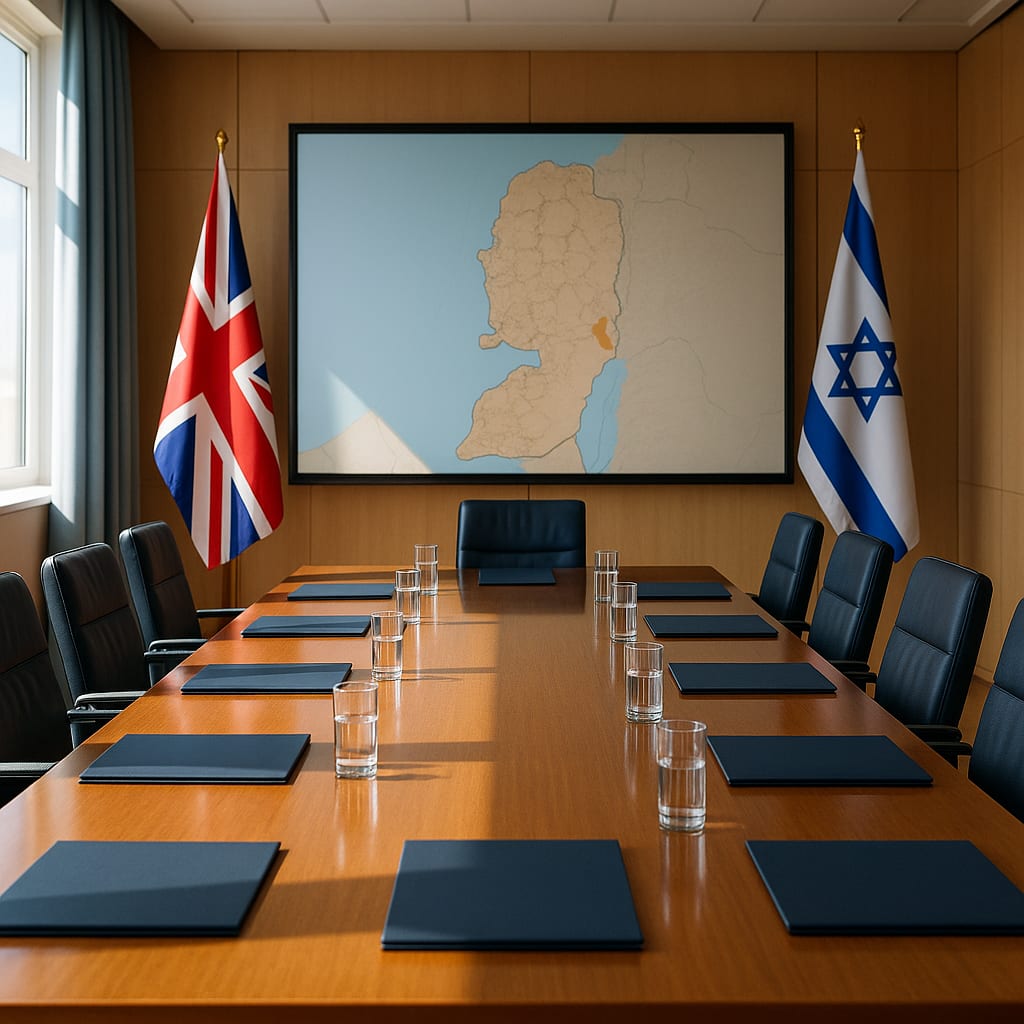
Israel issues tenders for about 1,200 housing units in E1; UK condemns and summons envoy
Narrative Snapshot
Israeli and international outlets converge on the sensitivity of E1 while emphasizing different facets of the move. Haaretz and the Times of Israel frame the development as an administrative step—opening bidding for roughly 1,200 homes after years of delays triggered by external pressure—while noting the strategic stakes raised by critics and the domestic political reading from Peace Now that the tender aims to “tie the next government’s hands” (Haaretz, Times of Israel). By contrast, BBC and Al Jazeera underline longstanding international condemnation and the legal framing used by Palestinians and their supporters, with BBC reiterating the assessment that building in E1 would effectively divide the occupied West Bank and Al Jazeera describing the project as illegal under international law.
Middle East Eye adds granular scope and land-use details often absent from briefer wire-style reports: seven settlement complexes comprising 1,234 units on approximately 12,000 dunams between Jerusalem and Ma’ale Adumim, interlinking residential, industrial, tourism, and infrastructure components. That emphasis on integrated development highlights risks to connectivity and space-use beyond housing counts alone, complementing BBC’s and the Times of Israel’s focus on territorial contiguity.
Coverage of the diplomatic response is most robust in UK-linked reporting. Middle East Eye, the Bangkok Post, and Haaretz all confirm London’s condemnation, summons of Israel’s chargé d’affaires, and the signal from Foreign Secretary Ed Miliband that the UK will set out a “comprehensive set of measures,” including sanctions targeting those involved in settlement expansion. Separate reporting the same week on France’s condemnation of settler violence and on National Security Minister Itamar Ben Gvir’s boast about a planned execution facility for Palestinian prisoners provides the backdrop many outlets use to situate E1 within a wider pattern of settlement activity and hardline policies (Middle East Eye, Haaretz).
What Happened
Israel issued a government tender advancing construction in the E1 area east of Jerusalem, long flagged by foreign governments and rights groups as highly contentious (Haaretz; Times of Israel; BBC). Initial coverage reported about 1,200 housing units; Middle East Eye specified 1,234 units in the southern part of the plan across seven complexes, spanning roughly 12,000 dunams between Jerusalem and Ma’ale Adumim and including residential, industrial, tourism, and infrastructure elements (Middle East Eye, 18 Aug). Haaretz noted prior iterations had repeatedly been delayed following international warnings and that the tender forms part of a broader plan approved last year for 3,401 units (Haaretz, 18 and 20 Aug). Palestinian actors condemned the move as part of an illegal settlement project (Al Jazeera). The UK condemned the tender as “unacceptable and destructive,” summoned Israel’s chargé d’affaires, and called for an immediate halt and retraction, with London signaling forthcoming measures, including sanctions targeting those involved in settlement expansion (Middle East Eye, 20 Aug; Bangkok Post; Haaretz, 20 Aug).
Why It Matters
E1 sits at a chokepoint between Jerusalem and Ma’ale Adumim that multiple outlets identify as critical to the territorial contiguity of the occupied West Bank; building there is widely seen as undermining prospects for a viable Palestinian state (BBC; Times of Israel; Middle East Eye, 18 Aug). The tender moves the project from prolonged planning limbo toward land marketing and practical implementation, suggesting a higher threshold for future reversals than prior cycles of delay (Middle East Eye, 18 Aug; Haaretz, 18 Aug). London’s reaction—condemnation, a diplomatic summons, and notice of a forthcoming “comprehensive set of measures,” including sanctions—introduces the prospect of European policy tools aimed at individual or sectoral actors tied to settlement expansion (Middle East Eye, 20 Aug; Bangkok Post; Haaretz, 20 Aug). France’s parallel condemnation of settler violence and settlement policy days earlier underscores sustained European scrutiny of West Bank dynamics (Middle East Eye, 14 Aug). For governments and multilateral bodies, the episode tests the efficacy of diplomatic censure, the willingness to employ targeted measures, and the durability of long‑standing parameters tied to the two‑state framework.
Diverging Narratives
Outlets diverge in terminology and emphasis. Israeli reporting from Haaretz and the Times of Israel uses institutional language about a government tender while acknowledging the diplomatic sensitivities and, via Peace Now, the claim that the timing seeks to constrain any successor government (Haaretz; Times of Israel). BBC and Al Jazeera center international legal and political critiques—“controversial” and “illegal”—and stress the strategic assessment that E1 building would divide the West Bank (BBC; Al Jazeera). Middle East Eye adopts occupation framing (“occupied Jerusalem”) and foregrounds the project’s integrated land-use footprint—residential through industrial and tourism—over and above housing counts (Middle East Eye, 18 Aug).
Even basic metrics vary slightly: Israeli outlets commonly reference “about 1,200” units, while Middle East Eye specifies 1,234 (Haaretz; Times of Israel; Middle East Eye, 18 Aug). On the diplomatic front, UK-focused coverage quotes Foreign Secretary Ed Miliband’s characterization of the tender as an “unacceptable and destructive act,” his demand to retract it, and the intention to detail measures including sanctions; other outlets summarize the condemnation and the summoning of Israel’s envoy without elaborating the sanctions element (Middle East Eye, 20 Aug; Bangkok Post; Haaretz, 20 Aug). Separate contemporaneous reporting on heightened settler violence condemned by France and on hardline domestic signaling by National Security Minister Itamar Ben Gvir provides context used by some outlets to frame E1 within broader trends, though these pieces do not establish a direct causal link to the tender (Middle East Eye, 14 Aug; Middle East Eye, 19 Aug).
What Happens Next
Two decision points emerge from the reporting. First, whether Israeli authorities convert the tender into awarded contracts and land marketing that trigger on‑the‑ground implementation. Haaretz recalls prior freezes after international pushback, while Middle East Eye characterizes this tender as a step toward practical execution; movement from bidding to signed awards would indicate entrenchment, whereas renewed delay would mirror earlier pauses (Haaretz, 18 Aug; Middle East Eye, 18 Aug). Second, the scope of the UK response. London has already summoned Israel’s chargé d’affaires and signaled a “comprehensive set of measures,” including sanctions targeting those involved in settlement expansion; concrete announcements would demonstrate follow‑through on this stance, while the absence of measures would leave the response at the level of censure (Bangkok Post; Haaretz, 20 Aug; Middle East Eye, 20 Aug). Analysts should watch for parallel European statements, given France’s recent condemnations of settler actions, and for any rapid tender awards that, as Peace Now argues, could constrain policy reversibility (Middle East Eye, 14 Aug; Times of Israel).