
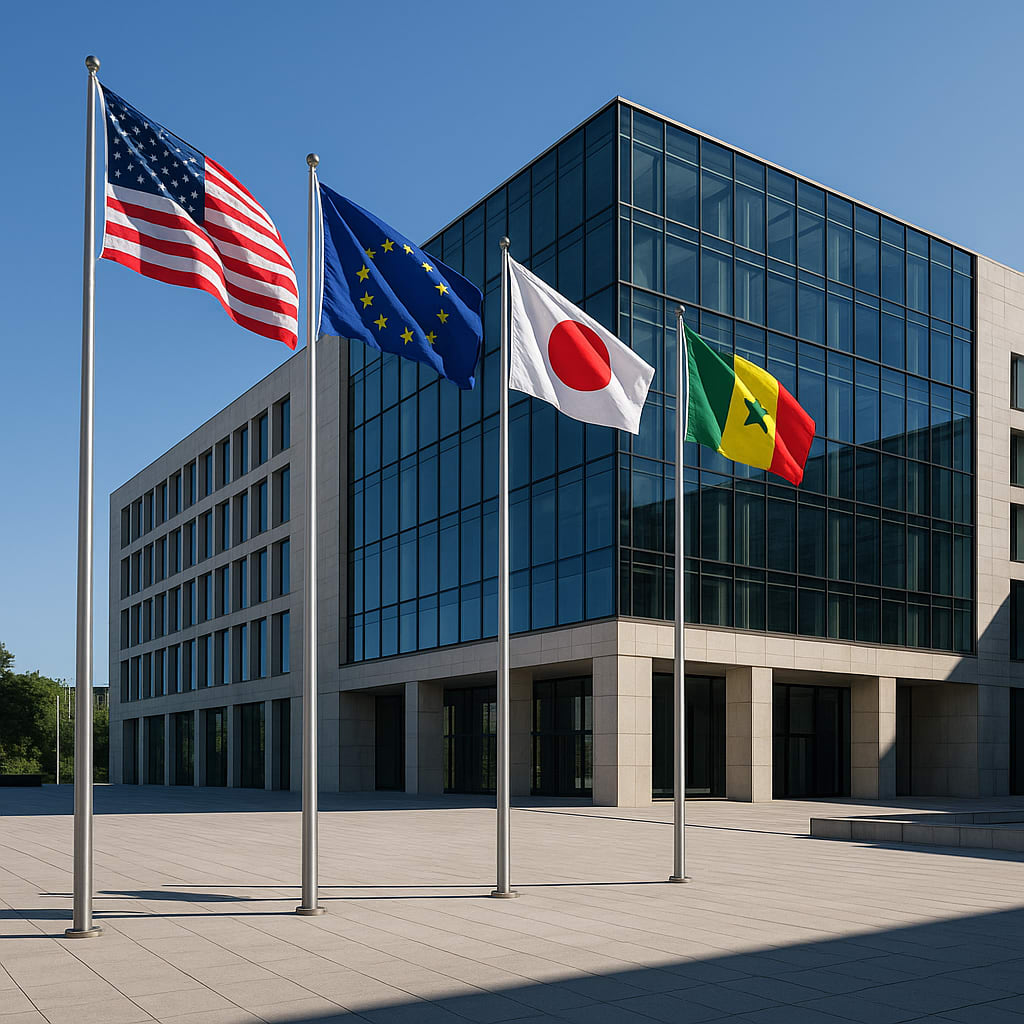
US sanctions ICC president Tomoko Akane and senior trial lawyer Abdoulaye Seye, prompting international pushback
Narrative Snapshot
Across outlets, there is broad agreement that Washington’s designations mark a further escalation in the Trump administration’s long-running confrontation with the ICC, with multiple sources labeling the move the latest step in a campaign against the court created in 2002 to prosecute atrocity crimes. The framing, however, splits along two axes: a jurisdictional argument advanced by US officials and a rule-of-law argument advanced by the court and its supporters. CGTN highlights Washington’s claim that the ICC seeks to assert authority over nationals of non-member states, which Secretary of State Marco Rubio called a dangerous precedent, while France24, Al Jazeera, Deutsche Welle, and Clarín foreground the ICC’s response that sanctions undermine the court’s independence and the rule of law.
Coverage from Middle East Eye, Tehran Times, The Guardian, and Le Monde centers the Israel/Palestine docket. The Guardian reports that Abdoulaye Seye was investigating alleged Israeli war crimes in Gaza, and Le Monde says the US measures target the heart of the Palestine investigation and any probe of nationals of non-states parties, especially Americans and Israelis. This emphasis contrasts with Bangkok Post’s and SCMP’s concise focus on Washington’s accusation that the court is politicized and has exceeded its mandate.
Japan’s position is a distinct subplot. The Japan Times frames the move as testing Tokyo’s support for multilateral justice amid alliance ties with the US, while Le Monde reports Japan called the sanctions against Japanese national Tomoko Akane “very regrettable.” Telesur underscores that the ICC Assembly of States Parties condemned the designations and notes EU members and Japan reaffirmed support for the court, situating the response within a coordinated defense by ICC backers.
What Happened
On 18 August 2026, US Secretary of State Marco Rubio announced sanctions on International Criminal Court President Tomoko Akane of Japan and ICC Senior Trial Lawyer Abdoulaye Seye of Senegal. CGTN reports the measures prohibit US persons from transactions with the two officials and effectively bar their access to the US financial system. Rubio accused them of directly engaging in ICC efforts to investigate, arrest, detain, or prosecute officials whose governments have not consented to ICC jurisdiction, language also cited by The Hindu and Le Monde. The United States is not a party to the Rome Statute establishing the ICC, as noted by multiple outlets. The ICC said the sanctions undermine the rule of law, according to France24, while Al Jazeera and Deutsche Welle report the court called them a flagrant attack. Telesur reports the ICC Assembly condemned the move, with EU states and Japan reaffirming support; Le Monde adds Tokyo deemed the sanctions “very regrettable.” The Guardian notes Seye was investigating alleged Israeli war crimes in Gaza.
Why It Matters
The sanctions crystallize a structural clash between consent-based sovereignty claims and treaty-based international criminal jurisdiction. Washington’s position, detailed by CGTN and The Hindu, rejects ICC authority over nationals of non-states parties and frames recent ICC activity as mandate overreach. By contrast, the ICC and its backers assert that punitive measures against judicial officers threaten institutional independence and the Rome Statute system’s capacity to address atrocity crimes, as reported by France24, Al Jazeera, Deutsche Welle, and Clarín. Telesur situates the action within an “escalation,” noting earlier US designations against ICC prosecutorial leadership and judges.
Allied dynamics are directly implicated. The Japan Times highlights the dilemma for Tokyo—an ICC supporter and key US ally—while Le Monde reports Japan’s public disapproval. European governments’ defense of the court, referenced by Deutsche Welle and Telesur, signals potential friction with Washington over the legitimacy of multilateral legal institutions. The Guardian and Le Monde’s focus on the Palestine investigation underscores that the measures intersect with highly sensitive dossiers involving Israel and, by extension, US interests.
Diverging Narratives
US officials present the sanctions as a defensive measure against a “politicized” institution intent on exceeding its mandate. Bangkok Post cites Washington’s characterization of the ICC as politicized, and CGTN quotes Rubio arguing the court has attempted to assert authority over nationals of countries that have not accepted its jurisdiction, calling this a dangerous precedent. Middle East Eye reports Rubio has made clear he intends to take the court apart “brick by brick,” framing the designations as part of a stated mission to dismantle the ICC for investigating Israeli and potentially US officials; Tehran Times reports similarly.
Opposing accounts accentuate institutional integrity and rule-of-law concerns. The ICC described the sanctions as undermining the rule of law and a flagrant attack on its independence, according to France24 and Al Jazeera, with Deutsche Welle noting that EU states and Japan defended the court. Telesur reports the ICC Assembly’s condemnation and warns, in its words, that escalation risks undermining ongoing investigations and complicating global efforts against atrocity crimes. The Guardian adds specificity by identifying Seye’s role in probing alleged Israeli crimes in Gaza, while Le Monde contends the US measures strike at the core of the Palestine investigation and any inquiry into nationals of non-states parties, particularly Americans and Israelis. Le Monde also reports Japan’s “very regrettable” assessment, while the Japan Times emphasizes the policy dilemma for Tokyo. Together, these accounts delineate a divide between sovereignty-first objections and a multilateral-justice defense centered on judicial independence.
What Happens Next
Key decision points flow from the stated positions. First, Washington’s course: Middle East Eye reports a declared intent to dismantle the ICC “brick by brick,” and Telesur characterizes the move as an escalation following previous designations. Analysts should watch for any additional US designations or regulatory steps affecting ICC personnel or operations, as well as official justifications anchored in jurisdictional consent.
Second, the response of ICC states parties. Telesur reports that the Assembly condemned the sanctions and that EU members and Japan reaffirmed support. Indicators to monitor include further collective statements or actions that sustain this backing, and whether public defenses from EU capitals noted by Deutsche Welle continue.
Third, Japan’s calibration. The Japan Times describes a dilemma for Tokyo, and Le Monde reports Japan called the sanctions very regrettable. Signals would include Japanese diplomatic messaging that balances alliance ties with support for the court, especially given Akane’s nationality.
Finally, casework continuity. The Guardian and Le Monde link the measures to the Palestine investigation; the ICC Assembly’s warning, reported by Telesur, spotlights whether investigations proceed without disruption.