
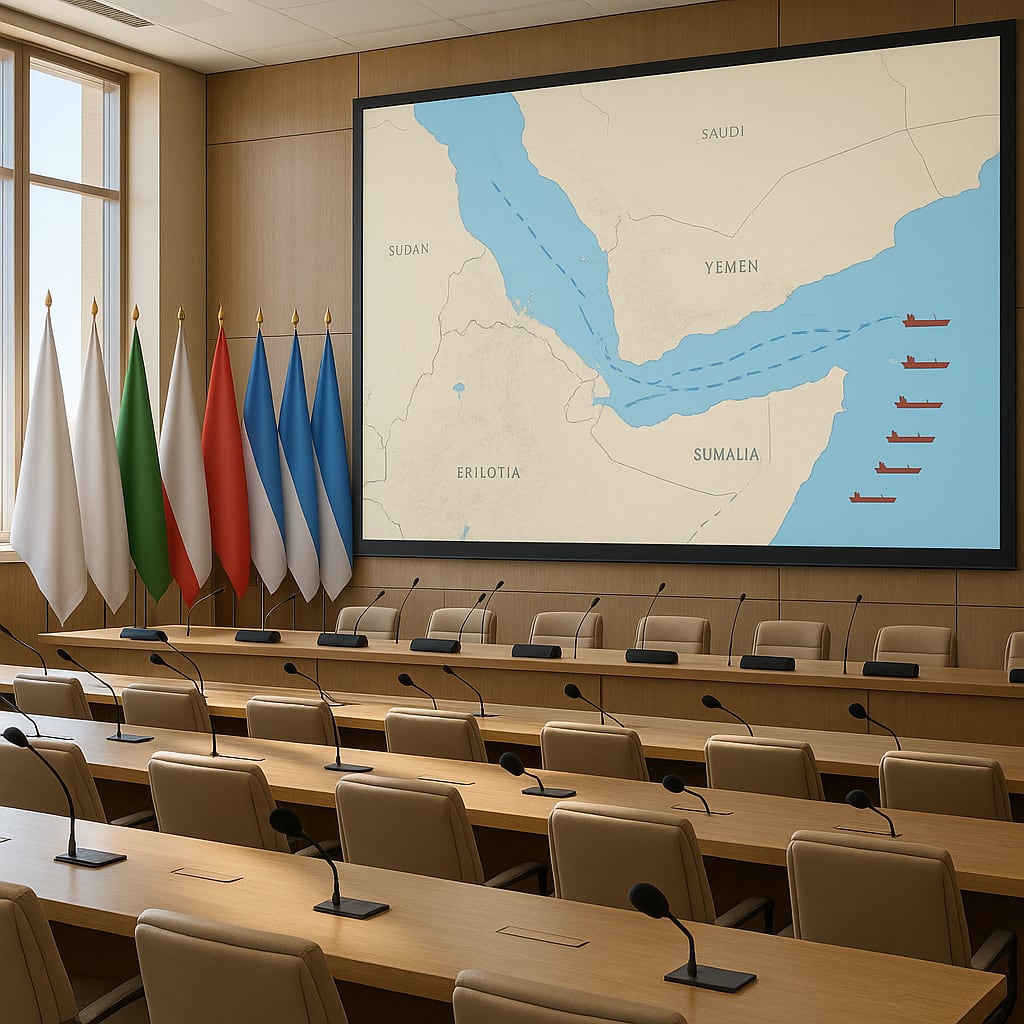
Houthis escalate strikes on Saudi energy and shipping as Riyadh activates multinational Red Sea security coalition
Narrative Snapshot
Across outlets, there is broad agreement that both the maritime and onshore theaters have intensified since mid-July, with the Houthis expanding claimed attacks on Saudi-linked shipping and infrastructure while Saudi Arabia formalizes a multinational naval response. Middle East Eye and TASS amplify Houthi spokesman Yahya Saree’s account of a self-declared maritime blockade and a tally of strikes on Saudi oil vessels, positioning these as responses to Saudi actions and as part of codified “rules of engagement.” By contrast, Arab News and RT foreground the institutional activation of a Saudi-led maritime coalition—its command structure, participating states, and intended operational focus on Red Sea and Gulf of Aden navigation.
Coverage splits in emphasis between chokepoint risk and domestic political calculus. Fox News centers the vulnerability of the Bab el-Mandeb, citing a lethal strike on the cargo ship Tihamah and raising the prospect of a “second Hormuz,” while Le Monde frames Riyadh’s dilemma: avoid entanglement in a new war with Yemen yet resist the solidification of a hostile, Iran-backed entity on its border. Meanwhile, CGTN highlights a sharp spike in Yemeni government operations against Houthi positions, underscoring that escalation is not confined to the sea lanes. The Hindu contributes a discrete data point from Houthi media about a drone strike on Saudi energy infrastructure, reinforcing the cross-domain character of the campaign.
A strand of normative interpretation appears in Middle East Eye’s commentary suggesting external actors shape the conflict’s boundaries from a “back seat,” contrasting with source-driven reporting on concrete operational choices—coalition-building, interdictions, and retaliatory strike patterns. UKMTO’s incident reporting functions as a neutral baseline on maritime harm, detailing damage assessments without apportioning responsibility.
What Happened
Houthi outlets said on 18 August the group targeted Saudi Aramco’s Jazan refinery with several drones, describing it as retaliation for airspace violations over Saada and Hajjah (The Hindu). UKMTO reported a cargo vessel was struck by multiple unknown projectiles 40 nautical miles southeast of Mocha and was unmanned at the time, sustaining a “complete constructive loss” (Middle East Eye, 18 Aug). Houthi spokesman Yahya Saree claimed eight Saudi oil vessels had been targeted since a 20 July ban on Saudi maritime shipping, and warned that “any comprehensive escalation will be met with comprehensive escalation” (Middle East Eye, 19 Aug; TASS). In parallel, Saudi Arabia announced the operational launch of a multinational maritime coalition for the Red Sea and Gulf of Aden, with 13 countries completing formalities and 15 signing a joint statement; Saudi Arabia will provide the first commander and Pakistan the deputy (RT; Arab News). Turkey confirmed participation in coalition planning (Middle East Eye, 13 Aug). Onshore, Yemeni government forces reported 181 operations against Houthi targets in 24 hours (CGTN), and officials said Houthi missile and drone strikes damaged Mocha port and civilian property in Marib (Middle East Eye, 16 Aug). Fox News reported fatalities from a Houthi strike on the Egyptian-owned Tihamah in Bab el-Mandeb.
Why It Matters
The reported mix of maritime interdictions, port strikes, and refinery targeting tests the resilience of a trade corridor that multiple sources identify as strategically central. RT links the Red Sea route’s importance to broader regional disruptions, while Fox News frames Bab el-Mandeb as a potential analog to the Strait of Hormuz, underscoring the limits of naval power in a fragmented Yemeni theater. The Saudi-led coalition’s activation—supported by Turkey and involving coordination among dozens of states per Arab News—signals an emergent, Saudi-centered security architecture intended to protect commercial navigation and share operational intelligence.
Le Monde’s depiction of Riyadh’s balancing act highlights a policy trap for Saudi decision-makers: avoid escalation that could entrench long-term conflict while countering a neighboring actor aligned with Iran. Concurrently, CGTN’s account of intensified government-Houthi fighting points to a land war dynamic that shapes, and may constrain, maritime risk mitigation. The UKMTO’s neutral incident reporting remains a critical operational reference for shipowners and insurers navigating heightened uncertainty.
Diverging Narratives
Actor intent and legitimacy are framed differently across sources. Houthi statements, carried by Middle East Eye and echoed by TASS, cast maritime actions as enforcement of a self-declared ban on Saudi shipping and defense of Yemeni sovereignty, complete with “rules of engagement” and quantified claims of forcing Saudi oil vessels to retreat. Saudi and allied outlets, including Arab News and RT, emphasize coalition-building to ensure freedom of navigation and protect commercial routes, detailing command integration and multinational participation rather than enumerating strike counts.
On harm and attribution at sea, UKMTO reports an unmanned vessel’s “complete constructive loss” near Mocha without assigning responsibility, whereas Fox News attributes a deadly strike on the Tihamah to the Iran-backed Houthis and situates it as potentially the first such fatalities in shipping since late February, citing Reuters. Onshore, Middle East Eye reports civilian harm and economic losses at Mocha port from Houthi attacks, while CGTN foregrounds Yemeni government claims of extensive operations causing Houthi casualties across seven provinces, each side presenting its actions as responsive. Le Monde’s note on Saudi reluctance to enter a new war contrasts with Houthi warnings of reciprocal “comprehensive escalation,” and Middle East Eye’s commentary posits external powers shaping conflict boundaries—an interpretive layer not reflected in the operational reporting from Arab News, RT, UKMTO, or CGTN.
What Happens Next
Three decision points emerge. First, coalition operationalization: Saudi Arabia’s next steps in activating command, intelligence sharing, and patrol patterns—along with Turkey’s and Pakistan’s roles—will indicate whether the coalition moves from planning to sustained deterrent presence (RT; Arab News; Middle East Eye, 13 Aug). Analysts should watch for deployments, joint exercises, and changes in UKMTO advisories along the Red Sea and Gulf of Aden.
Second, escalation thresholds: Houthi statements link further actions to Saudi restrictions and warn of reciprocal expansion (Middle East Eye, 19 Aug). Indicators include additional strikes on energy infrastructure like Jazan (The Hindu) and quantified claims of interdictions or retreating vessels (Middle East Eye, 19 Aug; TASS).
Third, the land-maritime interplay: Yemeni government reporting of concentrated operations and Houthi strikes on Mocha and Marib suggest battlefield dynamics that can amplify or reduce maritime risk (CGTN; Middle East Eye, 16 Aug). Resumption or prolonged suspension of commercial operations at Mocha, alongside any Saudi decisions to avoid or engage deeper militarily as described by Le Monde, will shape the trajectory of both fronts.