
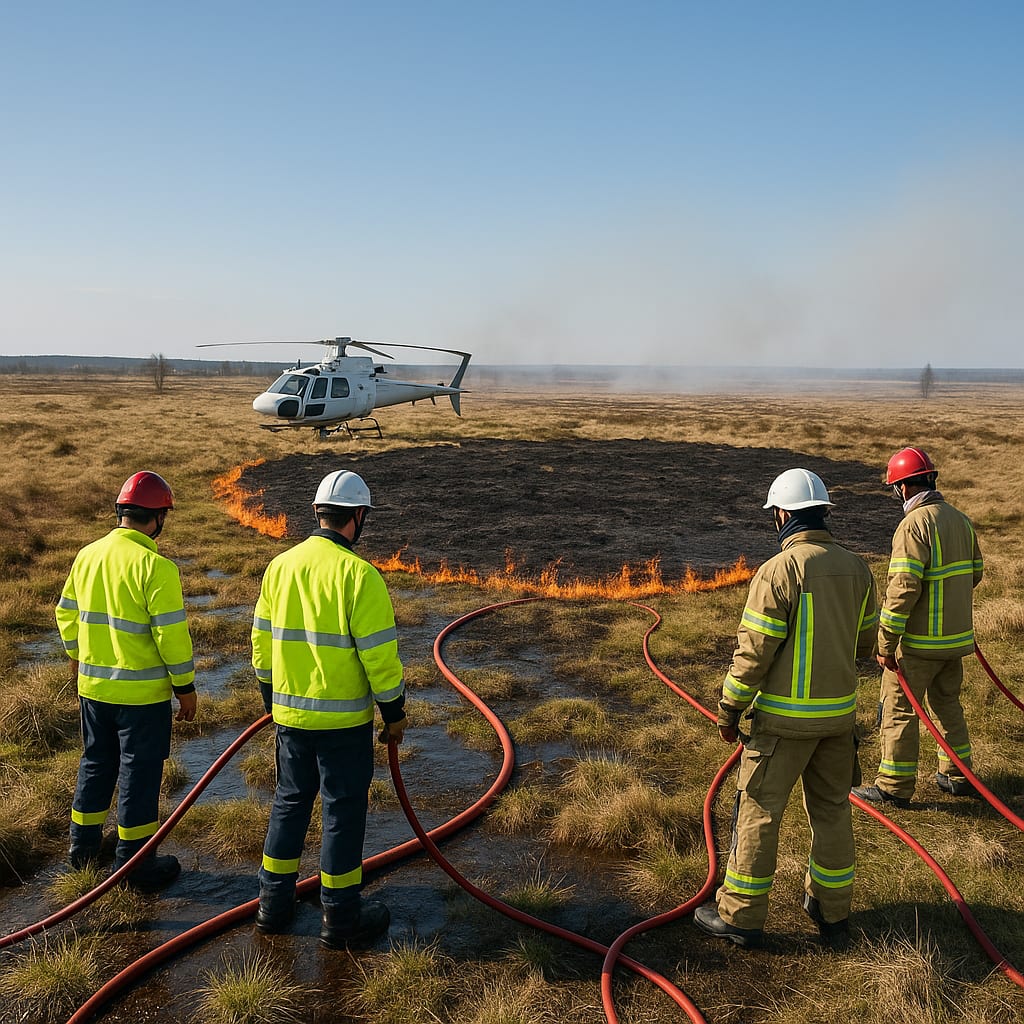
Belgium moves to encircle record High Fens wildfire as rains assist containment
Narrative Snapshot
Across outlets, the scale and uniqueness of the outbreak are treated as settled facts, with converging estimates that about 3,000 hectares burned—roughly half the size of Manhattan—after the fire’s rapid expansion in its early days. European and Asian coverage alike adopt superlatives but with different baselines: “largest in modern history” (France24) and “biggest on record” (CGTN) sit alongside “largest in a century” (Bangkok Post), while both The Hindu and Deutsche Welle quantify the footprint as half of Manhattan. CGTN adds a comparative benchmark, noting the blaze far exceeded Belgium’s 2011 fire of about 1,400 hectares.
Operationally, reporting coalesces around a multinational, resource-intensive campaign in a hard-to-access reserve. France24 highlights EU reinforcements and local farmers alongside firefighters; CGTN specifies three EU helicopters and two water bombers, plus crews from Belgium, Germany, and Luxembourg, with support from the army and evacuations of tourists and a children’s camp. Several outlets stress competing weather effects: Deutsche Welle underscores rains and cooler temperatures aiding containment, while Bangkok Post and France24 detail wind, rain, and extreme heat that complicated work, including air operations emphasized by the South China Morning Post as crucial in the reserve’s terrain.
The stakes are framed through proximity to Germany and the need to protect communities on both sides of the border. Al Jazeera reports 600 residents evacuated as the fire spread toward German towns; France24 cites hundreds of villagers displaced in Belgium; and Deutsche Welle notes precautionary evacuations in Monschau while underscoring that the blaze was kept out of Germany at that point. Even with signs of progress, Le Monde quotes Belgium’s interior minister warning that full extinguishment could take weeks, signaling a prolonged operational commitment.
What Happened
The fire broke out in the High Fens nature reserve near Belgium’s German border on a Friday and rapidly intensified in difficult terrain of boggy peatlands and pine forests. By Saturday 1600 GMT, authorities reported 2,700 hectares burned, up from 1,600 earlier that day and from 80 hectares on Friday, with the area doubling in 24 hours, and EU aircraft—three helicopters and two water bombers—deployed alongside firefighters from Belgium, Germany, and Luxembourg, the army, and local farmers. Evacuations followed: residents in several villages, tourists, and a children’s camp, with hundreds displaced and 600 residents leaving as the blaze pushed toward German border towns. By the following days the footprint reached roughly 3,000 hectares, about half of Manhattan. Cooler temperatures and rain aided containment even as wind and rain hampered air support. German authorities said the fire was kept out of Germany for now, while Belgium’s interior minister warned that full extinguishment would take weeks.
Why It Matters
This incident tests cross-border emergency coordination and surge capacity in a densely settled frontier area. EU aircraft deployments, reinforcements referenced by France24, and crews from neighboring Germany and Luxembourg indicate the operational value of pooled assets when terrain limits ground access and air support becomes pivotal. The High Fens’ hard-to-access landscape amplified reliance on aviation that, per Bangkok Post, can be constrained by adverse wind and rain, underscoring a planning challenge for European responders who must anticipate both heat-driven spread and weather-induced interruptions to air operations.
The fire’s status as Belgium’s largest on record—exceeding the 2011 benchmark—sets a new scale assumption for national planning and mutual-aid expectations. With evacuations reported on both sides of the border and Le Monde citing an official horizon of weeks to fully extinguish, authorities face sustained resourcing, rotating international crews, and community protection measures that could stress logistics and public communication across jurisdictions.
Diverging Narratives
Sources differ less on facts than on framing and temporal emphasis. On containment progress, Bangkok Post reports a push to “encircle” the blaze, while Le Monde quotes the interior minister saying the fire is “encircled” but that the situation remains “complicated” and will require weeks to extinguish. These are consistent with an evolving perimeter but expose different thresholds between establishing a line and achieving suppression.
Weather’s role is cast in contrasting operational terms. Deutsche Welle highlights that rains and cooler temperatures helped bring the fire “to heel,” whereas France24 stresses shifting winds and extreme heat complicating efforts, and Bangkok Post notes wind and rain hampering air support. Together they point to weather as both a suppressant and an operational constraint, especially for aviation.
Characterizations of scale are superlative yet nonidentical: “largest in modern history” (France24), “largest in a century” (Bangkok Post), and “biggest on record” (CGTN), with CGTN explicitly comparing the fire to 2011’s 1,400-hectare event. On cross-border risk, Al Jazeera reports spread toward German towns and significant evacuations, while Deutsche Welle emphasizes that the fire was kept out of Germany at the time of its reporting, even as Monschau residents were evacuated as a precaution.
What Happens Next
Two decision points will shape the trajectory. First is whether the encirclement holds and transitions into systematic extinguishment. Indicators include official updates on the perimeter’s integrity and burn area remaining near 3,000 hectares as reported by The Hindu, Japan Times, and Deutsche Welle, alongside Le Monde’s “weeks” outlook. Weather will be pivotal: further rains and cooler temperatures aiding ground crews (Deutsche Welle) versus conditions that limit flight hours for tankers and helicopters (Bangkok Post, South China Morning Post).
Second is cross-border risk management. Deutsche Welle’s note that the fire was kept out of Germany, paired with earlier evacuations in Monschau, sets a baseline for monitoring any renewed eastward spread. Signals include changes in evacuation posture reported by Al Jazeera and France24, additional deployments or drawdowns of EU aircraft detailed by CGTN, and any expansion of German or Luxembourg support. A stable perimeter with tapered evacuations would suggest consolidation; renewed evacuations or asset surges would imply fresh threats to containment.