
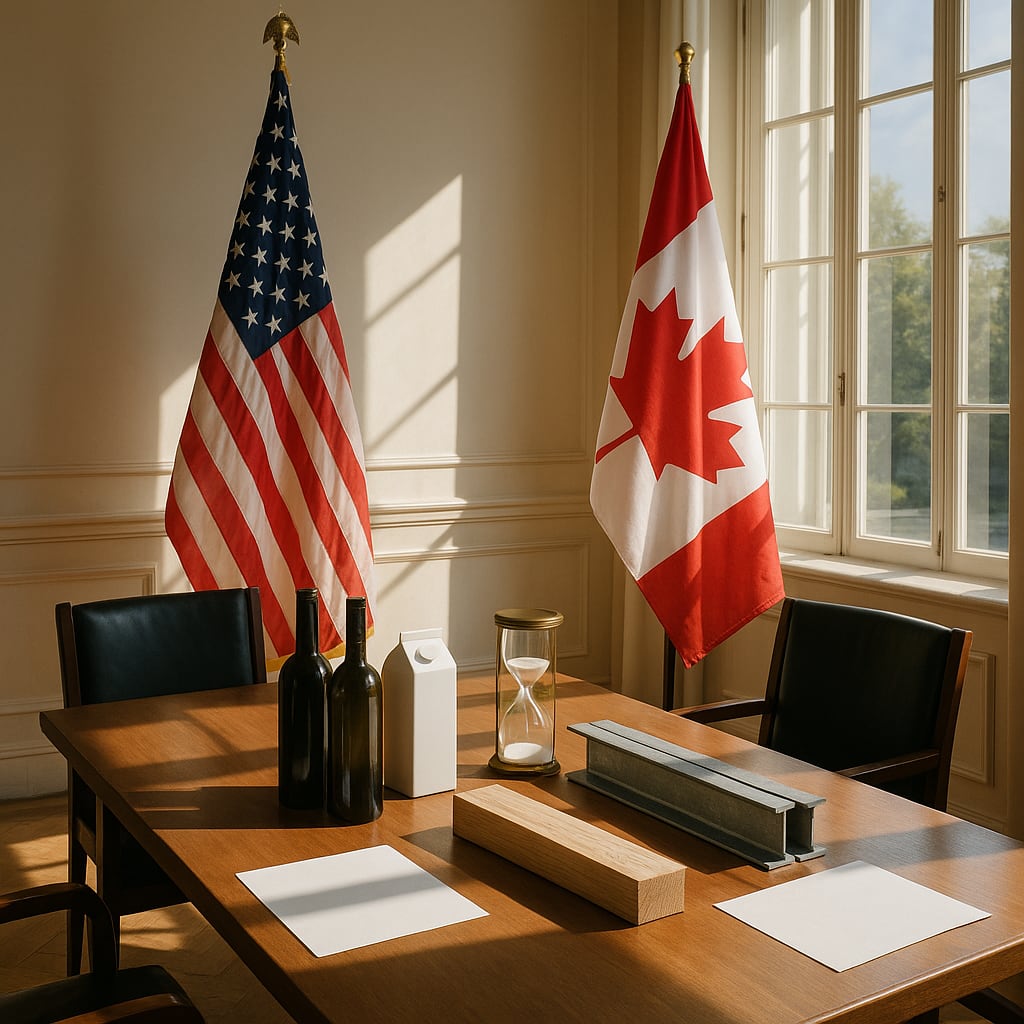
Trump pauses 50% tariffs on Canadian goods for three days as talks continue; Ottawa cites “substantial progress”
Narrative Snapshot
Across mainstream outlets, there is broad agreement that the tariff pause was announced at the last possible moment and framed by the White House as evidence a deal is near, while Canadian reporting stresses that negotiations remain unfinished. U.S. and international wires and broadcasters emphasize the three-day window and the breadth of goods that could be hit if talks fail, from dairy and alcohol to building materials and furniture. Canadian coverage focuses on domestic political and sectoral stakes, including pressure from provinces and industries and the knock-on effects for the renegotiation of the Canada-U.S.-Mexico Agreement. Elsewhere, tone diverges sharply: some outlets amplify President Trump’s claim of a “very fair” agreement, others highlight ambiguity around whether a deal exists at all, and still others center the dispute on Canada’s provincial alcohol rules and dairy market access.
What Happened
President Donald Trump ordered steep new U.S. tariffs of up to 50 percent on a wide range of Canadian imports, alleging discriminatory treatment of U.S. alcohol, automotive, and dairy products, with implementation slated just after midnight on August 19 (South China Morning Post; NBC News). After urgent leader-level calls on Monday and Tuesday, Trump announced on social media roughly 90 minutes before the deadline that he would pause the tariffs for three days, saying the United States and Canada had a deal subject to the finalization of documents (New York Times; BBC; CGTN). Canadian Prime Minister Mark Carney said only that “substantial progress” had been made and more work was needed (The Guardian). The proposed measures targeted roughly $20 billion in U.S. imports from Canada, including dairy, alcohol, and furniture (CGTN), with other reports citing hockey sticks, cement, clothing, and building materials among affected goods (NBC News; SCMP).
Why It Matters
The pause lands amid renegotiation pressures on North America’s trade framework and highlights the fragility of economic predictability between two tightly integrated economies, whose bilateral trade reached an estimated $909 billion in 2024 (The Guardian). Canadian analysts warn that the tariff threat could weaken Ottawa’s leverage in broader CUSMA talks (Toronto Star, Aug. 17), while others argue Canada should resist rushing into concessions, citing macroeconomic resilience (Toronto Star, Aug. 15). The dispute also exposes the salience of subnational rules in cross-border trade: U.S. spirits interests link the conflict to Canadian provincial restrictions on American alcohol (Fox News), and Quebec’s premier has publicly pressed Ottawa for details while maintaining existing limits on U.S. alcohol sales (Clarín, Aug. 20). For decision-makers, the episode underscores how sector-specific market access fights—particularly in dairy and alcohol—can escalate quickly into system-wide uncertainty affecting supply chains and investment (CBC News; NBC News).
Diverging Narratives
Accounts differ on whether the countries have a deal or merely a pathway to one. Trump characterized the outcome as a three-day pause premised on an agreement awaiting documentation and later described a “very fair” arrangement that would ensure no tariffs for U.S. farmers and businesses exporting to Canada (CGTN; Al Jazeera English, Aug. 19). Canadian officials, by contrast, publicly marked only “substantial progress” and emphasized ongoing work (The Guardian), while Canadian media urged caution about caveats in Trump’s announcement (Toronto Star, “Beware of the subclause”). International coverage also splits on emphasis: some present a straightforward suspension pending talks (BBC; Sky News; Bangkok Post; The Hindu), others note limited clarity after repeated leader calls (Japan Times), and some adopt a skeptical stance about the stability of any deal, pointing to immediate discrepancies between the two sides’ statements (RT). On causation, the White House’s charge of Canadian discrimination against U.S. alcohol, autos, and dairy (SCMP) contrasts with Canadian political and public responses spotlighting protests and domestic pushback (Clarín, Aug. 18). The scope of potential impact is framed expansively by U.S. and Canadian outlets listing broad product categories (NBC News; CGTN), while one commentary minimizes what remains outside existing North American agreements, focusing on alcohol, hockey gear, and wood and paper products (RT).
What Happens Next
Three decisions will determine the path forward. First, whether negotiators translate the announced “pause” into signed text within the three-day window; failure would risk the tariffs taking effect on roughly $20 billion of imports, with knock-on supplier shifts already flagged by U.S. businesses (CGTN; CBC News). Second, whether Ottawa adjusts sectoral access in ways consistent with reported U.S. priorities. Analysts point to technically expanding tariff-free dairy import licences without altering quotas or tariffs (Toronto Star, “Why Ottawa shouldn’t mess with Quebec’s milk”) and to easing provincial barriers to U.S. spirits, a demand amplified by U.S. industry (Fox News) and complicated by Quebec’s stance that talks are “far from over” and current restrictions remain (Clarín, Aug. 20). Third, how any interim deal intersects with CUSMA renegotiation dynamics, given warnings that tariff brinkmanship could erode Canada’s bargaining position (Toronto Star, Aug. 17). Analysts should watch for official text, provincial signals on alcohol policy, and any dairy licensing moves.