
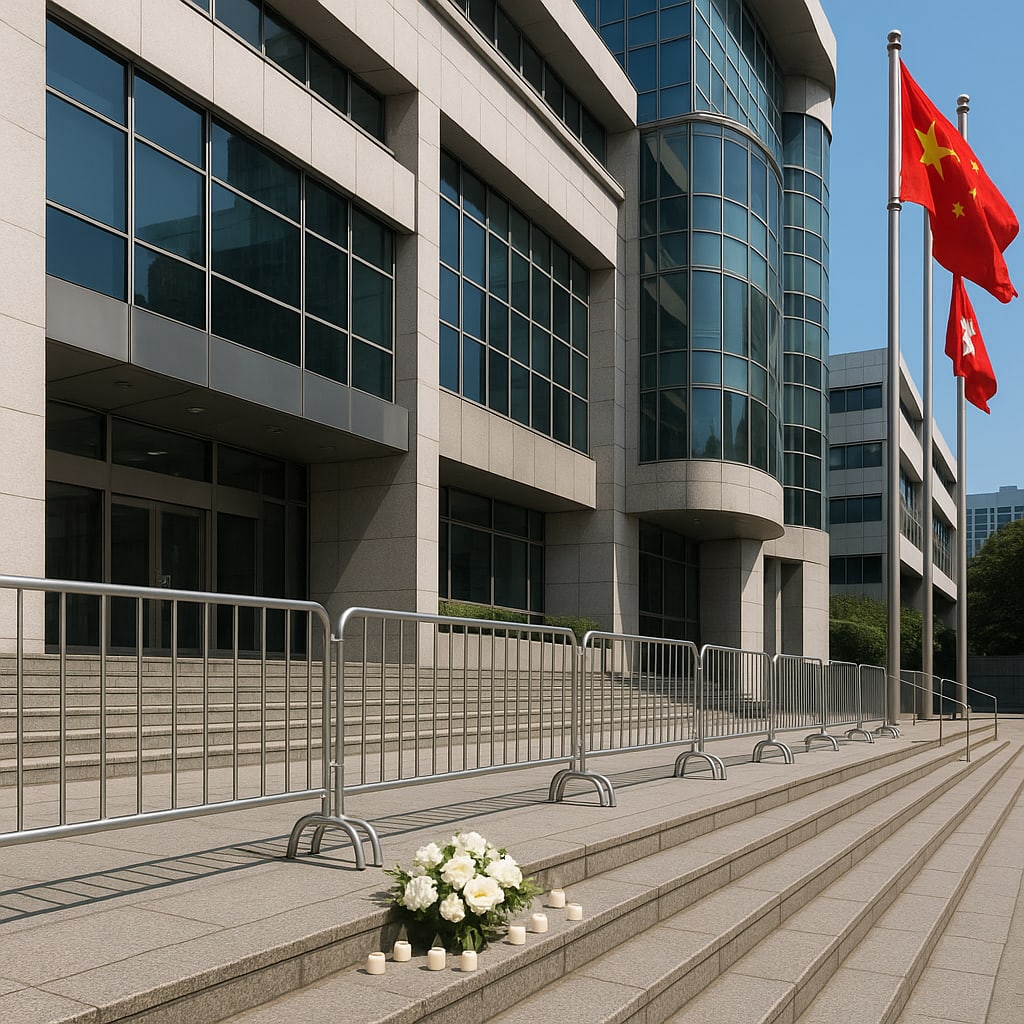
Hong Kong convicts two Tiananmen vigil leaders of inciting subversion under national security law
Narrative Snapshot
Across international coverage, there is broad agreement on the core facts: two former leaders of the group behind Hong Kong’s annual Tiananmen vigils were convicted of inciting subversion under the China-imposed national security law. Many outlets frame the case as emblematic of shrinking political space. Deutsche Welle and the Guardian emphasize that the proceedings highlight a deterioration of freedom of expression, while France24 and CBC underline that the security law has effectively crushed what was a once-thriving pro-democracy movement.
A contrasting strand centers on official legitimacy. The South China Morning Post highlights a forceful government response rejecting Western “slander,” insisting the verdict is “well-reasoned and sound.” France24 notes the case was decided by government-approved judges, a detail Western outlets cite to question the independence of the process.
Some outlets surface evidentiary specifics, affecting how readers assess “incitement.” Folha de S.Paulo reports the court’s focus on the repeated use of the phrase “end the one-party dictatorship,” while the Guardian references a press summary stating the pair incited others to organize or participate in acts by unlawful means to subvert state power. Elsewhere, the Toronto Star pivots to how commemoration persists informally through individuals like Tang Ngok-kwan, shifting attention from legal arguments to the social afterlife of the vigil.
What Happened
Two Hong Kong pro-democracy figures, Lee Cheuk-yan and Chow Hang-tung, former leaders of the now-dissolved Hong Kong Alliance in Support of Patriotic Democratic Movements of China, were convicted on August 21, 2026, of inciting subversion under the national security law (Japan Times; France24; Le Monde). They were charged in 2021 (France24; Toronto Star, Aug. 20). A press summary cited by the Guardian said they incited others to organize, plan, commit or participate in acts by unlawful means with a view to subverting state power. Folha de S.Paulo reported the court pointed to their repeated use of the phrase “end the one-party dictatorship.” France24 noted the verdict was delivered by government-approved judges under the China-imposed law. Most outlets report two defendants; BBC News said three activists were accused under the law. Le Monde reported the pair face up to ten years in prison. The Alliance had organized Hong Kong’s decades-old June 4 vigil (Sky News; CBC; Toronto Star).
Why It Matters
The case extends the national security law’s reach squarely into the realm of commemoration and civil society leadership, not only street mobilization. Multiple outlets report that the law has effectively dismantled Hong Kong’s pro-democracy movement (France24; CBC), and rights advocates argue the convictions deepen a broader erosion of free expression (Deutsche Welle; Guardian). Amnesty International called for the activists’ immediate and unconditional release (Al Jazeera), indicating sustained rights-based scrutiny.
Official pushback against foreign criticism, highlighted by the South China Morning Post, signals that authorities view such cases as legally orthodox within the post-2020 security framework and will defend them vigorously. For policymakers and institutions tracking rule-of-law baselines and civic space in Hong Kong, these narratives illustrate a hardened enforcement posture and an increasingly constrained environment for political remembrance—dimensions that shape external assessments and responses, including public messaging and monitoring of civil society resilience reported by outlets such as the Toronto Star.
Diverging Narratives
Rights-focused coverage contends the convictions exemplify curtailed freedoms. Deutsche Welle and the Guardian explicitly link the case to declining freedom of expression, and Al Jazeera relays Amnesty’s demand for immediate release. Another Al Jazeera report cites an activist group’s view that a “twisted” judicial system had predetermined guilt, underscoring skepticism toward procedural fairness.
State- and pro-establishment framing, as reported by the South China Morning Post, rejects those critiques, asserting the verdict is “well-reasoned and sound” and condemning Western statements as “baseless slander.” France24’s detail that government-approved judges handled the case is presented by Western outlets as context for concerns, while the SCMP presents official confidence in the court’s reasoning.
There are also factual emphases that shape interpretation. Folha de S.Paulo spotlights the defendants’ use of “end the one-party dictatorship” as pertinent to incitement, and the Guardian cites a press summary stressing “unlawful means.” BBC News mentions that three activists were accused, whereas most outlets focus on two convicted leaders, reflecting variance in how the case’s scope is described. The Toronto Star’s reporting on quiet acts of remembrance introduces a societal dimension distinct from legal and diplomatic frames.
What Happens Next
Sentencing is a central decision point. Le Monde reports the pair face up to ten years in prison; the severity of the sentence will indicate how courts apply the national security law to nonviolent political expression and commemoration. Analysts should watch for the court’s full reasoning, including how it interprets phrases like “end the one-party dictatorship” noted by Folha de S.Paulo and the “unlawful means” language cited by the Guardian, as indicators of the threshold for incitement.
A second vector is the official response to external criticism. The South China Morning Post’s account of authorities’ rebuttal suggests continued assertive messaging; subsequent government statements and diplomatic exchanges will signal whether that stance hardens or modulates. Finally, as the Toronto Star documents ongoing individual acts of remembrance, monitoring whether such activities draw official responses will clarify the practical enforcement boundaries around Tiananmen-related commemoration under the national security law.