
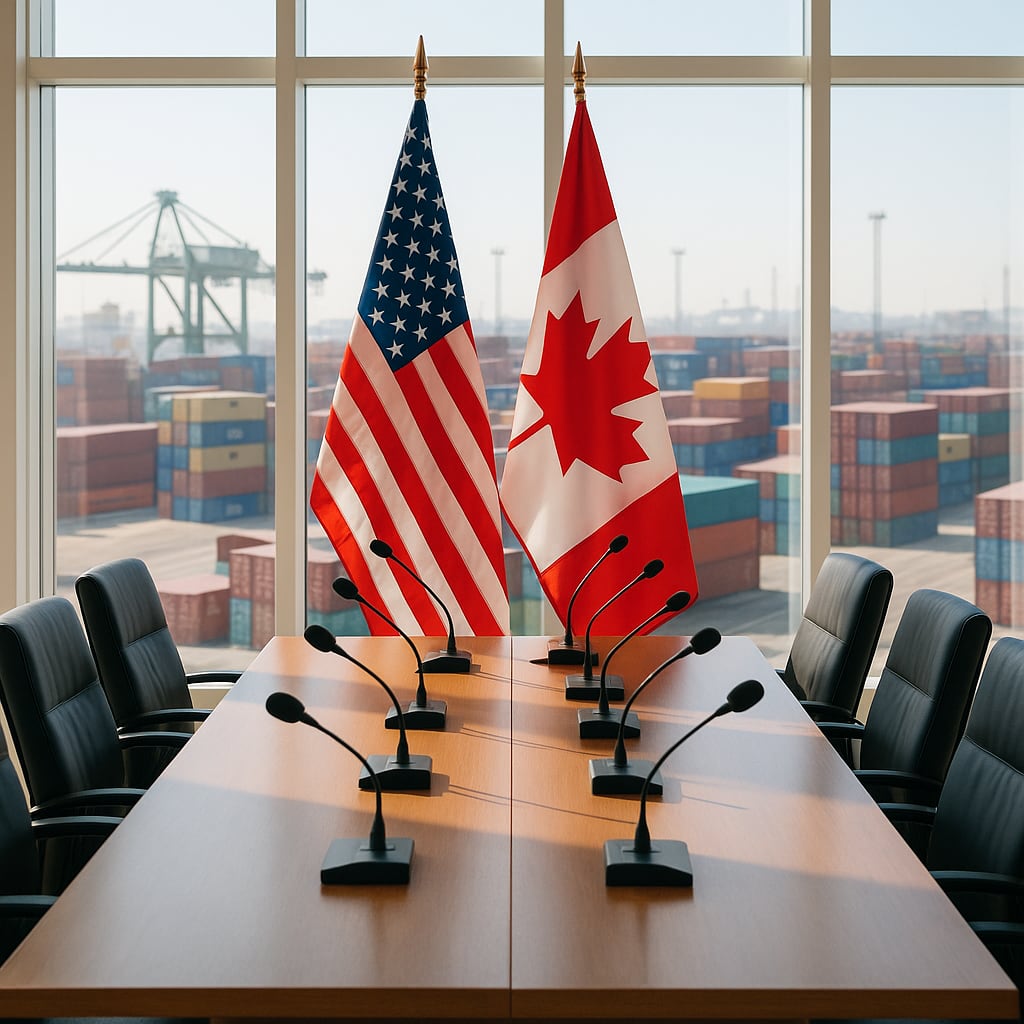
US imposes 50% tariffs on $20 billion of Canadian goods after talks collapse; Ottawa vows dollar-for-dollar retaliation
Narrative Snapshot
Across outlets there is broad agreement on the scope and immediacy of Washington’s move and Ottawa’s response: 50% US duties on roughly $20 billion of Canadian imports took effect after negotiators failed to close a deal, and Prime Minister Mark Carney pledged “dollar-for-dollar” retaliation (Japan Times; Le Monde; France24; Al Jazeera English; The Hindu; South China Morning Post). Coverage diverges, however, on why the talks failed and what was on offer at the end. Canadian and Chinese outlets foreground Carney’s charge that last-minute US changes were “unfair” and undermined the reliability of any agreement, alongside the rare use of Section 338 authority (CGTN; RT). By contrast, US and Brazilian reporting highlights USTR Jamieson Greer’s claim that Canada walked away from “the best deal,” including proposed US reductions on steel, autos, and lumber tariffs (Fox News; Folha de S.Paulo).
What is most at stake is framed differently by geography. Asian and European outlets emphasize the macroeconomic risk and political signaling to allies, including warnings from Washington that a trade war would be “devastating” for Canada (South China Morning Post) and the breakdown’s implications for allied cooperation (France24; Le Monde). Canadian-focused reporting elevates Ottawa’s potential leverage through energy interdependence, citing Carney’s televised reminder that Canada supplies the overwhelming majority of US natural gas and significant shares of electricity and crude (Toronto Star; Telesur English). Several outlets also illustrate how the tariff schedule reaches deeply into integrated North American supply chains and consumer markets, from industrial inputs to unexpected consumer goods such as waterproof coats, national flags, and even types of confetti (South China Morning Post; Folha de S.Paulo).
What Happened
Following a three-day pause announced on August 19 while leaders claimed a deal was near, US-Canada negotiations collapsed late on Friday, August 21, in Washington (CGTN; BBC News). At midnight Saturday, the United States imposed 50% tariffs on about $20 billion of Canadian goods—around 5% to 5.5% of Canada’s exports to the US—using Section 338 of the 1930 Tariff Act (Japan Times; The Hindu; CGTN; RT). Prime Minister Mark Carney suspended talks, directed negotiators to return to Ottawa, and pledged to match the duties “dollar for dollar” (CGTN; Le Monde; France24; Al Jazeera English). Ottawa said the counter-tariffs, effective September 8, would target sectors including dairy, steel, appliances, pulp and paper, and electronics (CGTN; Daily Nation; Telesur English). The US warned Canada it would be “foolish” to think it could win a trade war, while President Trump escalated rhetoric online (South China Morning Post; The Guardian; France24). On August 24, Trump announced plans to impose 50% tariffs on Canadian vehicles and steel starting in January 2027 (Telesur English).
Why It Matters
The rupture tests the credibility and resilience of North America’s trade architecture and dispute-management norms under CUSMA. Carney explicitly linked the breakdown to concerns about the United States’ reliability and warned that repeated disregard for existing agreements sends a negative signal for any renewal process (CGTN). The decision to invoke Section 338, a rarely used tool allowing up to 50% duties where US commerce faces “unequal or discriminatory” treatment, widens the aperture for discretionary, unilateral tariffs and will be closely read by other partners weighing exposure to US trade policy (RT; CGTN). European and Canadian commentary situates the episode in a broader trend toward US primacy of national objectives over shared economic coordination, raising questions about the benefits of engagement versus decoupling strategies for close allies (The Guardian; France24; Le Monde). Energy interdependence heightens the stakes: Canada publicly underscored its centrality to US natural gas, electricity, and crude supplies (Toronto Star; Telesur English).
Diverging Narratives
The core dispute over causation is stark. Ottawa says US negotiators introduced last-minute conditions that were “unfair” and “uneconomic,” undermining trust in any agreement; Carney suspended talks and recalled his team accordingly (CGTN; RT). Washington counters that Canada walked away from “the best deal,” asserting the US had offered to cut tariffs on steel, autos, and aluminum and to remove a new softwood lumber duty (Fox News; Folha de S.Paulo). France24 reports both sides blame the other for late changes. The parties also signal different theories of leverage. Carney highlighted Canada’s role in US energy security without announcing energy-specific measures, while US officials warned Canada it would be “foolish” to think it could prevail, predicting “devastating” consequences (Toronto Star; South China Morning Post). Even the composition of targeted goods pulls coverage apart: some outlets emphasize sectoral breadth, from hockey equipment to construction materials, while others stress the eclectic nature of the tariff list, down to flags and confetti, underscoring how widely the measures can ripple through supply chains and consumer markets (Telesur English; South China Morning Post; Folha de S.Paulo).
What Happens Next
Three decision points emerge from the record. First, Canada’s announced counter-tariffs are slated to start September 8; analysts should watch whether Ottawa finalizes the lists as telegraphed—covering dairy, steel, appliances, pulp and paper, and electronics—and at matching 50% rates (CGTN; Telesur English). Second, the diplomatic track is paused: Canada suspended talks, and USTR Jamieson Greer said no further negotiations are scheduled. Any change in that posture—public or backchannel—would be a key signal (CGTN; Fox News). Third, escalation signals warrant close monitoring. Trump’s subsequent announcement of 50% tariffs on Canadian vehicles and steel in 2027, if carried through administrative processes, would widen the conflict materially; confirmation steps or implementing actions will indicate intent (Telesur English). Across all paths, rhetoric and any move to link trade retaliation to energy flows—invoked in Ottawa’s messaging but not operationalized—will shape risk assessments (Toronto Star; Telesur English).