
Adilet wins Kazakhstan’s new Kurultai election; OSCE cites limited political choice
Narrative Snapshot
Across outlets, the outcome is uncontested but its meaning diverges. Russian state media foreground the Central Election Commission’s figures and swift congratulations from Moscow, centering institutional normalcy and partnership. Al Jazeera and the Toronto Star frame the vote chiefly as a consolidation of President Kassym-Jomart Tokayev’s authority, noting Adilet’s recent formation as part of the political reconfiguration. Deutsche Welle and the Bangkok Post stress constraints on competition, citing the banning of opposition parties and the OSCE’s assessment of a lack of political choice.
Coverage also differs on forward-looking signals. South China Morning Post elevates Tokayev’s remark that he has the right to seek re‑election, positioning the vote within a potential extension of his tenure. CGTN emphasizes the mechanics of the new constitutional order and scale of voting, treating the election as an administrative transition to a unicameral legislature rather than a contest over pluralism. What is at stake in these framings is whether the reform is read primarily as institutional consolidation or as procedural modernization under tight political control, with implications for Kazakhstan’s management of ties between Russia and Western institutions.
What Happened
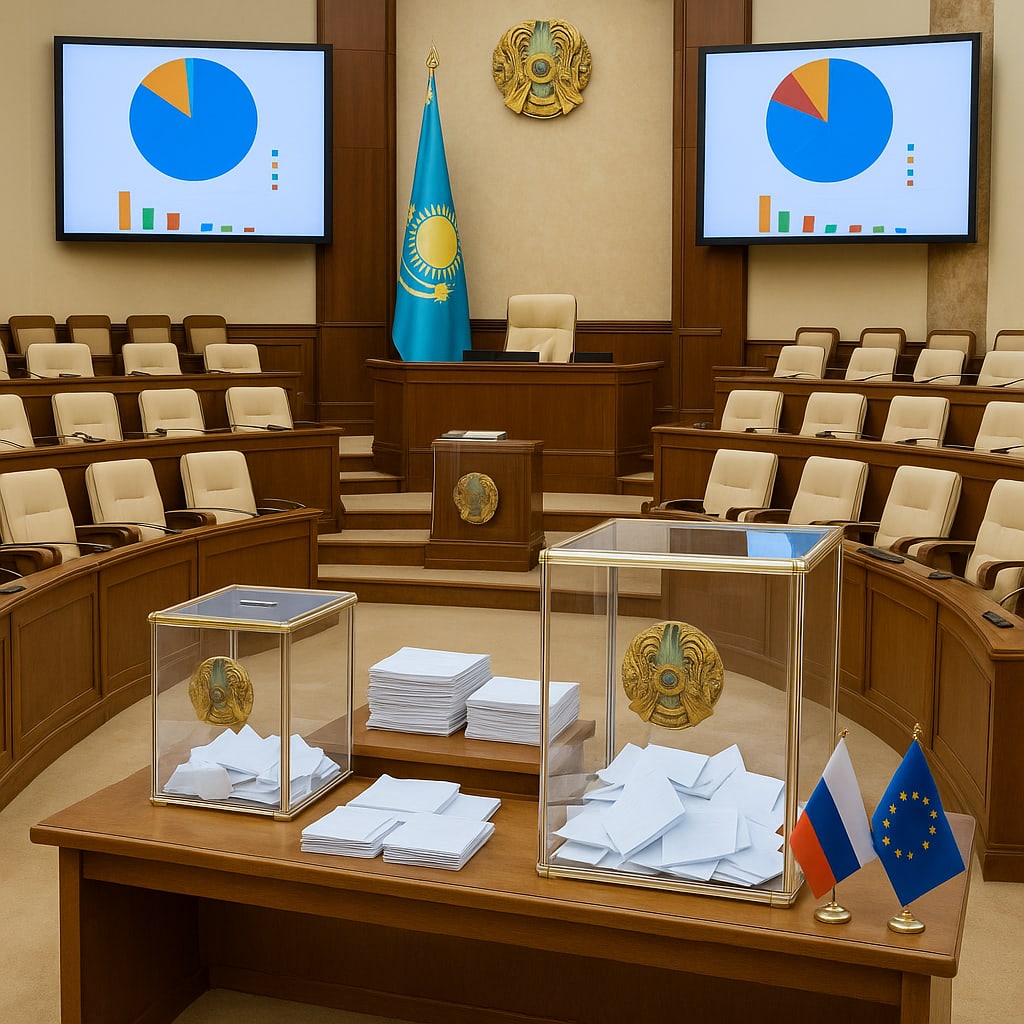
Kazakhstan held elections for a new unicameral parliament, the 145‑member Kurultai, created under a constitution that took effect on July 1, replacing the bicameral Mazhilis and Senate. The Central Election Commission organized voting across 10,423 polling stations for more than 12.6 million registered voters, with 545 candidates from seven parties on the ballot. Exit polls released on state television showed the pro‑Tokayev Adilet party taking about 71.8 percent of the vote, with the agrarian Auyl party second at roughly 6.4 percent. The CEC later reported Adilet received 71.17 percent, and that five parties won seats. According to reporting that listed threshold‑crossers, Respublica, Ak Zhol, and the National Social Democratic Party also cleared 5 percent, while updates indicated the People’s Party and the Greens did not. By 16:00 local time, turnout stood at 65.37 percent, per interim figures cited on election day.
Why It Matters
The result consolidates Tokayev’s governing coalition within a redesigned legislature dominated by a newly formed pro‑government vehicle, Adilet, which Al Jazeera reported was founded earlier this year. That alignment strengthens executive‑legislative cohesion as the Kurultai assumes lawmaking under the new constitution, potentially accelerating policy implementation. Externally, the outcome intersects with Kazakhstan’s balancing act between Russia and Western partners. Moscow’s prompt congratulations and emphasis on “comprehensive strategic partnership” signal expectations of continued close coordination, including at the inter‑parliamentary level. At the same time, the OSCE’s finding of limited political choice, alongside reporting that opposition parties were banned and only state‑approved lists competed, shapes how Euro‑Atlantic institutions assess Kazakhstan’s political trajectory. South China Morning Post’s note that Tokayev asserted a legal right to seek re‑election situates the vote within a possible extension of presidential incumbency, an additional variable for regional and multilateral engagement planning.
Diverging Narratives
Russian coverage underscores official figures and legitimacy, highlighting the CEC’s tally and President Vladimir Putin’s message expressing confidence in productive parliamentary ties to strengthen a strategic partnership. Chinese state media focus on administrative facts of the constitutional transition—election timing, the number of candidates, and the architecture of the new chamber—without engaging questions of competition. By contrast, multiple international outlets lead with consolidation: Al Jazeera describes Adilet as newly formed and pro‑government, and the Toronto Star frames the landslide as boosting Tokayev’s grip on power. The Bangkok Post cites the OSCE’s assessment that the elections lacked political choice, while Deutsche Welle reports that only seven state‑approved parties were allowed to run and opposition parties were banned. South China Morning Post adds a leadership‑timing dimension by quoting Tokayev’s statement that he has the right to be re‑elected. Uncertainties remain on the detailed seat distribution by party beyond the five entrants named in reporting, and on final certified turnout beyond interim figures published on election day.
What Happens Next
Two decision points are now salient. First, whether Tokayev seeks another term: he told reporters he has the right to be re‑elected, according to South China Morning Post. Analysts should watch for any formal announcements or legal clarifications that translate this signal into a political timetable. Second, how the new Kurultai operates under Adilet’s dominance: CGTN outlines the chamber’s 145‑member structure and five‑year terms, and TASS reports five parties entered. Early indications will come from leadership selections and the legislative agenda that tests executive‑legislative alignment under the new rules. Internationally, TASS notes Putin’s expectation of close parliamentary cooperation; concrete steps such as inter‑parliamentary initiatives will indicate how that partnership manifests. In parallel, the OSCE’s critique reported by the Bangkok Post—and Deutsche Welle’s note on banned opposition—sets a reference point for future observation reports and official reactions that will shape Kazakhstan’s engagement with Western institutions.