
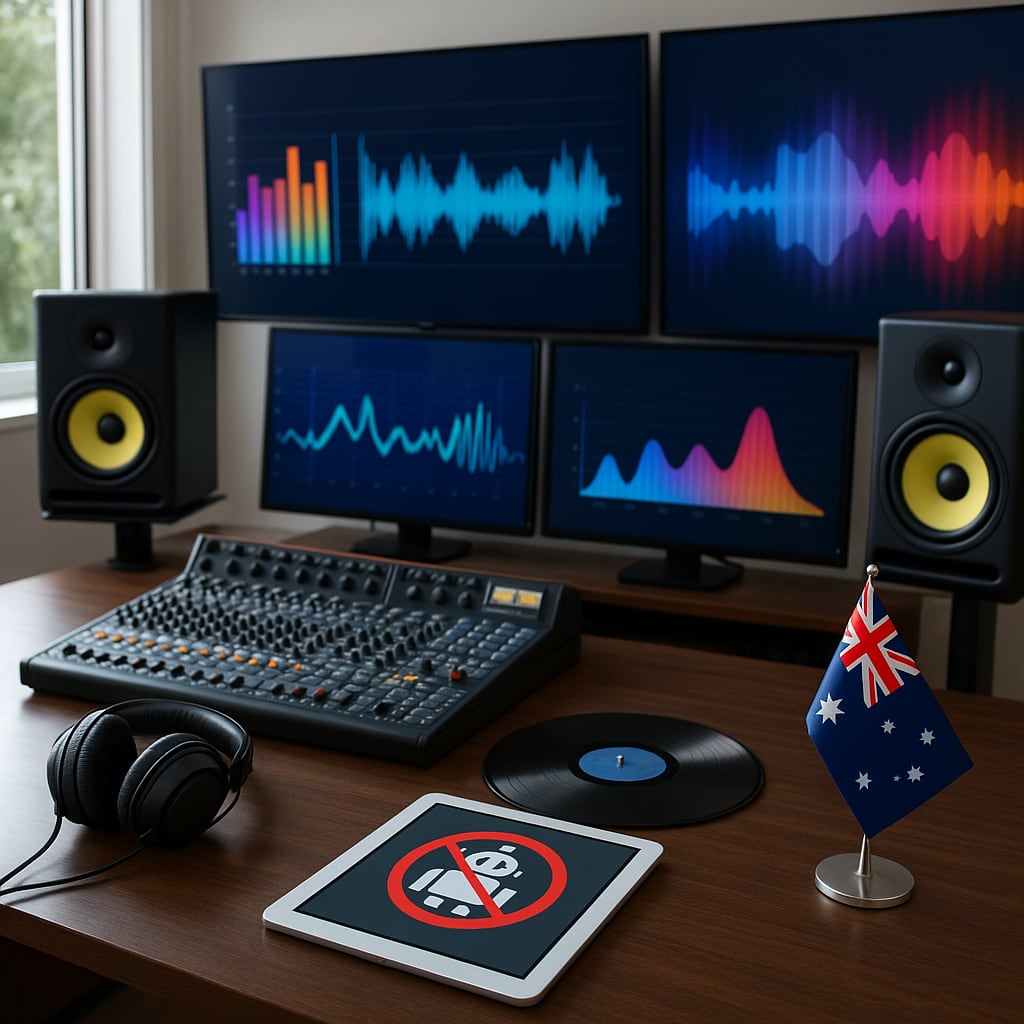
Australia’s music charts to exclude fully AI-generated songs under new ARIA rules
Narrative Snapshot
Across outlets, coverage converges on the same operational boundary: Australia’s official charts will remain open to works that use AI as an auxiliary tool while closing the door to tracks created entirely by machines. Reports emphasize different justifications for drawing that line. Some foreground protection of “the human nature of artistry” and artists’ livelihoods, framing the policy as safeguarding creative labor rather than rejecting technology. Others anchor the move in a concrete flashpoint: an AI-assisted remix of Madonna’s Like a Prayer that topped Australian charts or dominated radio play, demonstrating the immediate market effects of AI-made content.
There is also a subtle divergence in how strictly the policy is characterized. Several outlets describe a bar on “wholly” or “fully” AI-generated music, paired with eligibility where AI plays a “supporting role.” One account references works created “entirely or predominantly” with AI, a formulation that implies a potentially tighter threshold. The most salient stake across the coverage is institutional: how chart compilers define and operationalize “substantially human made” will shape which tracks gain formal recognition in one of the industry’s primary barometers of success.
What Happened
Australia’s recorded music industry, through the Australian Recording Industry Association, announced new chart-eligibility rules stating that music must be “substantially human made.” The association said “wholly AI-generated tracks will not be eligible for the ARIA Charts,” while works using AI in a “supporting role” will remain eligible. The guidelines take effect on Friday following the Tuesday announcement. The change comes weeks after a DJ acknowledged using AI to remix Madonna’s Like a Prayer, a version that topped Australian charts or became one of the most played tracks on Australian radio. Under the new framework, that track would stand to be excluded from official chart consideration. Outlets describe the move as a response to burgeoning generative technologies and related concerns about protecting the human dimension of artistic creation and the livelihoods of artists.
Why It Matters
This is a clear instance of sectoral self-governance establishing a formal threshold for AI involvement within a core market institution: the national charts. By distinguishing “supporting role” AI from “wholly” machine-made outputs, ARIA is codifying a practical standard for attribution and recognition in a system that influences industry signaling, promotion, and benchmarking. The public, rule-based line-drawing also addresses labor concerns surfaced in coverage, positioning chart policy as a protective instrument for human creators amid rapid diffusion of generative tools.
The decision highlights an emerging template for how cultural institutions might reconcile AI’s utility with preserving human authorship norms. It also surfaces administrative challenges—criteria, verification, and enforcement—that other compilers or industry bodies would face if adopting similar thresholds. For decision-makers in creative industries and related policy fora, the development illustrates how institutional rules can shape incentives and market access without invoking statutory bans.
Diverging Narratives
Coverage differs on emphasis and scope. Some accounts present the policy primarily as principle-setting—protecting “the human nature of artistry” and artist livelihoods—while others frame it as a targeted response to a specific incident, the AI-assisted Madonna cover that rapidly gained prominence. Reports also vary in their description of the threshold. Multiple outlets specify that only “wholly” or “fully” AI-generated tracks are barred, paired with explicit allowance for AI in a “supporting role,” suggesting a relatively permissive stance toward AI-assisted production. Another description references works created “entirely or predominantly” with AI, which could be read as signaling a stricter bar.
The language of “substantially human made” is central yet unresolved in operational terms across the reporting. None of the accounts detail how ARIA will assess the degree of human contribution or define “supporting role,” leaving practical questions about classification, disclosure, and enforcement unanswered. Outlets agree the new standard would render the recent Madonna cover ineligible for charting, but they do not address how edge cases—such as heavily AI-assisted but not fully machine-generated tracks—will be treated.
What Happens Next
Implementation choices will determine the rule’s bite. ARIA’s interpretation of “substantially human made” and “supporting role” will guide case-by-case decisions, especially for high-profile remixes and covers that incorporate AI components. Observers should watch for any clarifying guidance that translates these phrases into actionable criteria, since outlets report the allowance for AI as a tool alongside a ban on “wholly” AI-generated works.
Near-term indicators include how the Madonna Like a Prayer AI version is handled under the new regime; multiple reports indicate it would now be ineligible for the official charts. Attention will also focus on whether tracks publicly disclosing AI involvement continue to chart when framed as AI in a “supporting role,” as reported. Finally, note any variance between media characterizations—such as references to “predominantly” AI-created works—and ARIA’s applied practice, which will signal where the operational boundary is being drawn.