
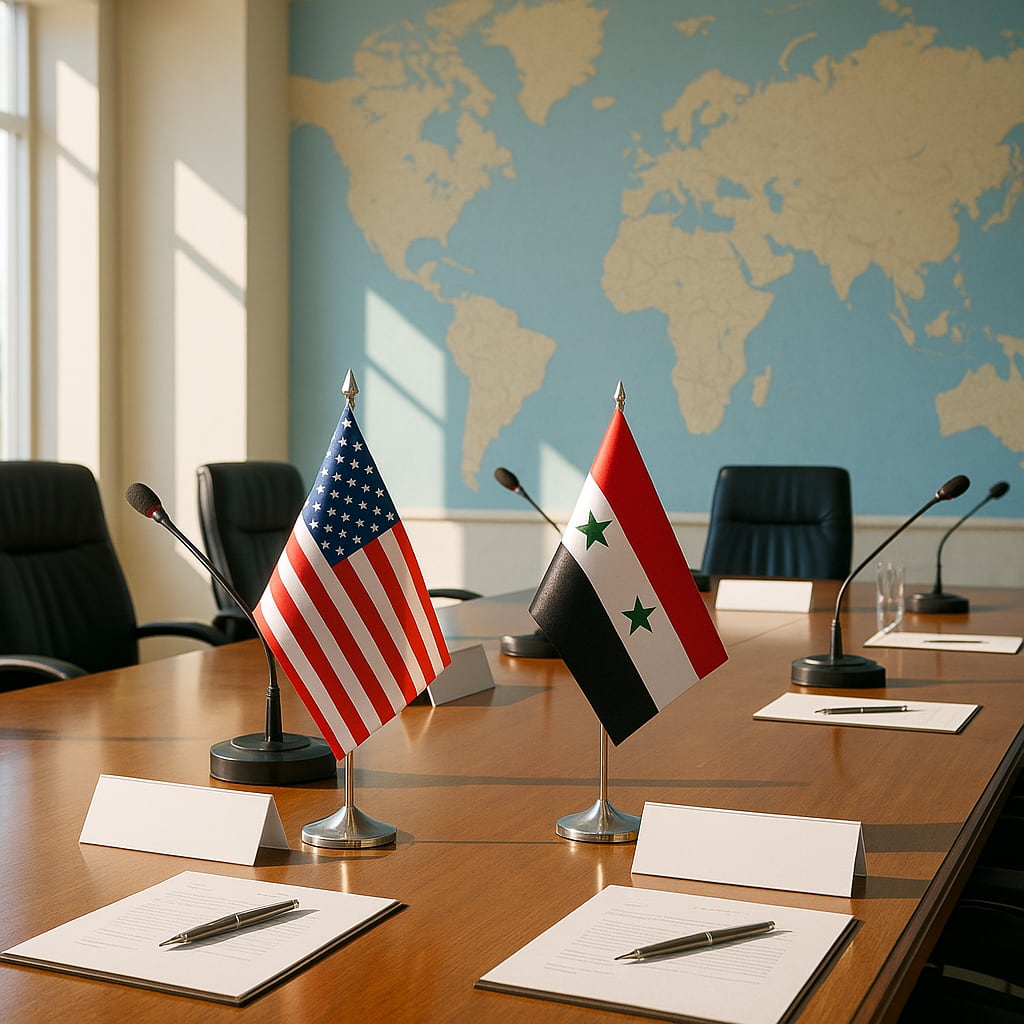
US removes Syria from terrorism sponsor list and delists HTS, easing decades of restrictions
Narrative Snapshot
Across outlets, there is alignment that Washington’s move lifts a long-standing barrier to finance and trade in Syria, with coverage foregrounding investment and market access. Reports emphasize the practical effects: removal of a major obstacle to capital flows and sanctions relief (South China Morning Post; Folha de S.Paulo; France24; The Hindu), ongoing or anticipated talks with banks (The Times of Israel), and a pathway to reintegration into the global financial system (Al Jazeera English).
Where accounts diverge is in how they frame the political and counterterrorism dimensions. Several outlets highlight that President Ahmed al-Sharaa is a former jihadist and ex–al-Qaeda militant (Le Monde; BBC News; Middle East Eye), while others stress formal assurances and “positive actions” he provided to the United States (Le Monde; The Times of Israel). Telesur English underscores that Hay’at Tahrir al-Sham (HTS) — delisted alongside Syria — is linked to al-Qaeda and played a dominant role in forming the new government, sharpening attention to the implications of decertifying both a state and a former terrorist-designated actor.
Regional framing also varies. France24 notes Turkey’s welcome and hopes for reintegration, while Telesur English situates the decision within Washington’s push to deepen ties with Damascus and advance efforts toward Syria–Israel normalization. Russian coverage foregrounds process and expectations: TASS reports the HTS delisting and signals from Damascus that it anticipates broader sanctions removal and a deepening strategic partnership with Washington.
What Happened
The United States removed Syria from its State Sponsors of Terrorism list on 24 August 2026, a designation in place since 1979. The State Department action, formalized through a Treasury Department notice, was paired with the revocation of designations on Hay’at Tahrir al-Sham/al-Nusrah Front (TASS; South China Morning Post; Telesur English). Secretary of State Marco Rubio cited “positive actions” and additional commitments from Syrian President Ahmed al-Sharaa, with Le Monde reporting “formal guarantees” that Syria would not support future international terrorism (Le Monde; The Times of Israel). The move followed a mandatory 45‑day congressional notification begun on 8 July, which outlets reported expired without blockage before formal rescission (Fox News; Middle East Eye, 23 Aug). Only Cuba, Iran, and North Korea remain designated (South China Morning Post). Damascus hailed the step as shedding a “dark stain,” linking it to reconstruction goals (The Times of Israel; The Hindu; CGTN).
Why It Matters
Delisting removes a foundational legal barrier to aid, defense exports, and financial transactions, reshaping the sanctions environment that has constrained Syria’s economy since 1979 (South China Morning Post; Middle East Eye, 24 Aug). The decision aligns with a broader US recalibration since the Assad government’s collapse in 2024 and with existing executive actions to unwind Syria-specific measures, including a 2025 order accelerating sanctions relief (Middle East Eye, 23 Aug; Fox News). Regionally, it intersects with efforts by US partners to re-embed Syria in diplomatic and economic circuits, with Turkey publicly welcoming the step (France24) and reporting of Damascus engaging major banks (The Times of Israel). Structurally, delisting both Syria and HTS narrows Washington’s SST roster to three states (South China Morning Post) and signals a pragmatic approach to counterterrorism designations when successor authorities are positioned as partners in stability and reconstruction (Le Monde; The Hindu; Telesur English).
Diverging Narratives
Outlets differ on causal framing and intent. Telesur English presents the move as part of a US drive to deepen ties with Damascus and to facilitate Syria–Israel normalization, while Middle East Eye highlights timing “following” a “serious and worrying” Israeli strike on a Syrian base, placing regional security dynamics near the decision’s foreground (Telesur English; Middle East Eye, 24 Aug). By contrast, The Hindu, Folha de S.Paulo, and Al Jazeera stress economic stabilization, investment, and financial reintegration as the principal contours. There is also variance in how the leadership transition is contextualized: BBC and Middle East Eye focus on President al‑Sharaa’s past as an al‑Qaeda-linked figure, whereas Le Monde and The Times of Israel emphasize US‑cited guarantees and “positive actions” that enabled the delisting.
The HTS decision is a fulcrum of interpretive tension. Some reports simply record the revocation (TASS; South China Morning Post), while Telesur English underscores the group’s al‑Qaeda linkages and role in the new government, raising questions about how delisting interacts with governance and counterterrorism commitments now attributed to Syria’s leadership. Russian and Syrian statements, relayed by TASS, push expectations further to comprehensive sanctions relief and a “strategic partnership,” a horizon not echoed in other outlets.
What Happens Next
Implementation and scope of relief will shape outcomes. France24 reports “corresponding sanctions relief” has been announced, while Fox News notes a 2025 executive order unwinding Syria sanctions infrastructure; analysts should track additional Treasury actions and regulatory guidance that determine how quickly banks and firms re‑enter the market. The Times of Israel reports Damascus is already in talks with major banks, making financial sector risk appetites and compliance postures key indicators of effective reopening.
Policy alignment among regional actors bears watching. Turkey’s welcome signals momentum for reintegration (France24), while Telesur English ties US moves to potential Syria–Israel normalization; concrete diplomatic steps or security de‑escalation would indicate traction. On the US‑Syria track, TASS cites Damascus’s expectation of broader sanctions relief and deeper partnership; subsequent US statements or assistance decisions — including the latitude to provide military aid noted by Middle East Eye — will clarify the trajectory and boundaries of engagement.