
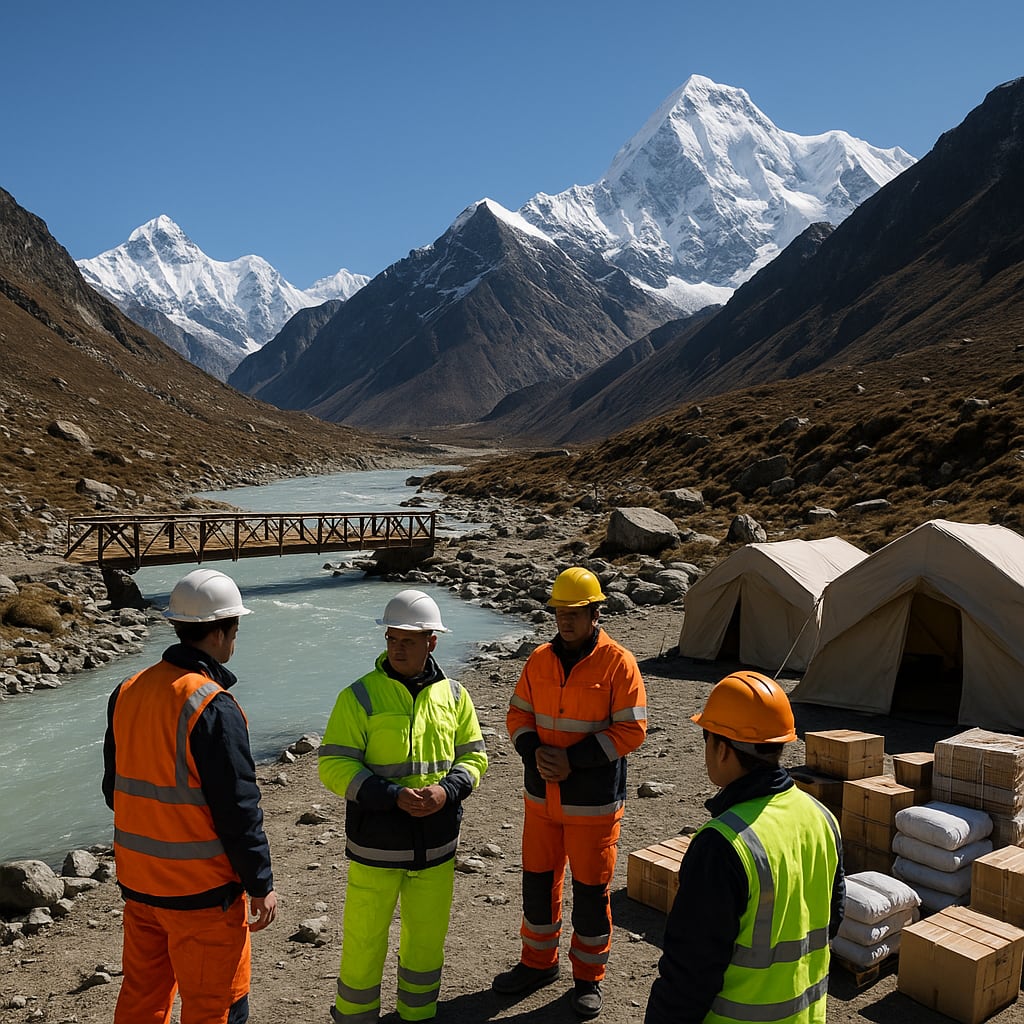
Glacial collapse drives catastrophic floods on the Nepal–Tibet border, leaving at least 160 dead and more than 1,300 missing
Narrative Snapshot
Across outlets, there is broad alignment that a high-altitude ice failure triggered the disaster, with early satellite assessments pointing to a glacier collapse and “ice avalanche” cascading into the valley (New York Times; BBC; France24, Aug. 26–27; Japan Times; Le Monde; La Repubblica; Clarin). The Times of Israel cites the USGS attributing the event to glacial collapse, while initial reporting from NBC also recorded local suggestions of an earthquake potentially setting off an avalanche, highlighting how causal narratives tightened around remote sensing as new analysis arrived.
Casualty and missing tallies vary sharply by jurisdiction and reporting window. As of August 27, several outlets cite at least 160–165 dead and more than 1,300 missing (Al Jazeera; Toronto Star; CBC; Deutsche Welle), while TASS relays Nepal police figures of 162 bodies recovered and 579 missing, and The Hindu’s live file cites “nearly 160” killed and over 750 missing. Chinese state media, summarized by the Guardian, reported three dead and 265 missing at a Tibet border hub. Accounting for foreign nationals is especially fluid: Nepal’s count of missing foreigners is reported at 393 (Times of Israel), 466 (Corriere della Sera), and 517 (ANSA). National outlets foreground their citizens—47 Americans (NBC), 53 Ukrainians including 46 tourists (Kyiv Independent), and an Israeli man in his 60s (Times of Israel).
Operational coverage splits between the physics of the hazard and the mechanics of response. Scientific explainers emphasize the Himalayan “Third Pole” warming and the difficulty of predicting sudden, high-density flows that move “like liquid concrete” (Bangkok Post; BBC; Japan Times; France24). Field reporting focuses on access constraints, with bridges and roads swept away and hydropower assets damaged (Telesur), narrow mountain roads delaying relief (Corriere della Sera), and difficult terrain hampering searches (NBC). China’s media emphasize the deployment of specialized teams—an additional 111 rescuers to Gyirong Port (ECNS; CGTN)—while Nepal-focused reporting highlights thousands of security personnel and helicopter operations (Daily Nation; CBC).
What is most at stake in the coverage is not only the evolving toll, but how cause attribution and risk framing cascade into cross-border disaster management, tourist safety governance, and infrastructure resilience in one of the world’s fastest-warming mountain regions (Japan Times; France24; Le Monde).
What Happened
A sudden torrent of water, mud, and rock rushed down the Nepal–Tibet frontier after a high-altitude glacier failure sent a massive ice-and-debris cascade into a river valley, inundating settlements and border crossings. Scientists analyzing satellite images described an “ice avalanche” from a collapsing glacier as the likely trigger (New York Times; BBC; France24, Aug. 26). The surge devastated towns along Nepal’s Bhote Koshi corridor, including Timure, Rasuwagadhi, and Syabrubesi (Telesur), and struck the Gyirong Port area in Tibet (ECNS; CGTN; Corriere della Sera). By August 27, outlets reported at least 160–165 deaths and more than 1,300 missing, amid evolving Nepal and China tallies (Al Jazeera; Toronto Star; CBC; Deutsche Welle; TASS). Roads and bridges were cut, and hydropower infrastructure was damaged (Telesur). Nepal mobilized thousands of security personnel and helicopters (Daily Nation), while China dispatched additional specialized rescue teams to the border port (ECNS; CGTN). Embassies opened helplines and tracked missing nationals (The Hindu; NBC; Kyiv Independent; Times of Israel; Corriere della Sera).
Why It Matters
The event underscores the systemic risk posed by accelerating ice loss in the Himalayas, where researchers have warned of rising disaster potential in the “Third Pole” and the near-impossibility of predicting sudden slope failures and high-density flows (Japan Times; France24; Bangkok Post; BBC). It also tests cross-border disaster coordination between Nepal and China at a critical trade and transit node, Gyirong Port, while damage to roads, bridges, and hydropower assets exposes infrastructure vulnerabilities with regional economic implications (ECNS; CGTN; Telesur; Corriere della Sera). The concentration of foreign trekkers and Hindu pilgrims in the affected valleys raises consular coordination demands and pressures for more robust risk communication and permitting regimes in peak travel corridors (Le Monde; Guardian; Times of Israel; Kyiv Independent; NBC). Diplomatically, ANSA reports a sizable U.S. funding pledge for affected populations, signaling potential for external support to adaptation and recovery, though such commitments were not corroborated across other outlets in this packet.
Diverging Narratives
Attribution of the trigger converges on glacial collapse and ice avalanche mechanics based on satellite analysis (New York Times; BBC; France24; Japan Times; Times of Israel citing USGS), yet early on-the-ground accounts also referenced an earthquake possibly setting off an avalanche (NBC). As investigations progress, this leaves an unresolved question about compound triggers—purely cryospheric failure versus seismic initiation—though current reporting leans toward the former.
Numbers remain contested and time-sensitive. By August 27, several outlets cite at least 160–165 dead and more than 1,300 missing (Al Jazeera; Toronto Star; CBC; Deutsche Welle), while TASS reports 162 bodies recovered and 579 missing, and The Hindu cites over 750 missing. Chinese state media figures cited by the Guardian list three dead and 265 missing at a Tibet border hub, suggesting differing geographic scopes and reporting baselines. Foreign national tallies diverge: Nepal’s counts appear as 393 (Times of Israel), 466 (Corriere della Sera), and 517 (ANSA), alongside country-specific figures such as 47 Americans (NBC) and 53 Ukrainians (Kyiv Independent). These discrepancies reflect rolling identification, communication outages, and varying inclusion criteria.
Framing diverges as well. Chinese coverage emphasizes rapid deployment and professionalization of response at Gyirong Port (ECNS; CGTN), while several international outlets foreground climate and cryosphere dynamics (BBC; Japan Times; France24; La Repubblica). Infrastructure impacts—bridges, roads, hydropower—feature prominently in regional and Latin American reporting (Telesur), and Italian media also stress satellite “before/after” imagery and the possibility of a second avalanche (Corriere della Sera). Finally, ANSA’s report of a U.S. $500 million pledge stands alone in this corpus, illustrating uneven visibility of aid announcements in early coverage.
What Happens Next
Several decision points will shape outcomes. First, access into cut-off valleys will determine the pace of rescues and recoveries; authorities have deployed helicopters and large security contingents, but narrow, damaged roads and washed-out bridges constrain movement (Daily Nation; NBC; Telesur). Watch for updates on route clearance and airlift capacity. Second, formal scientific attribution—now grounded in satellite assessments—will be refined; confirmation of a glacial collapse mechanism versus an earthquake-triggered failure would guide future monitoring priorities in the basin (New York Times; BBC; France24; NBC). Third, cross-border operational coordination around Gyirong Port, where China has sent specialized teams, bears on information-sharing and joint tasking; signals include joint briefings or liaison arrangements (ECNS; CGTN). Fourth, evolving consular tallies and embassy support—already visible via helplines and national missing lists—will influence evacuation logistics and potential international assistance, alongside any renewed hazard alerts if authorities maintain concerns about secondary slope failures (The Hindu; NBC; Kyiv Independent; Times of Israel; Corriere della Sera).