
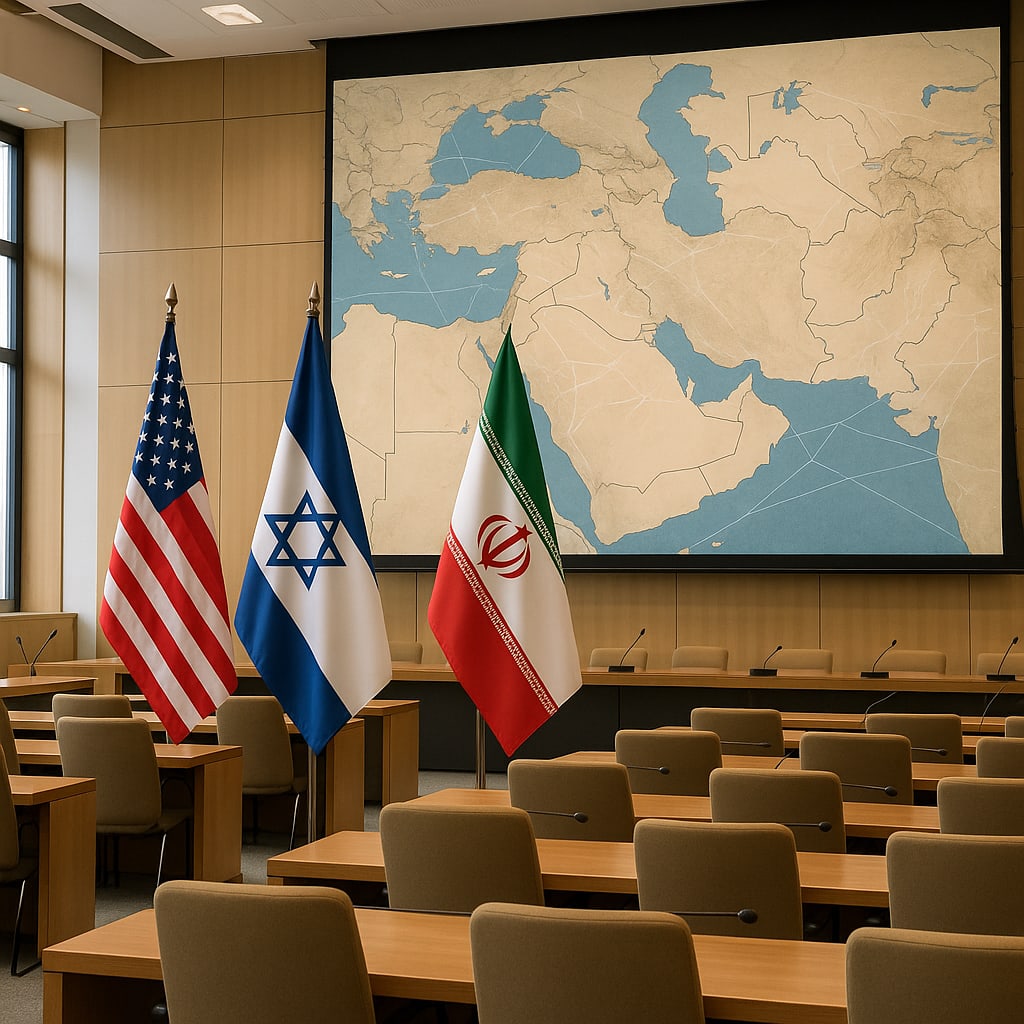
Netanyahu rejects diplomacy with Iran as U.S. pivots to intensified economic pressure and security threats surface
Narrative Snapshot
Coverage converges on two linked developments: Benjamin Netanyahu’s categorical public rejection of diplomacy with Iran and a U.S. turn toward expansive secondary sanctions after months of military confrontation. Indian, British and Chinese outlets foreground the Israeli leader’s remarks and his praise for Washington’s new measures, quoting his description of Iran’s rulers as “savages” and his assertion that “an agreement cannot be reached” (The Hindu; Middle East Eye; CGTN). Simultaneously, Israeli, Palestinian and Italian reports focus on security threats allegedly tied to Tehran, citing an Iranian plot against Yair Netanyahu in Miami and related threats toward Barron Trump (Haaretz; Al-Quds News; ANSA).
Where Chinese state media and affiliated commentators situate Washington’s sanctions shift as a cost-avoidance strategy with uncertain efficacy (CGTN analysis, Aug. 20–25), Middle East Eye stresses immediate economic strain inside Iran and the testing of regional trade ties, while noting the U.S. has held back from the most punitive options so far. Risk calibration from Washington is also reflected in reporting that U.S. staff are returning to several Middle East missions after wartime drawdowns, a move read as signaling reduced near-term danger (South China Morning Post). Against this, a Japan Times column argues Israel may be strategically worse off after six months of inconclusive hostilities, underscoring the debate over end-states versus tactics.
What Happened
Benjamin Netanyahu told an audience in an Israeli settlement that a diplomatic deal with Iran was impossible under its current leadership, praising U.S. President Donald Trump’s newly intensified economic pressure and recounting a recent meeting in which they discussed the prospect of negotiations (The Hindu; Middle East Eye; CGTN, Aug. 26). Parallel reporting alleged Iranian-linked plots against family members of both leaders: Haaretz, citing a U.S. source, said Israeli intelligence uncovered a plan last December to assassinate Yair Netanyahu in Florida, prompting his immediate return to Israel; Palestinian and Italian outlets referenced similar threats against Yair and Barron Trump (Haaretz; Al-Quds News; ANSA). Washington has broadened sanctions beyond finance and oil into digital assets, gold, aviation, shipping and technology, with secondary measures and time-bound pressure on third countries (CGTN analysis, Aug. 25). While Iran publicly dismissed the campaign and asserted maritime control east of Hormuz (Toronto Star; CGTN, Aug. 22), U.S. diplomatic staffing began to return to posts in Lebanon, Israel, Saudi Arabia and Iraq, suggesting lowered perceived risk (South China Morning Post).
Why It Matters
The alignment between Jerusalem’s rejection of talks and Washington’s sanctions escalation narrows near-term diplomatic off-ramps and shifts the burden onto financial coercion and compliance by third countries. Chinese analyses describe the U.S. pivot as an attempt to sustain pressure while containing the costs of continued military operations, with sanctions now reaching into technology and logistics networks well beyond Iran’s borders (CGTN analysis, Aug. 20–25). Middle East Eye highlights that the approach is already straining Iran’s regional trade relationships and could reverberate across energy flows, shipping and insurance tied to the Strait of Hormuz.
For decision-makers, the United States’ partial re-staffing of Middle East missions indicates a recalibrated threat assessment even as Treasury signals “unprecedented” isolation efforts (South China Morning Post; CGTN, Aug. 20). Iran’s dismissal of the measures and assertion of maritime control point to a protracted contest of endurance rather than rapid concession (Toronto Star; CGTN, Aug. 22). A Japan Times assessment that Israel may be strategically worse off after half a year of hostilities underscores the risk that coercive tools fail to deliver durable security gains absent a viable political track.
Diverging Narratives
Netanyahu’s language—categorically rejecting diplomacy and labeling Iran’s rulers “savages”—is presented as a firm policy line by Indian, British and Chinese outlets, with his office disseminating video cited in Italian coverage (The Hindu; Middle East Eye; ANSA; CGTN, Aug. 26). In contrast, reporting on sanctions splits between impact-centric and feasibility-centric frames. Middle East Eye emphasizes immediate economic tightening and the testing of Iran’s regional commercial ties, while noting that Washington has not yet deployed its most punitive options. CGTN’s news and opinion pieces question enforceability and strategic payoff, recalling prior rounds—“most crippling” and “maximum pressure”—that did not secure U.S. goals, a critique echoed by Iran’s foreign minister who publicly catalogued earlier failures and predicted the current push would also fail (CGTN, Aug. 20, 22; CGTN analysis, Aug. 21, 25).
Risk perception diverges as well. Reuters-sourced reporting via the South China Morning Post links the return of U.S. personnel to a lowered threat outlook, whereas Iran’s navy claims comprehensive monitoring and control east of Hormuz, signaling readiness for escalation if needed (SCMP; CGTN, Aug. 22). On the security front, Haaretz details a specific, time-bound assassination plot against Yair Netanyahu, while Al-Quds News and ANSA broaden the focus to threats involving both leaders’ sons, reflecting differences in sourcing granularity and emphasis (Haaretz; Al-Quds News; ANSA). Finally, the Japan Times column questioning Israel’s net strategic position after months of conflict juxtaposes tactical moves—sanctions, redeployments—with unresolved questions about end-state advantages.
What Happens Next
Three decision points emerge from the reporting. First, U.S. sanctions implementation and secondary enforcement: Treasury’s intent to force third-country choices and widen sectoral reach will hinge on partner compliance and whether Washington proceeds to the “most punitive” measures it has so far held back, as noted by Middle East Eye and CGTN (MEE; CGTN, Aug. 20, 25). Analysts should watch designations in shipping, aviation and digital assets, and any escalation in penalties on facilitating jurisdictions.
Second, regional risk calibration: the phased return of U.S. diplomatic staff suggests a reassessment that could reverse if Iran operationalizes threats or maritime incidents rise, given Tehran’s stated control posture in waters east of Hormuz (SCMP; CGTN, Aug. 22). Indicators include embassy security postures, maritime advisories and insurance pricing.
Third, the political track: Netanyahu’s rejection of talks narrows near-term diplomacy, but outside actors—such as Pakistan’s outreach referenced in Canadian reporting—may probe for de-escalation channels (Toronto Star). Movement would be visible through shuttle visits, backchannel confirmations, or moderated rhetoric from principals; absent that, expect continued reliance on economic coercion and countermeasures as outlined across the sources.