
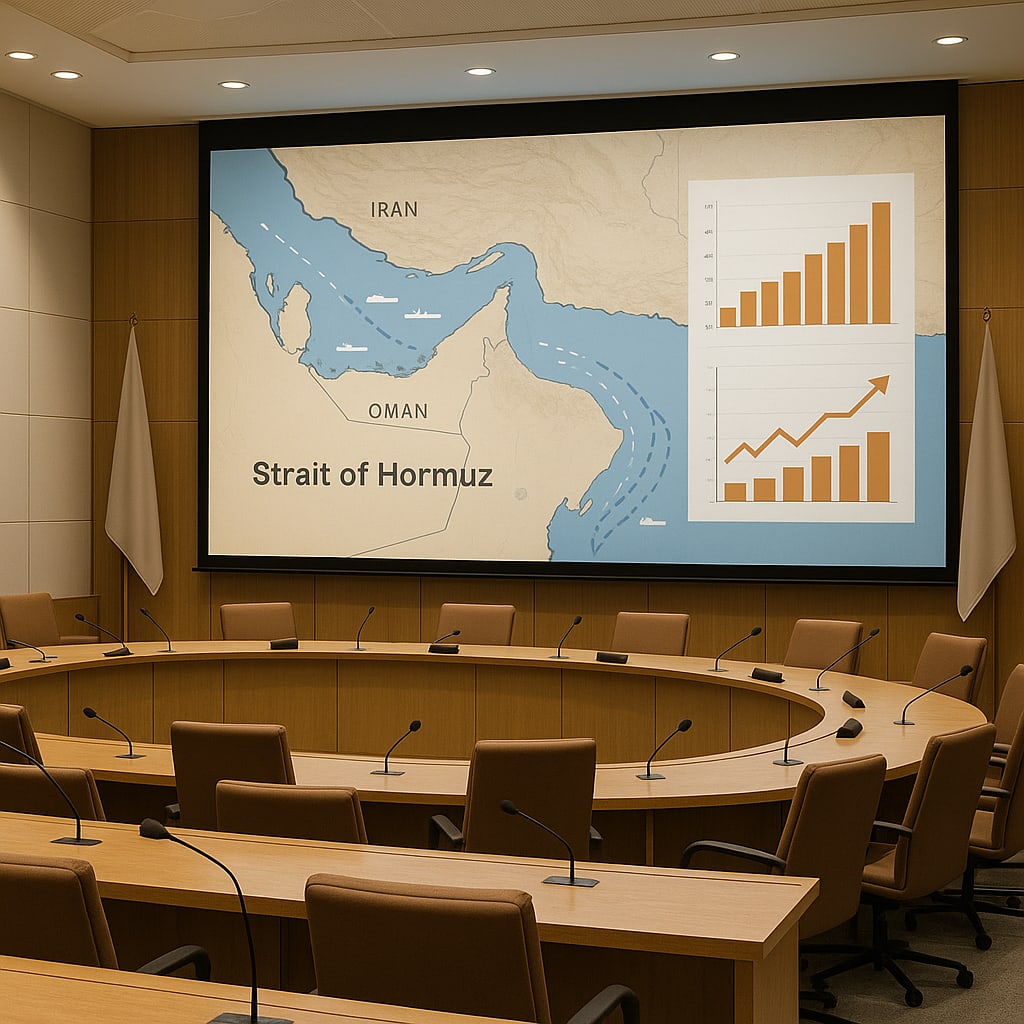
Hormuz shipping plunges as US blockade enforcement meets Iranian assertions of control
Narrative Snapshot
Across outlets, the operational picture converges on a sharply degraded maritime environment and sustained disruption to commercial traffic. The UK Maritime Trade Operations reports vessel flows about 90 percent below pre‑conflict levels with a severe risk rating and repeated projectile strikes, especially along the southern Omani route, while the International Maritime Organization has tallied 70 ship attacks in six months and 19 seafarer deaths and urged collective action to restore navigation (Middle East Eye; TASS). US military messaging emphasizes active enforcement—mine clearance claims, redirection and boardings—and an economic “endgame” of expanded secondary sanctions, whereas Iranian officials underscore conditional closure and asserted custodianship of transit pending a halt to US military actions (CENTCOM via MEE; CGTN; Al Jazeera; MEE).
Coverage also widens the frame from interdictions to the economic and diplomatic battlespace. Washington’s “Operation Economic Outcast” targets five sectors and threatens exclusion from dollar finance, prompting explicit warnings from Beijing and Iranian threats against alternative Gulf oil routes and US economic interests (CGTN; RT; Middle East Eye; The Hindu; The Guardian; MEE). Mediation channels are present but secondary in most reporting; the UN calls for renewed talks and notes global knock‑on effects on energy, food and fertilizers (CGTN).
What Happened
Six months into the conflict, the operational tempo in and around the Strait of Hormuz remains high and commercial traffic suppressed. The IMO counted 70 attacks and 19 dead within six months and appealed for UN‑backed solutions to restore navigation (TASS). UKMTO reported traffic roughly 90 percent below pre‑conflict levels, with 23 projectile incidents since early July and concentration of strikes on the southern Omani route; some days saw only one to two commodity vessels and as few as seven total ships, according to Italian and UK reporting that cautioned AIS gaps could revise counts (Middle East Eye; Corriere della Sera). The US says it cleared mines, assisted about 1,500 vessels in recent months, and as of 28 August had redirected 82 ships, disabled three and boarded two to enforce a naval blockade (CGTN; MEE). Iran’s IRGC declared the strait closed absent coordination with Tehran and linked reopening to an end of US military actions; officials cited an understanding with Oman on passage arrangements contingent on US commitments (La Repubblica; Middle East Eye). In parallel, Washington launched a sweeping sanctions campaign across digital assets, technology, gold, aviation and shipping, warning third countries of dollar exclusion; China signaled potential retaliation (CGTN; RT; Middle East Eye). The UN urged a return to negotiations as the war entered its sixth month (CGTN).
Why It Matters
The contest in Hormuz now spans both the security of a critical chokepoint and the reach of extraterritorial economic enforcement. Maritime risk at scale—severe threat levels, kinetic incidents, and traffic collapsing to a fraction of baseline—directly tests the norm of freedom of navigation that the IMO is urging states to defend through coordinated UN engagement (TASS; Middle East Eye). Simultaneous US secondary sanctions against multiple sectors and threatened exclusion from dollar finance widen compliance exposure for third countries and carriers, while Beijing’s warnings introduce major‑power friction into sanctions implementation (CGTN; Middle East Eye; RT).
For regional actors, Iranian declarations that transit depends on halting US military actions, coupled with threats to target alternative export routes if neighbors align with Washington, complicate Gulf energy security planning beyond the strait itself (Middle East Eye; The Hindu; The Guardian). UN‑backed mediation by Qatar, Pakistan, Egypt, Saudi Arabia and Kuwait offers limited but internationally supported avenues to de‑escalate amid mounting global impacts on energy, food and fertilizer supply chains (CGTN).
Diverging Narratives
US military statements project operational progress—international lanes “open” after mine clearance, assistance to roughly 1,500 vessels, and dozens of enforced redirections—paired with an economic strategy promising “asphyxiation” of Iran’s revenue and a “zero‑leakage” sanctions approach (CGTN; Middle East Eye; MEE). Iran’s IRGC counters that the strait is closed without Tehran’s coordination and will remain restricted until US military actions cease, citing an understanding with Oman on passage protocols; Iranian officials publicly reject US claims of openness and portray them as price management or face‑saving (La Repubblica; Middle East Eye). CENTCOM asserts Iran does not control the strait and highlights ongoing commercial transits with US assistance, while the White House declined to comment on whether it would accept any Iran‑Oman framework that excludes US warships (Fox News).
Operational data complicate both sides’ messaging. UKMTO’s severe risk rating and traffic levels about 90 percent below pre‑conflict baselines, along with reported projectile strikes, point to a waterway that remains highly constrained despite US enforcement activity (Middle East Eye). Market‑facing coverage notes nearly 40 million barrels of Iranian crude held in floating storage outside the blockade zone and reduced Chinese imports, suggesting sanctions‑era workarounds and pressure points coexist (Fox News). Some outlets also foreground rhetoric—such as claims of US “control” of Hormuz or RT’s framing of the war’s origins—illustrating how political messaging shapes, but does not settle, the operational picture (RT; The Guardian).
What Happens Next
Key decisions cluster around enforcement thresholds, conditional reopening, and third‑party alignment. If Washington intensifies its “zero‑leakage” approach—through additional OFAC listings, actions against floating storage, or secondary sanctions on Chinese entities—analysts should watch for Beijing’s retaliatory signals and shifts in shipowner compliance, which would indicate how far the sanctions perimeter extends (CGTN; Middle East Eye; Fox News). On the maritime side, Iran links any normalization of transit to an end of US military actions; formalization or public details of Iran‑Oman passage arrangements, and whether CENTCOM acknowledges or rejects operational constraints, will clarify whether a deconfliction regime is emerging or being blocked (Middle East Eye; Fox News; La Repubblica).
Regionally, neighbors’ responses to US economic measures are pivotal given Tehran’s threats to target alternative export routes; observable changes in routing, port operations, or security postures will signal risk migration beyond Hormuz (The Hindu; The Guardian). Diplomatic movement by UN‑backed mediators, if tied to verifiable reductions in attacks or UKMTO threat levels, would indicate traction toward de‑escalation (CGTN; Middle East Eye).