
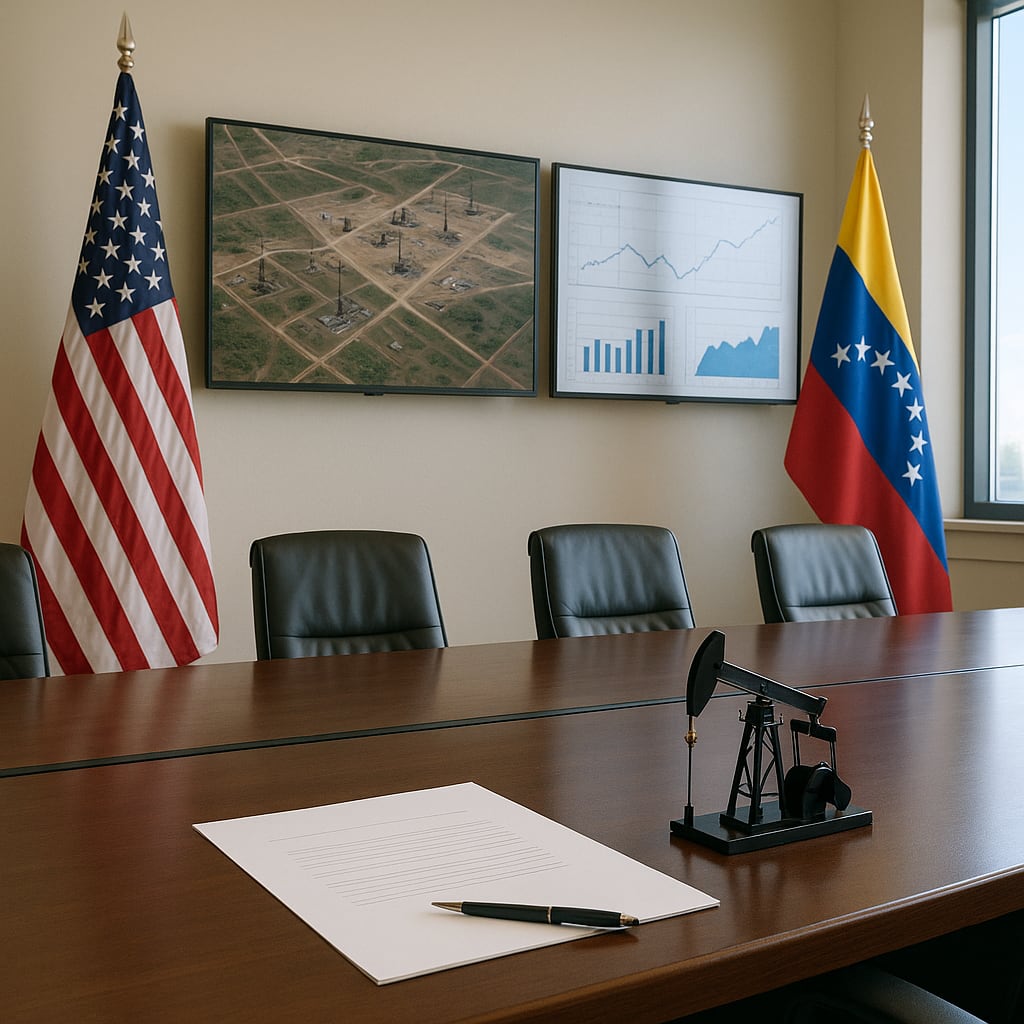
U.S. and Venezuela announce deal granting U.S. control over 65 billion barrels of oil reserves
Narrative Snapshot
Across U.S., European, Canadian, and Indian outlets, coverage converges on the headline claim: President Donald Trump said the United States and Venezuela reached a “historic” agreement giving the U.S. control—often described as majority control—over more than 65 billion barrels of Venezuelan oil reserves. The reporting is sparse on mechanics, and several outlets emphasize the absence of detailed terms. By contrast, Venezuelan and Latin American coverage supplies structure: development of 17 fields, large-scale investment, multi-decade duration, explicit output targets, and revenue expectations attributed to acting president Delcy Rodríguez.
Framing diverges by geography and editorial lens. BBC, France24, NBC, CBC, DW, and The Hindu foreground Trump’s declaration and the deal’s size. The New York Times introduces a different operational picture via a U.S. official: a partnership with a private company rather than state-to-state operational control. Al Jazeera flags criticism as a resource takeover with few disclosed particulars, while the Japan Times situates the move within a broader U.S. bid for hemispheric dominance. Russian outlets extend the horizon further, relaying reports of a potential 100-year lease and even a Venezuelan OPEC exit, neither finalized. Venezuelan state-aligned reporting stresses sovereignty, reconstruction, and “hemispheric energy security,” with Rodríguez as the principal voice, while regional media also note domestic demands for transparency and mixed public sentiment.
At stake are definitional issues—what “control” means in legal and operational terms; the scale and duration of access; and the alignment of this arrangement with Venezuela’s stated sovereignty and potential market realignments. The span of claims—from a 25-year build-out of 17 fields to floated century-long leases and expanded barrel counts—underscores how the agreement’s ultimate contours remain contested across sources.
What Happened
President Trump announced that the United States had entered an agreement with Venezuela granting control—described by multiple outlets as majority control—over more than 65 billion barrels of the country’s proven reserves (BBC; France24; NBC; CBC; The Hindu; DW; TASS, Aug. 28). Venezuelan authorities presented the arrangement as a bilateral program to reactivate the hydrocarbons industry, specifying development of 17 strategic fields, private operators, and investment exceeding $100 billion (Telesur English, Aug. 29; TASS, Aug. 29). Acting president Delcy Rodríguez linked the deal to economic recovery, hemispheric energy security, and market balance (TASS, Aug. 29). Additional parameters reported by Latin American outlets include a 25-year term with a production target of 1.5 million barrels per day (Folha de S.Paulo; Clarin, Aug. 30) and a revenue projection of roughly $209.3 billion (Telesur English, Aug. 30). The New York Times cited a U.S. official indicating a partnership with a private company. Russian coverage relayed reports that some fields could be leased for up to 100 years, with terms not finalized (TASS, Aug. 28; RT).
Why It Matters
Venezuela holds the world’s largest proven crude reserves, and channeling a significant tranche—more than 65 billion barrels—into a U.S.-linked operating framework could reshape supply expectations and investment patterns (DW). If implemented on the 17-field, multidecade basis articulated in Caracas, the agreement would embed long-term private-sector roles and cross-border capital flows, testing how “control” is apportioned among the Venezuelan state, U.S. actors, and corporate partners (Telesur English, Aug. 29; NYT). Venezuelan officials highlight hemispheric energy security and market balance, positioning the deal as a stabilizing instrument, while regional outlets frame it as part of a post-rupture normalization of U.S.–Venezuela ties (TASS, Aug. 29; Clarin, Aug. 29).
Competing descriptions of duration and scope—25 years versus reported 100-year leases; 65 versus 90 billion barrels—intersect with potential institutional consequences, including whether Caracas reconsiders its role in OPEC, as discussed in Russian reporting without a final decision (RT). The arrangement also surfaces governance and legitimacy questions at home, with calls for transparency and mixed public reactions likely to influence implementation (Clarin, Aug. 29; Bangkok Post).
Diverging Narratives
How the deal is characterized varies sharply. U.S. and European outlets report Trump’s assertion that the U.S. will control, or hold a majority stake in, more than 65 billion barrels of Venezuelan reserves, but provide limited detail on legal form or asset delineation (BBC; France24; NBC; CBC; The Hindu; DW; TASS, Aug. 28). The New York Times tempers this with an official’s comment that a private company partnership is envisaged, which implies operational control could be mediated through corporate vehicles rather than direct sovereign-to-sovereign mechanisms. Venezuelan and regional coverage reframes “control” as development of 17 specified fields via private operators, anchored by a 25-year timeline, output targets, and large investment commitments, while asserting preservation of sovereignty (Telesur English, Aug. 29; Folha de S.Paulo; Clarin, Aug. 30).
Further tension arises over scale and horizon: Latin American outlets cite 65 billion barrels and 25 years; Russian reporting amplifies discussions of 100-year leases and access to up to 90 billion barrels, stressing that terms are not finalized (TASS, Aug. 28; RT). Al Jazeera notes criticism of the arrangement as a takeover with few disclosed particulars, and Bangkok Post captures domestic ambivalence—skepticism coexisting with hopes for economic relief. A subset of European and Russian coverage also places the deal in the context of earlier leadership change in Caracas attributed to U.S. actions, a framing largely absent elsewhere (Le Monde; RT).
What Happens Next
Key parameters still appear unsettled. Russian reporting says some leasing terms remain under negotiation, including duration, while Venezuelan officials have publicly described a 25-year framework; clarity on contract length and field-by-field concessions will be determinative (TASS, Aug. 28; Folha de S.Paulo). Identification of operating partners will signal how the New York Times’ “private company” structure translates into practice, and whether control is exercised via joint ventures, service contracts, or other instruments. Caracas has outlined 17 fields, major capital inflows, and specific output targets; watch for published field lists, investment schedules, and early production metrics (Telesur English, Aug. 29; Clarin, Aug. 30).
Russian outlets report discussions about a possible OPEC exit without a decision; any formal steps by Venezuela toward altering its OPEC status would mark a structural shift (RT). Domestically, opposition calls for transparency and public sentiment—skeptical yet hopeful—could shape regulatory approvals and revenue allocation, influencing whether projected revenues near $209.3 billion materialize (Clarin, Aug. 29; Bangkok Post; Telesur English, Aug. 30).