
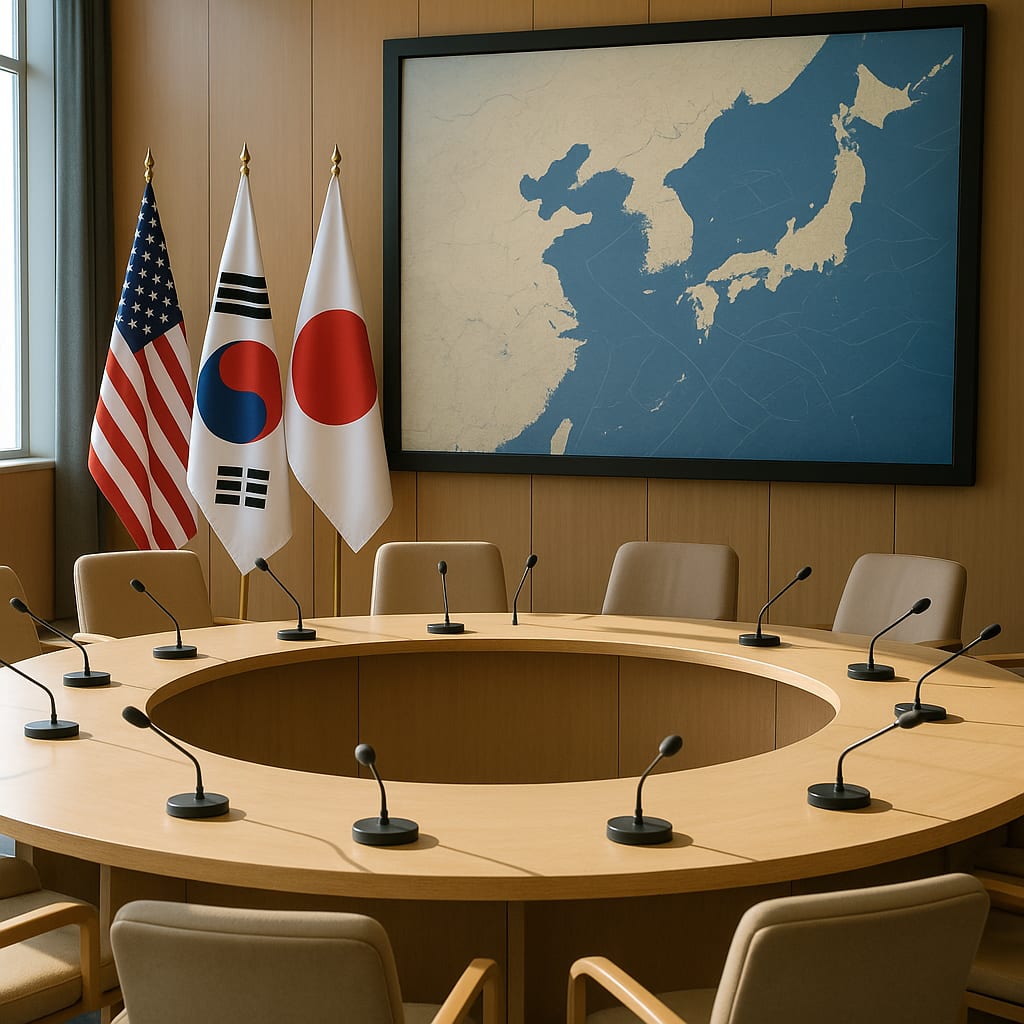
North Korea condemns US–Japan–South Korea drills and US arms move as Trump seeks new Kim summit
Narrative Snapshot
Across Asian and Latin American outlets, there is broad agreement that Pyongyang is framing allied military activity and US policy tools as evidence of sustained hostility while Washington signals renewed summit diplomacy. Japan Times highlights North Korea’s designation of trilateral maritime exercises as a threat even as US President Donald Trump presses for a new meeting with Kim Jong Un. Clarin echoes this framing, reporting Pyongyang’s charge that denuclearization remains a point of tension and its defense of nuclear arms as a sovereignty guarantee.
European and UK coverage foregrounds policy instruments beyond exercises. Middle East Eye details North Korea’s warning of a “powerful response” to a planned US sale of AIM-9X missiles to South Korea and to new US funding for programs documenting human rights abuses and challenging North Korea’s information controls. Le Monde’s column by Richard Haass argues that an approach that flatters Kim and disrespects democratic South Korea risks peninsula stability and will fail if judged by denuclearization outcomes.
Russian state media situates these moves in a wider realignment narrative: RT portrays Japan’s break with Moscow and a closer Russia–North Korea relationship as consequences of US power reshaping Northeast Asia’s security order, and characterizes Japan’s defense and foreign policy as subordinate to Washington. The Diplomat adds a domestic constraint to Japan’s calculus, noting that the “Tanaka affair” still casts a long shadow over Tokyo’s ability to commit to dialogue with Pyongyang.
What Happened
North Korea denounced recent US–Japan–South Korea maritime drills as a threat, according to Japan Times, as President Donald Trump sought a new meeting with Kim Jong Un. In parallel, Middle East Eye reports that the US State Department approved a possible $125 million sale of AIM-9X Sidewinder Block II missiles and related equipment to South Korea. Pyongyang warned of a “powerful response” and said the sale would adversely affect regional security. It also criticized US plans to fund programs documenting human rights abuses in North Korea and expanding information access, initiatives launched by the State Department’s Bureau of Democracy, Human Rights, and Labor.
Clarin underscores North Korea’s accusation that Washington maintains a hostile posture despite conciliatory presidential gestures, while defending its nuclear arsenal as essential to sovereignty. Le Monde carries Richard Haass’s critique of Trump’s diplomatic approach. RT frames allied coordination as part of a US-driven reshaping of regional security. The Diplomat points to domestic Japanese constraints on dialogue with Pyongyang.
Why It Matters
The juxtaposition of intensified trilateral military coordination, new US security and human rights measures, and a proposed leader-level meeting spotlights a familiar policy tension: deterrence signaling and coercive tools may complicate near-term diplomacy when Pyongyang equates them with hostility. Middle East Eye’s reporting on arms sales and human rights programming shows Washington widening the toolkit beyond summits, while Japan Times and Clarin capture how North Korea links exercises and denuclearization demands to its threat perceptions.
Le Monde’s column highlights alliance-management risks if diplomacy sidelines or disrespects South Korea, now a major economic power; this underscores that process design, not just outcomes, shapes stability. RT’s narrative of a Japan–Russia rupture alongside closer Russia–North Korea ties points to broader realignment pressures associated with US-led coalitions. The Diplomat’s reference to the lasting shadow of the Tanaka affair suggests domestic political memory can constrain Japan’s latitude, affecting trilateral cohesion and any regional diplomatic sequencing.
Diverging Narratives
Pyongyang’s storyline, reflected in Japan Times and Clarin, is that US-led exercises, arms sales, and human rights initiatives demonstrate a persistent hostile policy, making its nuclear arsenal a non-negotiable security guarantee. This casts Trump’s outreach as cosmetic unless underlying activities change. Middle East Eye adds specificity to this grievance set, identifying the AIM-9X sale and new funding to document abuses and challenge North Korea’s information monopoly as proximate triggers for threats of a “powerful response.”
By contrast, Le Monde features Richard Haass’s view that Trump’s diplomacy is miscalibrated, risking peninsula stability by flattering Kim and slighting South Korea, and that it will not deliver denuclearization if that is the benchmark for success. RT advances a structural critique centered on US power realigning Northeast Asia, attributing Japan’s break with Moscow and North Korea’s emergence as a Russian ally to Tokyo’s policy deference to Washington. The Diplomat does not contest alliance logic but underscores a domestic factor—fallout from the Tanaka affair—limiting Japan’s ability to commit to direct dialogue with Pyongyang. Together, these accounts differ on causality and remedy: reduce “hostility” as defined by Pyongyang, reframe diplomacy to protect allied equities, or recognize great-power alignment effects and domestic constraints.
What Happens Next
Several decision points will shape the trajectory. First, whether Washington moves from approval to execution of the AIM-9X sale to South Korea will signal if deterrence enhancements proceed despite Pyongyang’s warnings; a go-ahead would likely reinforce North Korea’s “hostile policy” framing reported by Middle East Eye and Clarin. Second, implementation of US-funded programs to document human rights abuses and expand information access in North Korea will test Pyongyang’s threatened “powerful response,” making delivery mechanisms and partner selection key indicators.
Third, the tempo and scope of future US–Japan–South Korea maritime drills, flagged by Japan Times and criticized by Pyongyang, will influence whether North Korea conditions engagement on military restraint. Fourth, the feasibility of a new Trump–Kim meeting, noted by Japan Times, hinges on whether outreach is paired with steps Pyongyang views as de-escalatory and whether, as Le Monde’s column argues, allied equities—especially South Korea’s—are visibly respected. Finally, watch for signals from Tokyo on dialogue; The Diplomat’s reference to the Tanaka affair suggests domestic politics could circumscribe Japan’s role in any renewed talks.