
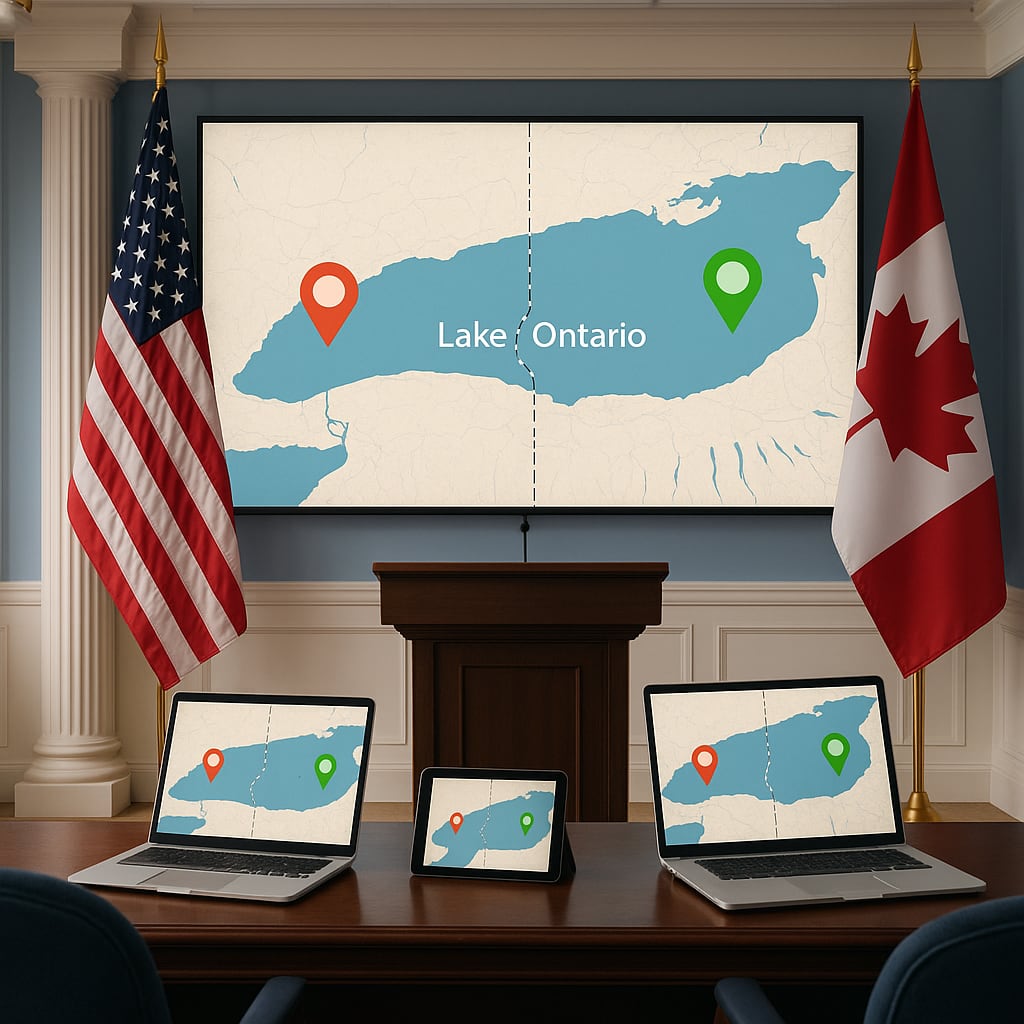
Trump’s order renaming Lake Ontario to ‘Lake America’ triggers cross-border backlash and platform changes
Narrative Snapshot
Across North American and international outlets, coverage converges on how digital infrastructure amplified the dispute. Reports from Canada, Europe, and Asia detail Google Maps’ geofenced relabeling—“Lake America” for U.S. users, “Lake Ontario” in Canada, and dual naming elsewhere—presented as the platform implementing a U.S. government agency decision following the order. Multiple outlets also note spillover into Canadian public-sector websites that pull Google map tiles, underscoring how private platforms can propagate U.S. administrative designations across borders despite divergent national positions.
Canadian and UK reporting foregrounds political spectacle as a strategic communication contest. Ontario’s premier installed a prominent “Lake Ontario. Now and Always” sign, while Donald Trump posted a video of himself knocking down a facsimile sign and replacing it with “Lake America,” with one Italian outlet specifying the clip was AI-generated. Several accounts situate this symbolism explicitly alongside tariff measures, portraying the naming gambit as the visible tip of a broader trade confrontation.
U.S. domestic coverage splits between institutional and community responses. One House Democrat is preparing legislation to nullify the order, while local businesses around Niagara Falls told reporters they will not adopt the new name. Indigenous leadership framed the order as an affront to historic agreements and cultural heritage, demanding rescission and grounding the lake’s name in Haudenosaunee language and diplomacy.
What Happened
Donald Trump signed an executive order on 29 August to rename Lake Ontario as “Lake America.” The move unfolded amid a trade fight that a UK outlet tied to a 50% U.S. tariff on Canadian steel and Canadian retaliation. Ontario’s premier responded by placing a large “Lake Ontario. Now and Always” sign on the shoreline, while Trump posted a video depicting himself toppling a Lake Ontario sign and installing a Lake America version; an Italian paper specified the video was AI-generated. The Seneca Nation’s president condemned the order as “unpresidential,” citing the lake’s Indigenous name and urging reversal. A U.S. House Democrat announced plans for a “Hands Off Our Great Lakes Act” to challenge the order. Google Maps switched to “Lake America” for U.S. users but retained “Lake Ontario” in Canada, with some non-U.S./Canada users seeing both; Canadian media reported knock-on effects where government sites pulling Google data reflected the change. Upstate New York businesses told reporters they would keep using “Lake Ontario.”
Why It Matters
This episode links symbolic toponymy to live trade leverage, demonstrating how executive action can reframe a shared natural feature during tariff escalation. Reporting presents the naming move as an adjunct to punitive measures, situating it within hardening U.S.-Canada economic frictions. It also exposes cross-border governance frictions between national naming sovereignty and platform-mediated maps, as Google aligned with a U.S. agency decision for its American user base while leaving Canadian and global views unchanged. The spread of the label into Canadian government websites that rely on Google illustrates how private technical dependencies can unintentionally import disputed designations into official communications. Indigenous pushback elevates treaty, heritage, and consultation questions that domestic actors now link directly to foreign economic policy signaling. A House legislative response introduces a U.S. separation‑of‑powers dimension, signaling potential checks on executive naming authority with implications for future disputes over shared geographies.
Diverging Narratives
Outlets differ in their primary lens. UK and Canadian coverage consistently yokes the label change to tariff escalation, positioning it as the public-facing expression of a trade rift. U.S. local reporting instead highlights practical noncompliance by businesses that intend to keep “Lake Ontario,” emphasizing community continuity over geopolitical signaling. Indigenous perspectives, carried prominently in U.S. and Argentine outlets, foreground cultural rights and historical treaties, casting the order as erasure rather than negotiation tactic. Process reporting in Canada clarifies that the United States cannot compel Canadian adoption and explains that Canadian naming authority remains intact; a U.S.-based account also notes that a House Democrat will introduce a bill to block the order.
Accounts of the president’s video diverge in characterization: UK coverage describes a clip where he tears down an avatar of the Ontario sign and dances to a familiar song, while Italian coverage specifies the footage was generated with artificial intelligence. On the digital front, most international reports agree Google localized the change for U.S. users, with several noting Canadians retain “Lake Ontario” and some users outside North America see both names. A German outlet adds that Canadian government websites drawing from Google Maps have echoed the U.S. label—an unintended effect absent from other reports but consistent with the platform’s technical propagation.
What Happens Next
Three decision points emerge. First, Congress: a House Democrat plans to introduce the “Hands Off Our Great Lakes Act” to nullify the order. Progress from introduction to committee action will signal whether legislative checks materialize or whether the executive designation stands unchallenged. Second, platforms and public-sector adoption: Google has already localized the label; watch whether it maintains this configuration, extends dual labeling more broadly as some outlets report for non‑North American users, or whether Canadian agencies adjust procurement and technical settings to avoid inheriting “Lake America” through embedded map tiles. Third, cross‑border policy linkage: UK reporting ties the naming dispute to steel tariffs and Canadian retaliation; changes in tariff posture or negotiating signals from Ottawa or Washington will indicate whether the naming issue remains a performative adjunct to trade pressure or recedes alongside any de‑escalation. Finally, the White House response to the Seneca Nation’s demand for rescission will reveal whether Indigenous objections influence any revision or revocation of the order.