
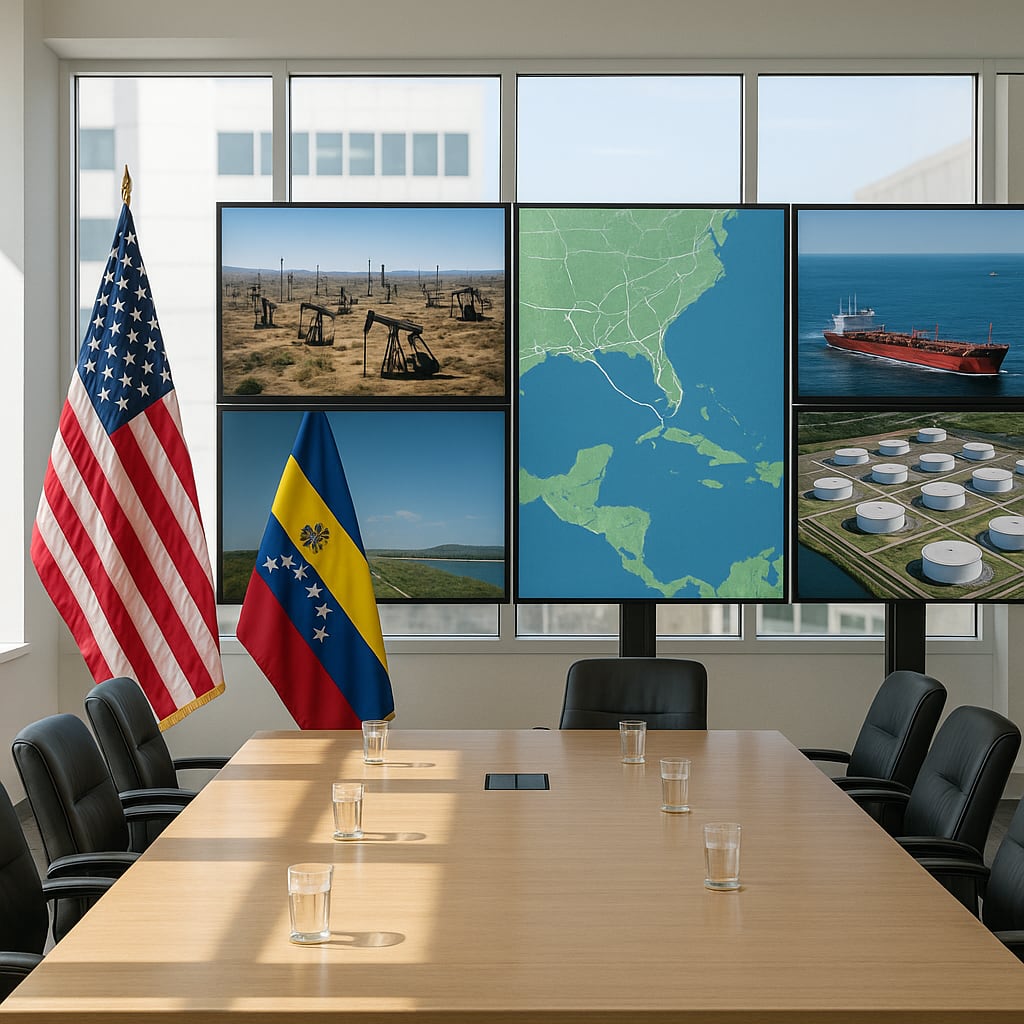
U.S. announces deal for majority control of 65 billion barrels of Venezuelan oil
Narrative Snapshot
Across outlets, there is broad agreement on the scale of the U.S. claim—majority control over more than 65 billion barrels of proven Venezuelan reserves—paired with limited detail on mechanics and financing. Major English-language and international wires and broadcasters repeated the headline assertions while noting unanswered questions or emphasizing sparse terms; several pieces explicitly flagged the lack of specifics and lingering legal and practical uncertainties.
Framings diverge on legitimacy and political economy. Venezuelan and Russian state-aligned sources cast the agreement as developmental and stabilizing, highlighting revenue projections, long-term field development, and hemispheric energy security. A U.S. business-facing perspective lauded potential price relief. In contrast, commentary from Japan and Iran situated the deal in a neocolonial and coercive lineage or criticized feasibility and intent, while Qatar-based coverage raised the prospect of resource takeover.
A strategic throughline in Latin American and Brazilian reporting is asset reallocation away from Chinese and Russian companies to a U.S.-backed operator, with North American and defense institutions moving into commercial energy roles. Canadian coverage focuses on market displacement risks to heavy crude flows to the U.S. Gulf Coast, stressing that upstream constraints make rapid volume growth unlikely.
What Happened
President Donald Trump announced on August 28 that the United States had reached what he called “the biggest oil deal in world history,” asserting majority U.S. control over more than 65 billion barrels of proven Venezuelan reserves and saying the arrangement would come at no cost to U.S. taxpayers (Middle East Eye; The Guardian; BBC; South China Morning Post; NBC News; RT; The Hindu; Al Jazeera English). Trump credited Secretary of State Marco Rubio, Defense Secretary Pete Hegseth, and Venezuela’s interim president, Delcy Rodríguez. Subsequent reporting described a 25-year framework to develop 17 fields targeting 1.5 million barrels per day and projected Venezuelan revenues of about $209 billion (The Hindu; TASS; teleSUR English). The White House later identified North American Blue Energy Partners as a U.S. partner, and the New York Times reported the Pentagon’s Office of Strategic Capital helping lead the deal (Toronto Star/AP; New York Times, Sep. 1). Brazilian media said the U.S.-backed firm would assume fields previously controlled by five Chinese companies and one Russian (Folha de S.Paulo).
Why It Matters
The agreement links U.S. security and industrial policy instruments to resource control in the hemisphere, with the Defense Department’s Office of Strategic Capital moving into oil deal architecture (New York Times, Sep. 1). It follows the removal and arrest of Nicolás Maduro and the installation of Delcy Rodríguez, illustrating how leadership change has reshaped Venezuela’s hydrocarbons governance and external alignments (Le Monde; Corriere della Sera; Times of Israel). If implemented at the advertised scale, the venture could redirect market share on the U.S. Gulf Coast, directly competing with Canadian heavy crude and altering regional trade flows, even as near-term production gains are constrained (CBC News). Reporting that a U.S.-backed firm will take over assets from Chinese and Russian companies underscores a rebalancing of influence over Latin American energy (Folha de S.Paulo). The administration’s stated plan to refill U.S. petroleum reserves with Venezuelan oil ties the deal to domestic energy price politics amid ongoing external shocks (Al Jazeera English; Times of Israel).
Diverging Narratives
Supportive coverage emphasizes mutual benefit and long-horizon development. Venezuelan and Russian outlets highlighted the 25-year timetable, 17 strategic fields, and contributions to national revenue, hemispheric energy security, and market balance (TASS; The Hindu; teleSUR English). A U.S. market voice framed the deal as a “generational win” for gasoline prices and technological upgrading of Venezuela’s industry (Fox News).
Critical and skeptical accounts stress legitimacy, sovereignty, and feasibility. Qatar-based coverage described the arrangement as a seizure of resources and noted the paucity of details (Al Jazeera English, Aug. 29). Commentary in Japan tied the move to a history of U.S. neocolonial resource control in Latin America and questioned a reported $100 billion financing gap (Japan Times, Aug. 31; Sep. 1). Iranian outlets called the effort a historic robbery and derided plans to refill the U.S. reserve with Venezuelan oil as strategically misguided (Tehran Times). Canadian reporting underscored operational constraints and cautioned against expectations of rapid production growth (CBC News). On scope, narratives vary between majority control of a 65-billion-barrel tranche and a 20 percent share of Venezuela’s total reserves, with references to 1.5 million barrels per day of future output (BBC/Guardian/SCMP/NBC; Clarín). Separately, the New York Times noted reliance on a private Venezuelan firm close to the government, while later disclosures pointed to a U.S. partner and Pentagon-linked financing, reflecting unsettled deal architecture (New York Times, Aug. 29; Toronto Star/AP; New York Times, Sep. 1).
What Happens Next
Implementation hinges on deal structure and financing. The White House has not detailed funding for large-scale field development, and Japanese reporting highlights an unresolved $100 billion question; signals from the Pentagon’s Office of Strategic Capital and any supplemental financing announcements will indicate feasibility (Japan Times, Sep. 1; New York Times, Sep. 1). Asset transfer and operational ramp-up will be tested by reported shifts of fields from Chinese and Russian operators to a U.S.-backed firm, and by the 17-field, 1.5 million barrels per day target; contract disclosures and early production data will be key (Folha de S.Paulo; The Hindu; TASS).
Policy choices will shape market impact. The administration’s stated plan to refill the Strategic Petroleum Reserve with Venezuelan oil and meetings with industry on refining capacity will affect U.S. supply balances; watch for SPR purchase schedules and refinery run adjustments (Al Jazeera English, Aug. 30; Clarín). In Caracas, calls for rapid elections and domestic sentiment—mixing doubt and hope—could influence political durability and social license for the venture (NBC News; Bangkok Post; CGTN). Finally, any Venezuelan decision on OPEC participation, referenced by Trump, would carry cartel and price-management implications (Clarín).