
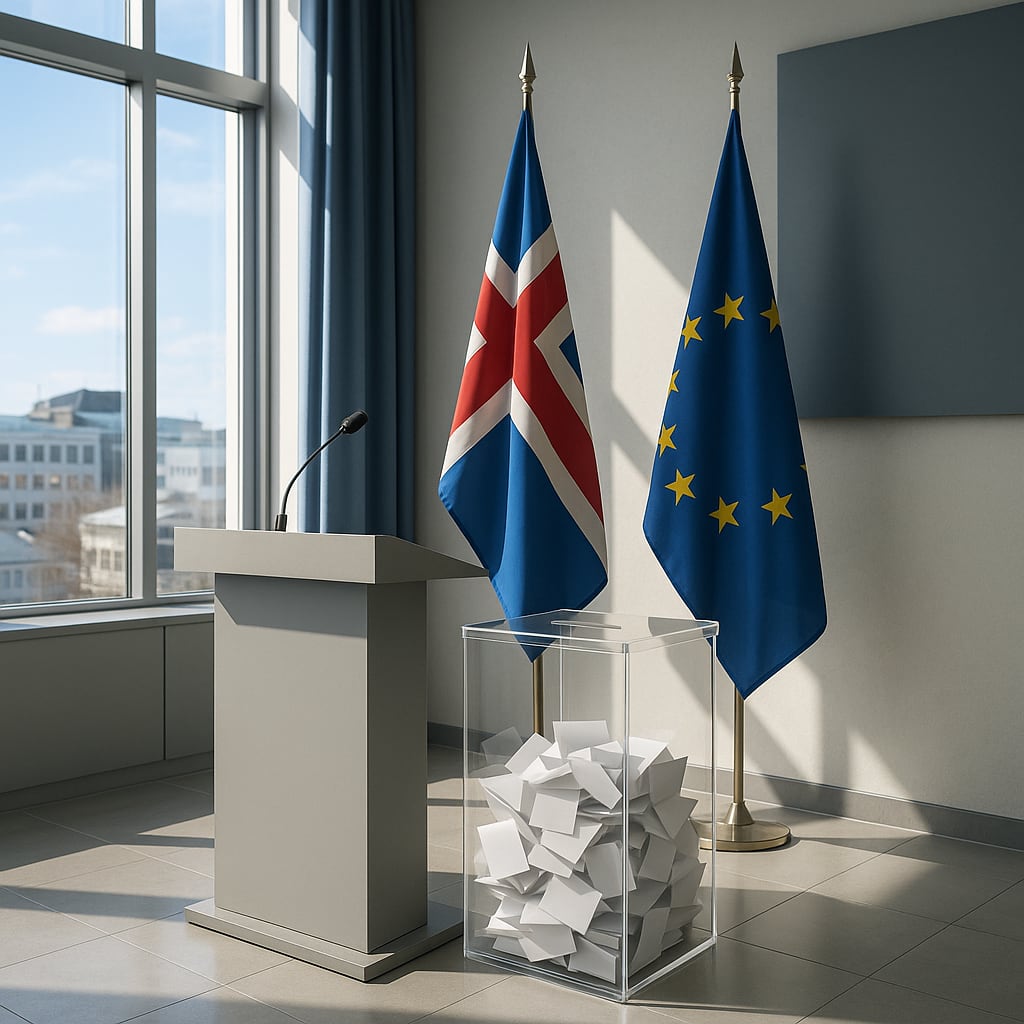
Iceland voters narrowly reject resuming EU membership talks
Narrative Snapshot
Across outlets, there is broad agreement on the result, its narrowness, and the centrality of fisheries and sovereignty to the campaign. Multiple reports cite a margin of roughly 52.8% to 47.2% against reopening talks, with Reykjavik the only area to back the proposal, according to Iceland’s public broadcaster and national officials cited by The Hindu, France24, and the South China Morning Post. European coverage consistently foregrounds sovereignty and economic control—especially over fishing—as the decisive themes, with Le Monde describing a campaign centered on independence and the island’s strategic resources, and CBC relaying voters’ concerns that fishing waters were too important to risk.
Where coverage diverges is in the framing of security and geopolitics. Italian and U.K. outlets underscored Arctic tensions and doubts about U.S. reliability as part of the pre-referendum debate, while Fox News placed unusual emphasis on former President Donald Trump’s expressed interest in Greenland and what that could mean for Iceland’s security calculus under NATO. Another line of contrast is over campaign dynamics: The Guardian highlights the resourcing of the “no” camp and the potential influence of ballot wording, and La Repubblica details a disinformation environment, including false claims about a “common European army.” RT adopts a more openly Euroskeptic frame, casting the outcome as a rejection of “Brussels” and external dictates, in contrast to mainstream outlets’ focus on policy trade-offs within existing European arrangements. Post-vote, Italian media also emphasize high engagement—La Repubblica reports turnout at 82.5%—and note celebrations by European populist leaders, a thread picked up by ANSA and Corriere della Sera.
What Happened
Iceland held a referendum on August 29 on whether to resume European Union accession negotiations suspended in 2013 and formally canceled by a conservative government in 2015, though the European Commission kept the candidacy open, as recounted by Telesur English. Results announced on August 30 showed 52.8% voting “no” and 47.2% “yes,” with only about 9,500 votes separating the sides, according to France24 and figures cited by national media. Reykjavik was the only area to back reopening talks, The Hindu reported, while early counts from five of six constituencies already pointed to a “no,” Deutsche Welle noted. La Repubblica reported turnout at 82.5%. In the run-up, polls showed a tight race, with Le Monde and ANSA describing a near tie and Telesur citing a Maskina survey putting “yes” narrowly ahead. After the vote, Prime Minister Kristrún Frostadóttir said the government would not initiate new accession talks and that referendums cannot be held “every one or two years,” TASS reported.
Why It Matters
The outcome locks in Iceland’s existing European integration model—participation in the single market and Schengen—while keeping it outside the EU customs union and any path toward adopting the euro, as noted by France24. It underscores how control over fisheries and resource policy can outweigh prospective benefits of full membership for small, high-income states, a point emphasized by CBC and the South China Morning Post. The vote will be scrutinized in Brussels, Le Monde reported, with Italian coverage indicating the EU will look to strengthen ties short of accession, according to Corriere della Sera. Strategically, the decision leaves Iceland’s security posture anchored in NATO and bilateral arrangements, a context highlighted before the vote by Corriere della Sera and Fox News, even as Italian reporting suggests Reykjavik may seek additional bilateral defense understandings after the referendum. The campaign’s information environment—flagged by La Repubblica—also illustrates the growing salience of disinformation in European integration debates.
Diverging Narratives
Explanations for the result coalesce around two competing emphases. Many outlets stress sovereignty over fisheries and domestic economic control—Le Monde, CBC, and France24 frame these as pivotal—while others foreground geopolitics and security, from North Atlantic tensions to questions about U.S. reliability and the Greenland factor noted by Corriere della Sera and Fox News. Assessments of the campaign diverge as well: The Guardian describes a well-funded “no” camp and points to the possible impact of question wording, whereas La Repubblica attributes part of the “no” momentum to an “intense climate of disinformation,” including false claims about conscription into a non-existent EU army. RT advances a broader Euroskeptic narrative, portraying the vote as a defense against “bureaucrats and warmongering,” a framing not shared by mainstream European and North American reporting that centers institutional trade-offs and sectoral policy stakes. Finally, while pre-referendum polls showed a near dead-heat with some edge for “yes” (Le Monde; Telesur’s Maskina poll), post-vote reactions split between EU-level reflection on next steps (Le Monde) and political celebration by European populist figures noted by ANSA and Corriere della Sera.
What Happens Next
Domestically, the government’s stated position is that it will not reinitiate accession talks and does not intend to revisit the question frequently, per Prime Minister Frostadóttir’s remarks reported by TASS. Analysts should watch for whether Reykjavik moves to deepen bilateral security arrangements, as Italian coverage suggests was under consideration after the vote, and how that interacts with Iceland’s existing reliance on NATO and its U.S. defense agreement referenced by Fox News. On the EU side, Le Monde reports that Brussels will scrutinize the result, and Corriere della Sera indicates an interest in strengthening relations short of membership; signals to monitor include proposals for sectoral cooperation within the EEA and Schengen frameworks. Given the campaign dynamics flagged by The Guardian and La Repubblica, another indicator will be whether Iceland updates information integrity measures around future EU-related consultations, even as Al Jazeera notes the result halts the reopening of talks for now.