
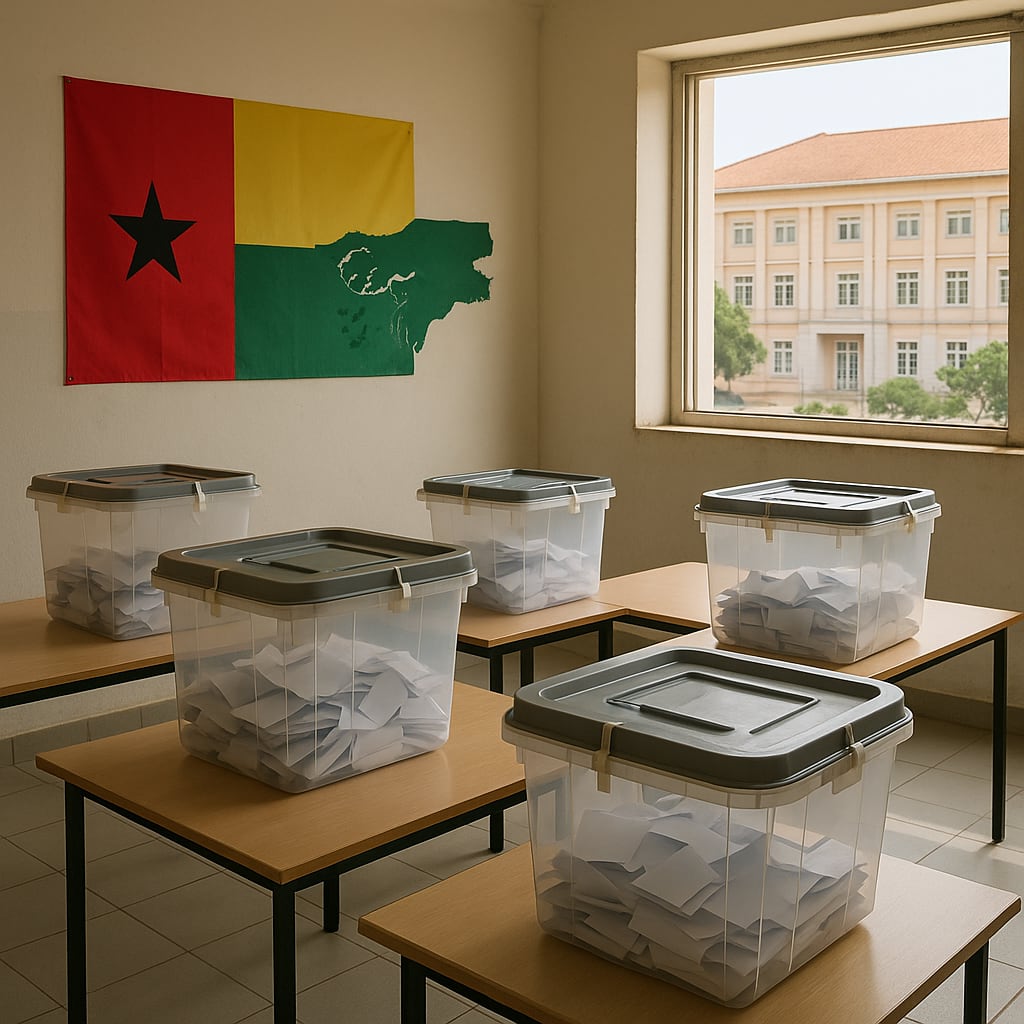
Guinea-Bissau votes on a constitutional shift to expand presidential powers ahead of December polls
Narrative Snapshot
Across outlets, there is broad agreement that the referendum centers on expanding presidential authority against the backdrop of a 2025 military coup and a pledged return to elections later this year. Coverage converges on the timing and stakes: the vote occurs months before December polls that the military authorities say they will hold, with the draft charter recasting executive-legislative relations and the rules of representation. Reporting also aligns on the process being led by a military-installed leadership, with some outlets explicitly labeling it a junta-run transition and others emphasizing the transition to civilian rule.
The strongest granularity on institutional redesign appears in Chinese state media, which details appointment and dismissal powers for the president, authority to chair the Council of Ministers, the ability to dissolve parliament during serious political crises, a five-year residency requirement for presidential hopefuls, and a sharp reduction in members of parliament and constituencies. Al Jazeera’s preview frames the proposal as reshaping parliament and elections while its follow-up highlights the military leaders’ stabilization rationale. European outlets surface the political contestation most clearly: Le Monde notes opposition calls for a boycott, while Deutsche Welle underscores that the military government seeks to expand presidential power but pledges elections in December. North American wire coverage carried by the Toronto Star highlights the referendum as a step toward returning to democracy after the coup, and AllAfrica/RFI places the ballot within a military-run transition aimed at restoring civilian rule later this year.
What Happened
Guinea-Bissau held a constitutional referendum on August 30, ten months after a coup, with vote counting underway. Military leaders present the ballot as a means to stabilize future civilian governments, and the military authorities have said they will hold elections in December. The draft constitution would shift the system toward a stronger presidency: it empowers the president to appoint and dismiss the prime minister and government, chair the Council of Ministers, create or abolish ministries, and dissolve parliament and dismiss the government in times of serious political crisis. It also introduces a five-year residency requirement for presidential candidates. Structural changes to representation include cutting the number of legislators from 102 to 65 and reducing constituencies from 29 to 12. The current leadership emerged from a November 2025 coup, with a transitional president sworn in less than a year later, and opposition actors have called for a boycott.
Why It Matters
The draft charter would replace a parliamentary system with a presidential one, centralizing executive authority and redefining checks within Guinea-Bissau’s institutions. It would also reconfigure representation by shrinking parliament and consolidating constituencies, changes that could recalibrate party strategies and legislative capacity. Because the military authorities have said national elections will take place in December, the referendum outcome determines the constitutional framework under which those contests are organized, including who can stand for president given the residency rule and how legislative seats are apportioned.
For external actors engaging Guinea-Bissau’s transition—regional partners, election support providers, and observers—the process intersects two tracks: a junta-led legal overhaul and a pledged electoral timetable. The stated justification from military leaders is stability for future civilian governments, while other reporting frames the exercise as a junta-driven expansion of presidential power. How these shifts affect executive-legislative balance and the credibility of the December timetable will shape engagement choices.
Diverging Narratives
Outlets diverge most clearly on framing and emphasis rather than on the basic facts of the ballot. Al Jazeera reports the military leaders’ stated rationale that the referendum is designed to stabilize future civilian governments. Deutsche Welle characterizes the process as a military government seeking to amend the constitution to give more powers to the president, while simultaneously noting the pledge to hold elections in December. The Toronto Star’s Associated Press dispatch highlights the vote as part of returning the country to democracy after its latest coup, and AllAfrica/RFI similarly situates it in a military-run transition billed to restore civilian rule later this year.
French reporting in Le Monde introduces domestic political resistance by noting that the opposition has called for a boycott, a dimension not foregrounded in several other accounts. Chinese state media emphasizes the institutional specifics and potential “far-reaching implications” for governance, laying out detailed executive powers and structural changes to parliament and constituencies, as well as a residency requirement for presidential hopefuls. Al Jazeera’s preview underscores that the proposal would reshape parliament and elections but stops short of the same level of granularity. The contrast between a stabilization narrative, a junta-power-consolidation frame, and a return-to-democracy lens underscores how stakeholders might read the referendum’s legitimacy and its implications for December’s scheduled polls.
What Happens Next
Two decision points emerge. First is the certification of referendum results. With counting underway, the outcome will determine whether Guinea-Bissau proceeds under a revised constitutional architecture that concentrates presidential powers and restructures representation, or under existing arrangements. The military authorities have said they will hold elections in December; analysts should watch whether that timetable is reaffirmed alongside the referendum result and how authorities link the result to election administration.
Second is implementation. If the draft is approved, election administrators and political actors will need to operationalize reduced parliamentary seats and constituencies, and apply the five-year residency requirement for presidential hopefuls ahead of December 6, as reported. Observers should track official guidance on candidate eligibility screening, any legal challenges or opposition responses in light of the boycott call noted by Le Monde, and whether the crisis-dissolution provisions are codified in a way that affects the conduct of the transition the military government and several outlets describe.