
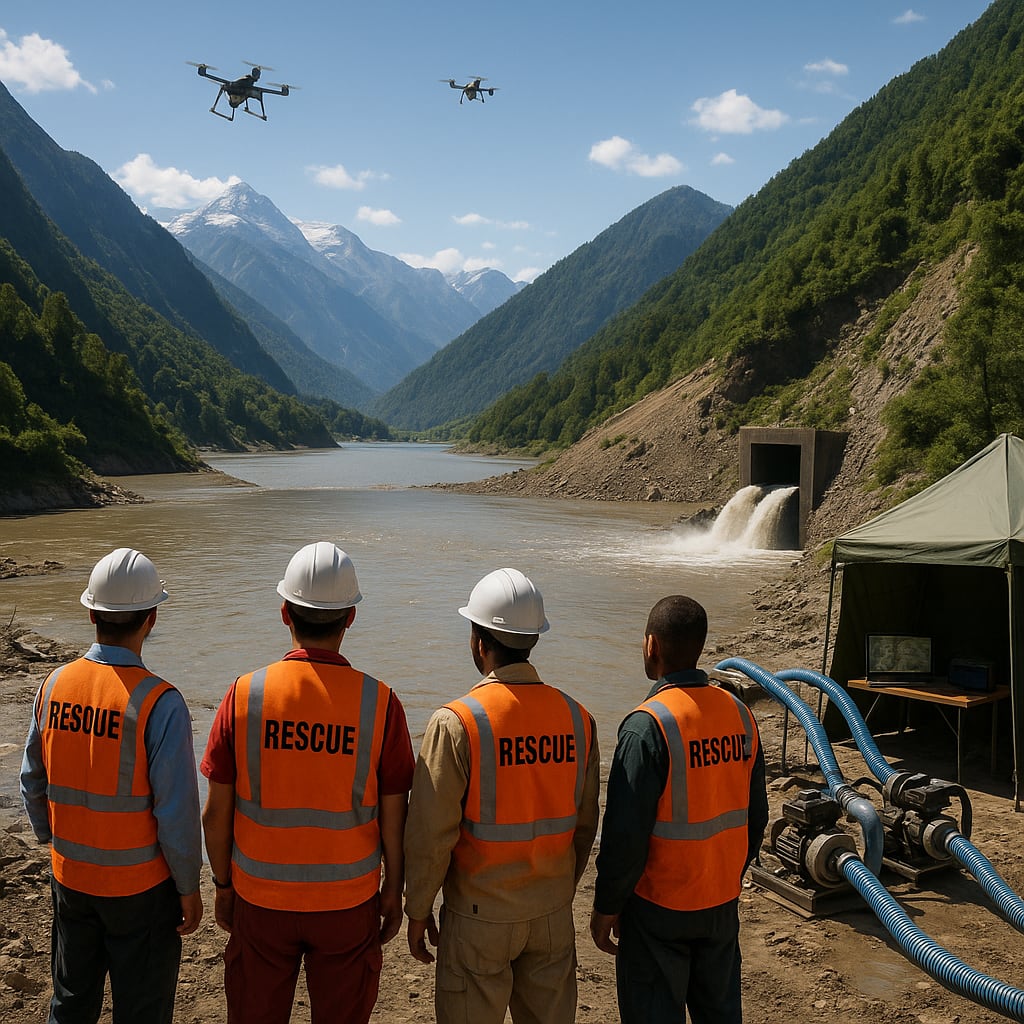
Cross-border Himalayan floods leave more than 900 dead and thousands missing as Nepal and China focus on hydropower tunnel rescues
Narrative Snapshot
Across outlets, reporting converges on the scale and cross-border character of the disaster, the operational focus on trapped hydropower workers, and a rescue environment shaped by perilous terrain and secondary hazards. Nepal’s disaster authority counted 903 dead and 4,247 missing by August 31, with China reporting 16 dead and 546 missing on its side; the Red Cross estimated roughly 93,000 people affected (CGTN, Le Monde, TASS, Deutsche Welle; France 24). Multiple reports place hundreds feared trapped inside tunnels at hydropower projects, making engineering access the central rescue challenge (The Guardian, RT, CBC, Bangkok Post).
Emphasis diverges on causation and governance. Chinese state media amplify a glacial-collapse chain event linked to climate change through expert interviews and reconstructions, while international outlets highlight both the warming signal and scientific caution pending formal attribution (CGTN; New York Times; CBC; Japan Times). Coverage from China details the scale of domestic mobilization and Beijing’s delivery of aid and tunnel experts to Nepal, while European and regional media track multi-country assistance and the logistical limits of coordination in Himalayan terrain (CGTN; France 24).
Outlets also draw different lines around crisis management. Several report that Nepal’s initial caution about foreign rescue teams shifted to expedited appeals as the tunnel crisis sharpened, and they underline the absence of a unified cross-border casualty count, complicating situational awareness (South China Morning Post; Telesur English). Separate strands follow the consular dimension as families from the United States, India, Australia, Japan and others seek information, and the mortuary strain that led to mass burials and DNA collection in Nepal—developments that raise legal, religious and identification challenges (The Guardian; New York Times; Toronto Star; Deutsche Welle; BBC; Japan Times; Fox News; South China Morning Post).
What Happened
A sudden ice-rock avalanche originating in Nepal on August 26 triggered a high-velocity debris flow that swept down the Bhote Koshi/Trishuli corridor, striking settlements and infrastructure and slamming into the Gyirong Port area on the Tibet (Xizang) side within minutes (CGTN animation; CGTN explainer). Nepal’s National Disaster Risk Reduction and Management Authority reported 903 dead and 4,247 missing by August 31; China reported 16 dead and 546 missing in Xizang (CGTN; Le Monde; TASS; Deutsche Welle). Rescue priorities concentrated on hydropower tunnels where hundreds were feared trapped, as nearly 21,000 Nepali security personnel and engineering teams from Nepal, India, China and South Korea worked the sites under hazardous conditions (The Guardian; The Hindu; RT; Bangkok Post; CBC). China activated Level‑II emergency responses, deployed over 2,000 personnel in Xizang, and airlifted aid and tunnel specialists to Nepal; other governments and the EU stepped up assistance (CGTN; France 24). Operations were repeatedly complicated by a landslide‑dammed lake upstream; authorities temporarily paused and then resumed rescues as the lake level fell and immediate risk diminished (CGTN; RT; The Hindu).
Why It Matters
The event exposes acute gaps in transboundary disaster governance across the Himalayas, where hazards originate and propagate across borders faster than response systems can synchronize. The absence of a unified casualty accounting mechanism and the reliance on ad hoc information exchange hinder shared situational awareness and complicate consular operations for hundreds of missing foreign nationals (Telesur English; CGTN; The Guardian). With hydropower corridors central to Nepal’s development and regional power flows, the concentration of casualties in tunnels underscores systemic risk in project siting, emergency egress, and contractor preparedness under cascading hazards (The Guardian; RT; The Hindu; Telesur English).
Causation coverage—ranging from strong linkage to a climate-driven glacial collapse to more cautious attribution—points to a policy imperative for cross-border early warning, glacier-lake monitoring, and data sharing that can translate into actionable lead times for operators and communities (CGTN; New York Times; CBC; Al Jazeera English). Operationally, the rapid bilateral deployments and China’s provision of experts, satellite imagery and hydrological data to Nepal signal pathways for practical cooperation, even as Nepal’s evolving stance on foreign teams reflects hard lessons from 2015 and the need for clearer protocols (CGTN; South China Morning Post).
Diverging Narratives
Outlets differ on how firmly to attribute the trigger to climate change. Chinese state media foreground a Nepalese geologist’s assessment that sustained warming destabilized high-elevation ice-rock, leading to collapse and a rapid debris flow; international reporting emphasizes that while Himalayan warming heightens risk, the exact chain of events remains under study (CGTN; New York Times; CBC; Japan Times). Reporting also varies on the scale and status of foreigners among the missing: early Chinese figures cited roughly 260 foreign nationals unaccounted for, while later tallies in international outlets referenced several hundred to more than 700, alongside country-specific cases (CGTN; The Guardian; RT; BBC; Japan Times; Fox News).
On crisis management, Chinese and state-aligned outlets stress swift multi-agency mobilization, progress in access and the dispatch of experts and aid to Nepal, whereas several foreign outlets spotlight rescue pauses due to secondary hazards, the difficulty of reaching tunnel sites, and Nepal’s initial hesitance followed by appeals for international rescue teams (CGTN; RT; France 24; South China Morning Post). Finally, the humanitarian narrative diverges in emphasis: Western and regional reporting document mass burials, DNA collection, and overwhelmed morgues—including community sensitivities—while Chinese coverage concentrates on logistics, hazard monitoring, and cross-border support (New York Times; Toronto Star; Deutsche Welle; Le Monde; The Guardian; CGTN).
What Happens Next
The tunnel operations are the immediate hinge point. Rescue agencies are clearing inundated and debris-choked galleries at multiple projects; breakthroughs or setbacks in establishing safe ingress will dictate survivability windows and resource prioritization (The Guardian; RT; Bangkok Post; CBC). Upstream hazard control remains a live variable: authorities have set up observation posts and hydrological monitoring around the landslide-dammed lake; any renewed rise or breach risk would force further pauses and rerouting of assets (CGTN; RT; The Hindu).
International assistance coordination is another decision node. Nepal has already accepted foreign engineering teams and Chinese tunnel experts after initial caution; watch for formal requests to additional partners and how roles are deconflicted on-site (South China Morning Post; CGTN; France 24). Information governance will shape both consular response and recovery: the establishment—or not—of a joint Nepal‑China casualty reconciliation process and continued sharing of satellite and flow data will determine how quickly missing person lists stabilize and downstream alerts improve (Telesur English; CGTN). Finally, early recovery choices at hydropower sites—temporary stabilization, integrity assessments, and phased restart—will signal how authorities balance energy security with ongoing geotechnical risk (Telesur English; The Hindu).