
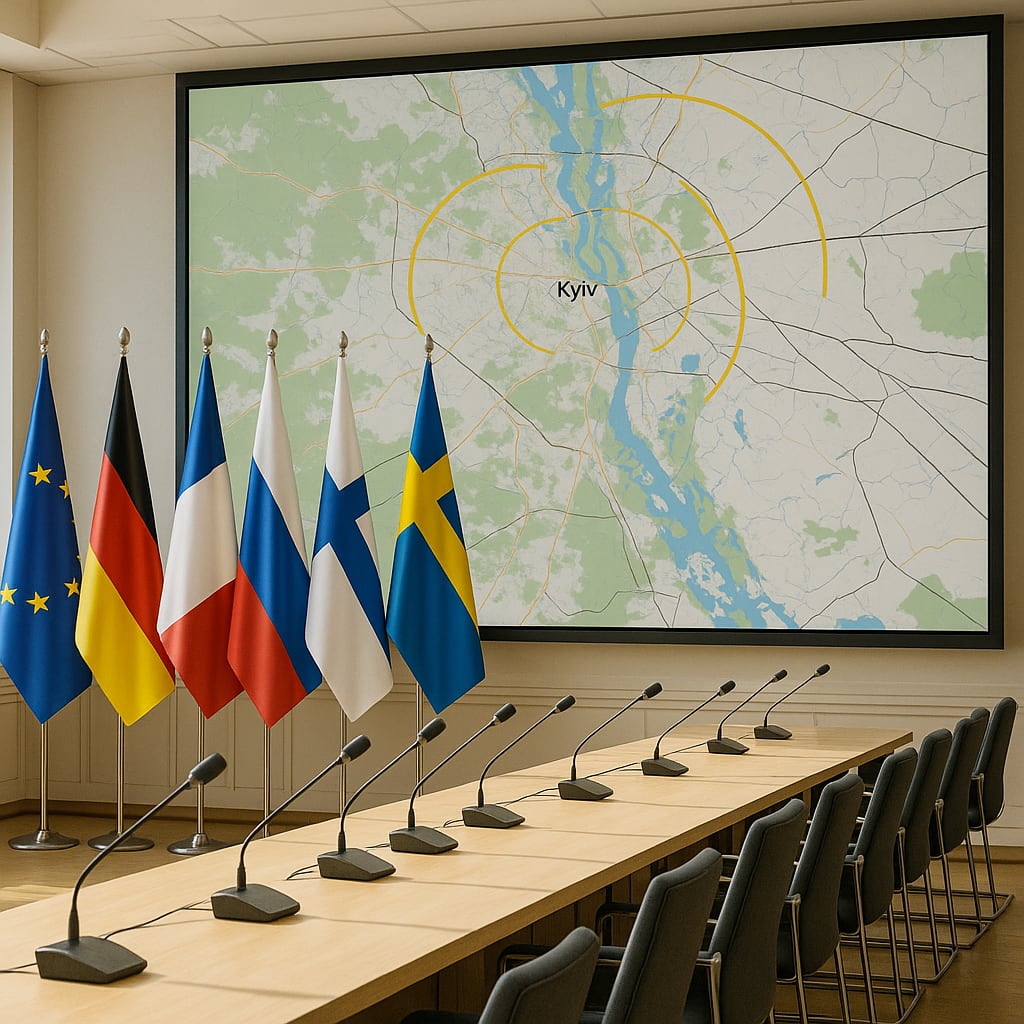
Sixth day of Russian strikes kills at least 12 in Kyiv region as Ukraine tightens security; Ukrainian drone hits Russia’s Ust-Luga port
Narrative Snapshot
Across international and Ukrainian outlets, the casualty count and the tempo of attacks are broadly aligned: most reports cite 12 dead in and around Kyiv amid a sixth straight day of strikes, with emphasis on damage to rail infrastructure and the mounting civilian toll. Coverage coalesces around two operational shifts: Russia’s near-continuous day-and-night raids and the use of jet‑powered drones, both presented as straining Kyiv’s air defences and civilian resilience.
Where outlets diverge is in framing and emphasis. European and North American reporting underscores the defensive challenge, with The Guardian relaying President Volodymyr Zelenskyy’s claim that Moscow is exploiting a shortage of US‑made Patriot interceptors, while the New York Times and France24 spotlight the newly persistent tempo and injuries to children as the school year begins. Regional and Ukrainian outlets detail institutional and societal adaptation: Bangkok Post reports tightened security protocols across Kyiv’s transport, schools, and parliament; the Kyiv Independent chronicles near‑constant alerts, the “first bell” of the school year moved into shelters, and a government audit of defence needs. Several sources also situate the strikes within a widening battlespace, noting Ukrainian drones igniting a fire at Russia’s Ust‑Luga port and reported drone incursions into Estonia and Romania.
What Happened
A sixth consecutive day of Russian aerial attacks on Kyiv and its surrounding region left at least 12 people dead and many injured, according to Ukrainian authorities cited by multiple outlets. The Guardian and CBC News report that strikes intensified around 2:30 a.m., with eight killed in Kyiv and four in nearby areas; seven fatalities occurred at a railway depot on the city’s left bank, and the Kyiv Independent specifies that six rail workers were among the dead. The Hindu notes one victim was an Indian citizen. France24 reports that children were among the injured as schools reopened, and the Kyiv Independent describes first‑day‑of‑school ceremonies moving into shelters. Bangkok Post says Kyiv imposed stricter security protocols for public transport, schools and parliament. Le Monde reports a fire at Russia’s Ust‑Luga port following a Ukrainian drone strike, while the Kyiv Independent notes Estonia and Romania reported drone incursions during the aerial exchanges.
Why It Matters
The sustained use of jet‑powered drones and round‑the‑clock salvos marks a tactical evolution that stresses Ukraine’s air‑defence readiness and stockpiles. The Guardian relays Zelenskyy’s assertion that Russia is exploiting a shortfall of Patriot interceptors, sharpening the salience of allied resupply decisions and integrated air‑defence planning. Targeting rail infrastructure, as reported by Folha de S.Paulo and others, raises risks to Ukraine’s military logistics and economic throughput, pressing Kyiv to harden critical nodes while keeping essential services functioning.
Civil protection and continuity of governance are being tested in real time: Bangkok Post reports citywide security tightening, and the Kyiv Independent depicts an education system adapting schooling to air‑raid realities. The cross‑border dimension is widening, with Le Monde’s account of a Ukrainian drone igniting a fire at Russia’s Ust‑Luga port and the Kyiv Independent noting drone incursions reported by Estonia and Romania, highlighting regional airspace management pressures. Internationally, The Hindu’s report of an Indian casualty underscores potential consular and diplomatic engagement beyond Ukraine’s immediate partners.
Diverging Narratives
Disparities in immediate figures persist as situation reports firm up. Le Monde cites “at least 11” dead in Kyiv and its region, while several outlets, including The Guardian, CBC News, France24, Folha de S.Paulo, and the Kyiv Independent, report 12. The Guardian attributes seven fatalities to a strike on a Kyiv railway depot; the Kyiv Independent notes six rail workers among the dead, clarifying but not fully reconciling the breakdown. On intent and capacity, Ukrainian officials quoted by Bangkok Post frame Russia’s drone campaign as an effort to “paralyse” the capital, while The Guardian highlights Zelenskyy’s claim that Moscow is exploiting a shortage of Patriot interceptors to sap morale.
Outlets also vary in emphasis between humanitarian impact and institutional adaptation. France24 foregrounds injured children and the overlap with school reopening, as the Kyiv Independent chronicles classes moving to shelters. Al Jazeera English focuses on residents weighing whether to leave the city after nearly continuous strikes. On the wider theatre, Le Monde reports a Ukrainian drone strike setting ablaze the Russian port of Ust‑Luga, while the Kyiv Independent notes Ukraine’s confirmation of a drone strike in Russia and separate reporting on drone incursions into Estonia and Romania, indicating differences in attribution detail and the breadth of cross‑border incidents covered.
What Happens Next
Air‑defence resupply and deployment choices loom. If partners address the interceptor shortfalls Zelenskyy flagged via The Guardian, Kyiv’s capacity to blunt sustained drone salvos could improve; if shortages persist, the pressure of day‑night strikes described by the New York Times and France24 is likely to continue testing urban defences. Analysts should watch official statements on interceptor deliveries and reported interception rates during subsequent waves.
Kyiv’s governance adaptations will shape civilian resilience. Bangkok Post’s reporting on heightened security across transport, schools, and parliament, coupled with the Kyiv Independent’s accounts of shelter‑based schooling, points to a choice between maintaining in‑person services under protection or curtailing operations if threat levels rise. Future municipal directives and education ministry guidance will signal the path taken.
Cross‑border dynamics bear monitoring. Le Monde’s report on Ust‑Luga and the Kyiv Independent’s note on drone incursions into Estonia and Romania indicate decisions by Kyiv and regional governments on how to manage tit‑for‑tat strikes and airspace incidents. Follow official communiqués on incidents in neighboring airspace and confirmed strikes on Russian infrastructure for indications of escalation management or containment.