
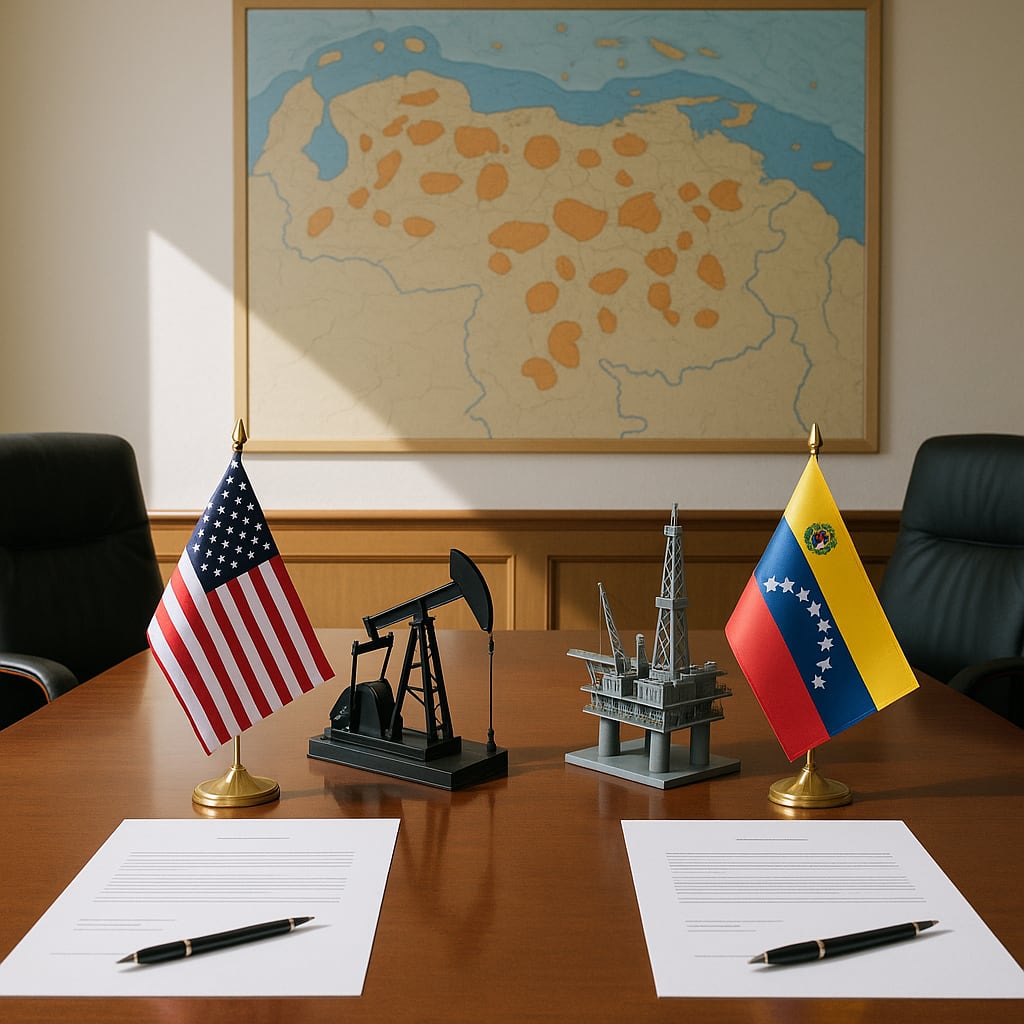
US–Venezuela sign 25-year oil pact tied to 17 fields and a 65 billion-barrel package, as Chevron expands and Washington details Pentagon role
Narrative Snapshot
Venezuelan state-aligned and official sources frame the agreement as sovereignty-preserving and fiscally advantageous, highlighting statutory safeguards, projected state take, and macroeconomic spillovers. Telesur cited provisions under Venezuela’s reformed Hydrocarbons Law, with royalties up to 16% and a 34% income tax, and a revenue projection of about $209.3 billion based on $65 per barrel, alongside a goal to lift output beyond 1.5 million barrels per day across 17 blocks over 25 years.
US and European outlets emphasized the scale and structure of control rather than fiscal terms. Multiple reports relayed President Donald Trump’s claim of “majority” US control over more than 65 billion barrels, and France24 said Washington would create and control a private company to hold reserves of that size. The New York Times underscored that the project could take years to materialize and reported that the Pentagon’s Office of Strategic Capital is helping lead the deal.
Skeptical coverage coalesces around two axes: neocolonial risk and operational realism. Brazilian, Japanese, French, British, Iranian and Thai outlets highlighted accusations of “control” and historical analogies to resource extraction, while others stressed Venezuelan doubts and legal-political risk. At the same time, market-focused reporting flagged investment gaps and long lead times; one analysis noted an unresolved “$100 billion” funding question for the new venture, and Canadian industry voices discounted near-term competitive threats even as Chevron announced a $7 billion expansion.
What Happened
On August 28, President Donald Trump announced what he called “the biggest oil deal in world history,” claiming the United States had secured “majority” control of over 65 billion barrels of Venezuelan proven reserves at no cost to US taxpayers. Acting President Delcy Rodríguez defended the pact as a 25‑year framework covering 17 strategic fields, targeting more than 1.5 million barrels per day, preserving national ownership, and delivering an estimated $209.3 billion to the Venezuelan state under fiscal terms she described as robust. Venezuela’s National Assembly approved the agreement on September 1 ahead of a visit by US Energy Secretary Chris Wright, who arrived in Venezuela to finalize the deal and said output would double. In Caracas, the US oversaw the signing of “tens of billions” in agreements between Venezuela and Chevron, Italy’s Eni, and GE Vernova. Chevron separately confirmed a $7 billion plan to double Venezuelan output in its joint ventures to roughly 600,000 barrels per day over five years. Subsequent reporting described US partnering with North American Blue Energy Partners and the Pentagon’s Office of Strategic Capital helping lead the venture.
Why It Matters
The pact embeds a 25‑year US role in developing Venezuelan oil, potentially reshaping hemispheric energy security narratives that Venezuelan and Russian state-aligned sources link to “balance” and regional supply. It also intersects with the United States’ domestic energy politics: the White House and supportive commentators tied the deal to future gasoline prices, while The Times of Israel contextualized it amid still‑high prices six months into the Iran war. Institutional innovation is notable: the New York Times reported Pentagon credit tools underpinning the arrangement, a departure from conventional commercial diplomacy and a precedent for security-linked energy finance. The agreement could catalyze broader Western corporate re‑entry; France24 said it is meant to encourage other US firms despite “serious challenges,” and Chevron’s expansion underscores first‑mover advantage after years of presence. For third countries, Canada’s sector is not alarmed, suggesting limited short‑run market displacement. Politically, European and Latin American coverage stresses how implementation will test claims of Venezuelan sovereignty and democratic restoration.
Diverging Narratives
Core framing splits on control versus sovereignty. Trump and multiple outlets said the US would gain “majority” control over more than 65 billion barrels, with France24 adding that Washington would create and control a private company to hold that reserve package; Al Jazeera and the BBC also characterized the arrangement as granting control over much of Venezuela’s reserves. In contrast, Rodríguez and Telesur insist Venezuela “retains ownership and sovereignty” under constitutional and legal frameworks, citing specified royalties and taxes.
There are inconsistencies in scope and quantification. While many reports cite “majority control” of 65 billion barrels, a Folha de S.Paulo dispatch described the deal as ceding 20% of reserves to Washington, and Le Monde framed it as allowing the US to exploit 17 fields with potential of 65 billion barrels. Financing claims also conflict: Trump said the deal comes at no cost to US taxpayers, yet the Japan Times reported the White House had not explained a $100 billion investment expectation, and the New York Times said the Pentagon’s Office of Strategic Capital is involved, implying public backstops.
Operational outlooks diverge between ambition and caution. Officials spoke of doubling output, and Chevron detailed a five‑year plan; the New York Times said the agreement could take many years to bear fruit. Political risk assessments vary: Brazilian coverage relayed neocolonialism concerns and legal risks; European outlets noted the absence of detail fueling speculation favorable to Washington; US officials countered accusations of “stealing oil,” and supportive commentary projected “generational” price benefits. Venezuelan public sentiment, per Thai reporting, blends suspicion with hope for recovery.
What Happens Next
Three decision points will shape implementation. First, governance and financing of the new venture: watch for formal disclosures on the US‑created company’s structure and capital stack, given France24’s description of US control, the New York Times’ reporting on Pentagon financing tools, and the Japan Times’ open $100 billion question. Signals include Congressional oversight moves in Washington, Venezuelan publication of contract terms, and lender participation.
Second, operational ramp‑up versus bottlenecks: monitor whether Wright’s stated doubling and Chevron’s $7 billion plan translate into sustained production increases toward the >1.5 million bpd target cited by Venezuelan officials and state media. Indicators include JV drilling schedules, infrastructure contracts, and OPEC‑tracked output.
Third, domestic and diplomatic conditionality: several outlets highlighted legal‑political risks and Venezuelan skepticism, while the Guardian reported opposition alarm over democracy’s trajectory. Analysts should track National Assembly oversight, court challenges, and any US statements tying further deals—France24 noted more could be announced—to governance benchmarks, alongside continued public messaging from both governments countering “control” and “stealing” narratives.